Lampetia and Phoebe (fable)
1920. Oil on canvas.On display elsewhere
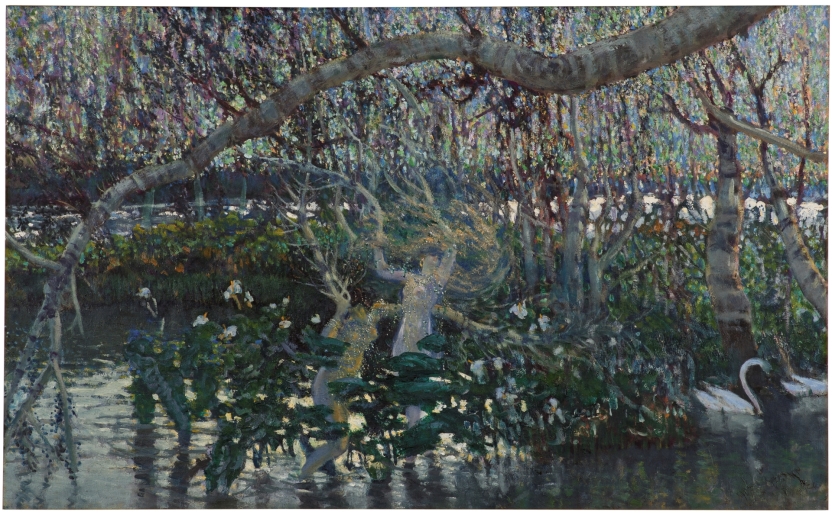
This canvas is a stark example of Muñoz Degrain´s firm commitment during his last years to Symbolist postulates, which appear to varying degrees at this stage of his career, and here has a special role in the evocation of the elements of literature and myth, in which the wooded landscape features with the prominence of a primary protagonist. On this occasion, the master turns to the fable of Lampetia and Phoebe, daughters of Helios, the Sun, and shepherdesses of their father’s flocks. After the death their brother Phaethon, struck down by Jupiter’s bolt, the mourning sisters were turned into white poplars in the waters of a marsh. Cycnus, Phaethon’s close friend, was so grieved that the gods turned him into a swan. He can be seen looking at his metamorphosis reflected in the water.
This mythological episode explains the label on the back of the painting. The artist used this scene to develop a fantastic and mysterious landscape on the banks of the lake, surrounded by a dense grove of trees with bare, twisted trunks. Among their branches mingle the desperate figures of the girls who were metamorphosed because of grief. The clarity of an invisible sky can barely be perceived. The painter was particularly fond of this type of gloomy, somewhat ghostly and oppressive-looking woodland. On occasions, he wished to embellish the landscape by including a few figures to provide a plot, as in the interestingly entitled Ofelia in the Forest. It is located in Museo de Málaga, and is very similar in its approach.
Museo Nacional del Prado, Maestros de la pintura valenciana: del siglo XIX en el Museo, Madrid, Museo Nacional del Prado, 1997, p.136-137 nº 18