Landscape with ruins
1871. Oil on canvas.Not on display
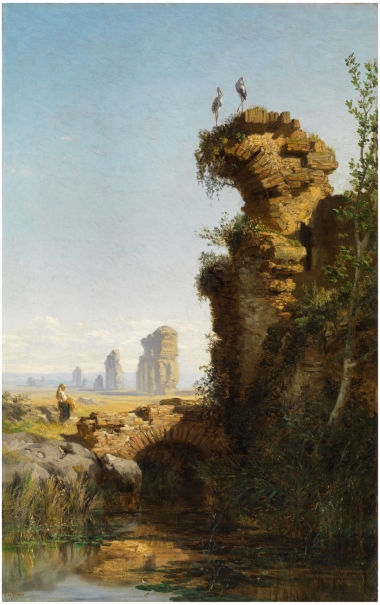
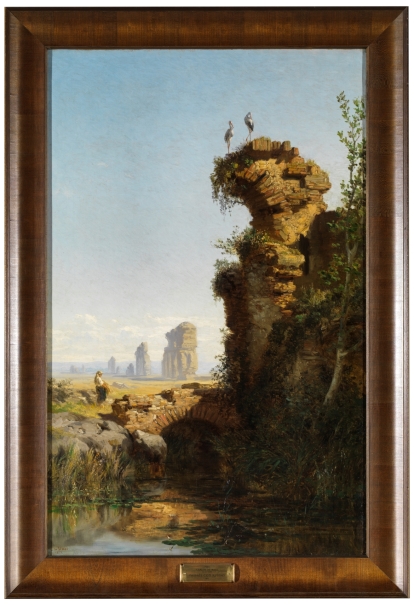
A summer landscape in which the waters flowing through the sewers of an aqueduct are stagnant between the reeds and the vegetation growing on its banks. The ruins of one of the corners of the construction are crowned by the figures of two storks that have nested on the top. The remains of the structure of the pillars and the arches of the aqueduct mark a slight diagonal that structures the composition of the painting, in which the broad, clear expanse of sky plays a prominent role. On the left, a female figure holding a bundle of wheat in her lap and wearing a headdress typical of the Italian peasantry sets the scene in the rural environment of the Roman countryside. The remains of the construction that lie on the vast plain correspond to the ruins of the Claudian Aqueduct, taken from the vicinity of the church of Santo Stephano Rotondo, very close to Rome. This aqueduct, built in the time of the emperor Caligula and inaugurated in the time of Claudius (to whom it owes its name) had a very long route. In its course, it collected the waters of the Cerulean and Curzian torrents and served, together with seven other aqueducts, to supply the water needs of Rome. Its ruins are still visible today, and it is unlikely that they were directly captured by Haes. There are no indications that Haes visited Italy, especially not in the summer of 1871 when he is known to have been in the Cantabrian Mountains. For this reason, it is thought that he would have copied some engravings, which is a resource that he had already employed on some occasions as a didactic method for teaching his students. It is very likely that Haes was inspired by some of the engravings in the collection of Piranesi, Varie vedute di Roma antica e moderna, which contained countless views of the Claudian Aqueduct as it passes through Rome and whose 1745 edition was widely spread throughout Europe.