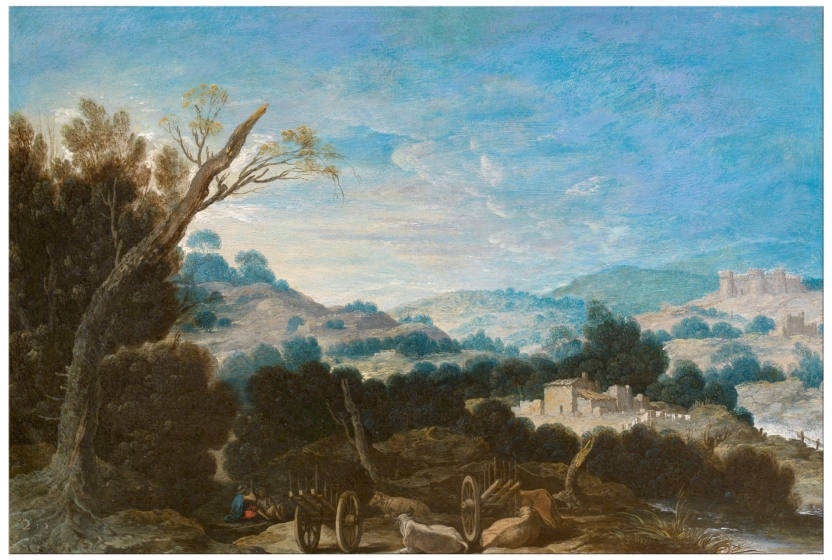
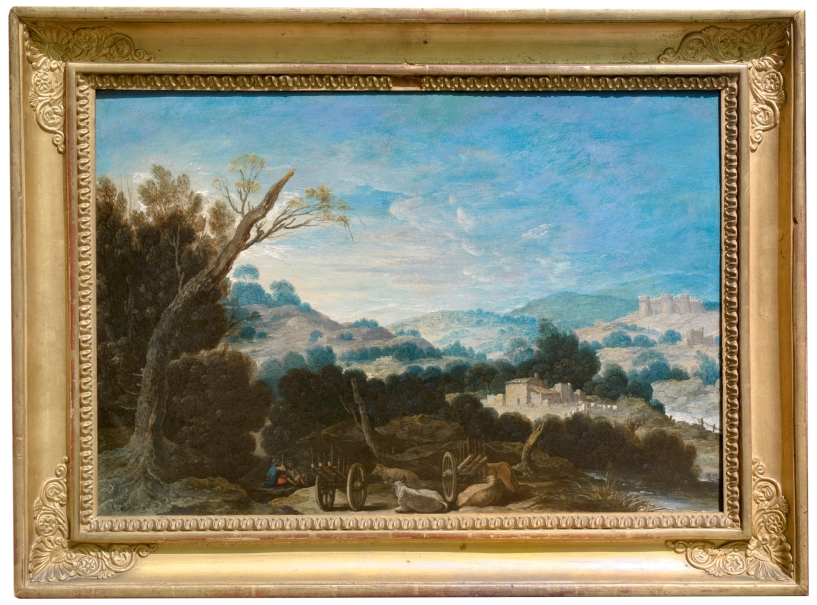
Landscape with shepherds
1600 - 1650. Oil on copperplate.Room 018
Two peasants rest by the bank of a creek after each unyoking a team of oxen from their respective carts. They are surrounded by an undulating landscape that has a wide horizon and a sky that has been greatly worked. A farmhouse appears in the midground, and a castle in the background. A smooth grade of intensity and tones of the vegetation and the colour range are used to truthfully and efficiently render the spatial composition. The general features of the scene, the typology of its constructions as well as the shape and execution of trees and foliage are common to the already known works by Francisco Collantes’ (1599–1656) and support attributing the work to him.
There are several elements that make it a rather unique work within his production. Firstly, its support (a copper sheet) and, related to that, its size. Both the material and dimensions were unprecedented in works by Collantes up until that time, which is not only of art historical importance but is also of aesthetic significance. Its size and support have contributed to a pictorial execution much more precise and thorough than usual in larger paintings and have created a much more diverse and controlled illumination. Through that size and support, Collantes also approached 17th-century European landscape painting tradition, which very often expressed itself with similar elements both in Flanders as in Rome. There are quite few known analogous Spanish examples. That foreign influence is also noticeable in the oxen in the foreground, which probably come from a Nordic print. Considering its composition and pictorial values, the painting is also significant in Collantes’ production. He opted to prioritise midgrounds and backgrounds as well as the sky instead of his usual strategy of invading the foreground with a large tree or a combination of rocks and vegetation, which provides the compositions with a bizarre and unstable sense, and an artificial arrangement of elements. Therefore, he proves an extraordinary ability to balance masses and to build a calmer and more naturalistic scene. The result is a work of significant aesthetic qualities, adding a new dimension – as an artist that worked in small format and who occasionally shared the aesthetic of classical landscape – to Collantes’ aesthetic profile known up until now. In addition to his common values, the dearth of landscape painting – and of these formats in particular – in Spanish art prior to 17th century must be taken into account.Museo Nacional del Prado, Memoria de actividades 2009, Madrid, Museo Nacional del Prado, 2009, p.24