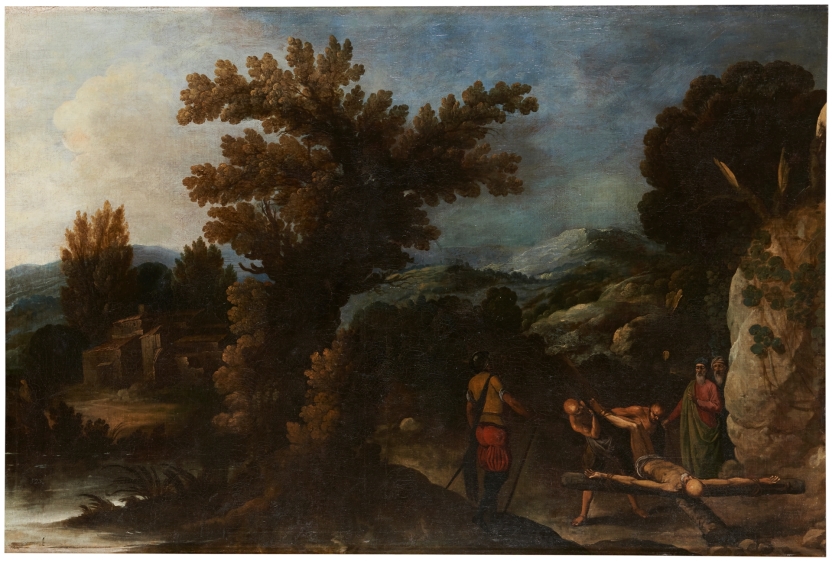
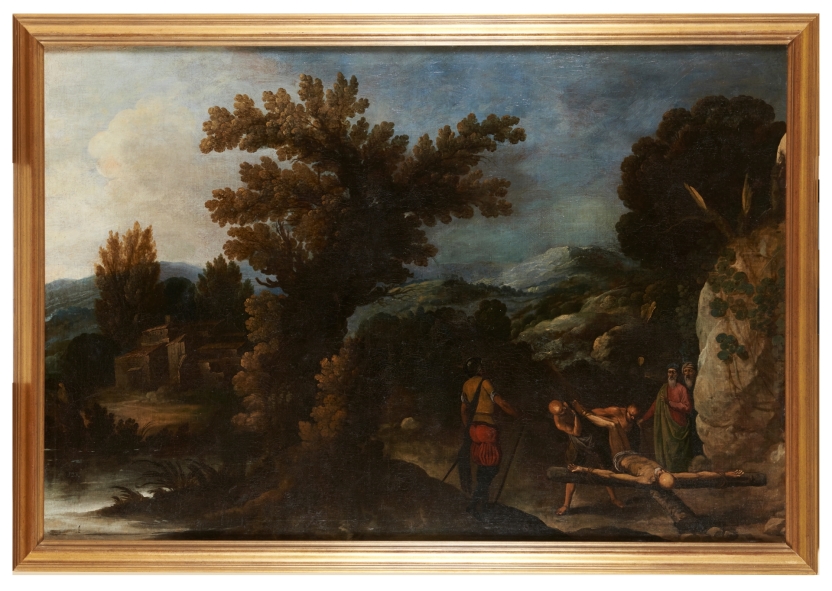
Landscape with the Crucifixion of Saint Peter
First half of the XVII century. Oil on canvas.On display elsewhere
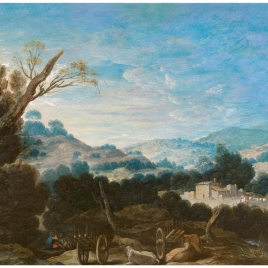
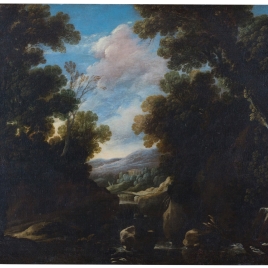
The canvas depicts a landscape, the development of which is organised in three levels that are staggered in depth. This is common in Flemish painting of this genre, and there are several examples in Spain of which the painter must have been aware. The elements that make up the composition also display a play of vertical and horizontal lines, clearly ordered and balanced, which are perhaps remotely reminiscent of certain landscapes by Italian painters or Nordic artists passing through Italy.
The trees, arranged to the left and right of the composition, are set backlit against the sky and are covered with golden leaves blown by the wind, evoking the autumn weather. In the background are mountains, which raise the horizon and clarify the scene, which is rich in backlighting and ochre, greenish, and blue hues.
All this provides the work with a scenographic character that serves as a framework for the religious story that takes place in the foreground on the right. In the presence of three figures arranged around the central group, two executioners crucify Saint Peter upside down. According to tradition, he asked for it in order to distinguish his martyrdom from the death of Jesus Christ. The Apostle has already been tied to the cross and the moment of raising the cross is depicted. The central part of the scene, painted with smooth brushstrokes, is strongly illuminated. The figures of the companions are arranged in balanced groups of inferior technical quality.