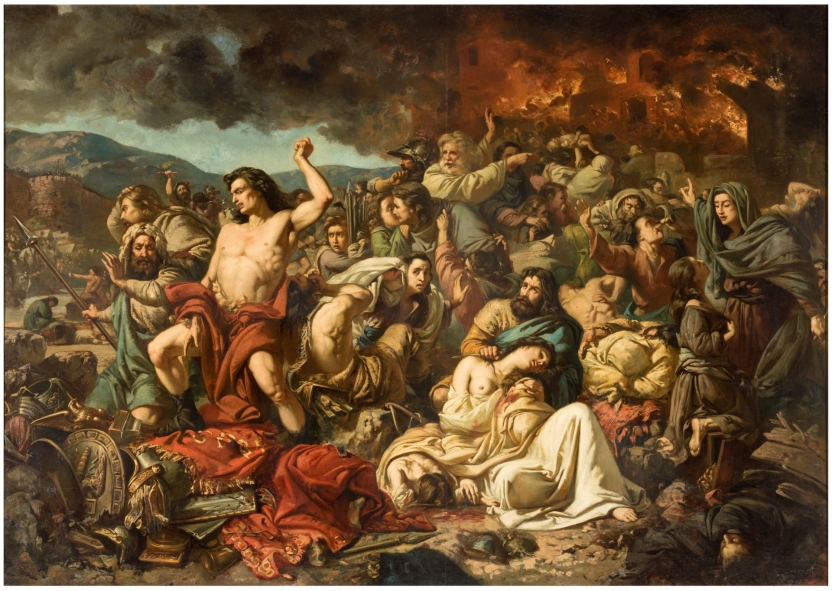
Last day of Numantia
1858. Oil on canvas.Not on display
The painting was submitted to the 1858 National Exhibition of Fine Arts out of catalogue. It the first example of this theme to appear in such competitions and would later be followed by several sequels. Although it had been repeatedly mentioned in the biographies devoted to Martí Alsina, the painting remained anonymous until the early 1990s. Its recovery is an extremely important contribution to our knowledge of this Catalan master´s youth production.
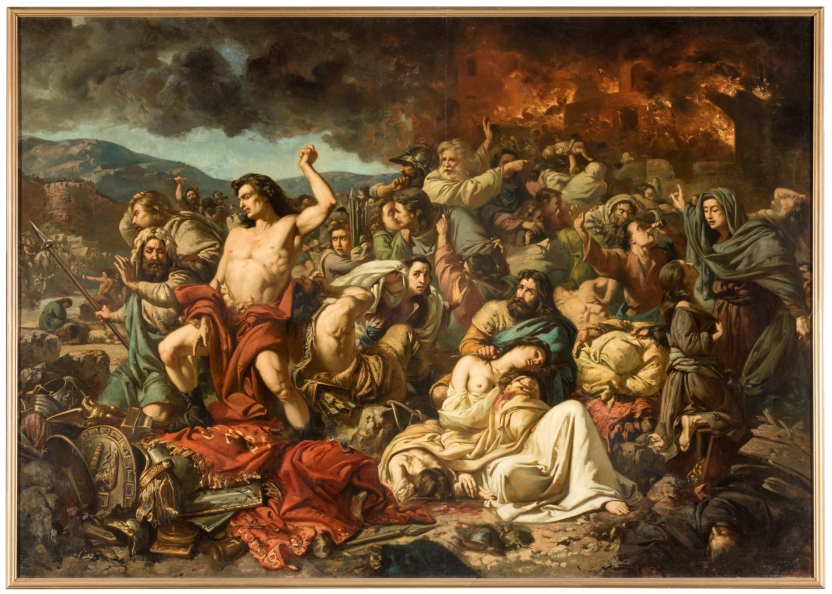
The painting depicts the moment when, after suffering a long and harrowing siege by Scipio´s Roman troops in 133 BC, the inhabitants of the city of Numantia decided to burn their city and end their lives before submitting to invasion. Thus, a tumultuous group of Numantine citizens crowd around the walls of the burning city before the sight of the Roman troops, who appear stationed in front of their fortified camp in the background of the painting.
The painting exhibits some obvious carelessness in the execution, understandable both because of the painter´s inexperience with compositions of this scale and the impetuosity of his style. However, the work is extraordinarily modern for a time when the genre was still immersed in the strictest late-Romantic academic purism. Indeed, the boldness of his precocious realism is surprising in the bravura of his technique, untamed and unpredictable. It is based on thick brushstrokes of strong impasto, with an eminently pictorial treatment of the material, insistent in some of the figures, whose flesh tones are treated with the voluptuousness characteristic of the painter´s mature style and in his undeniable mastery of the great compositions. It is truly overwhelming in the dramatic piling up of the figures that make up the scene, skilfully arranged to emphasise the sensation of unrestrained flight. Martí Alsina´s mastery of human anatomy is likewise on display. An example, the young man with long hair and a muscular torso who tramples on the Roman insignia and banners in a somewhat exaggerated manner. In the foreground of the painting, appears a dead woman whose foreshortened face immediately recalls an ancient bust and shows the underlying classicism in the design of some of the figures. Or there is the matron in the tunic on the far right, conceived with a monumental and assured gravity, also evoking examples of classical statuary.
A surviving preparatory sketch, discovered in a shop in Madrid, also in the early 1990s, shows numerous variations with respect to the final work, such as in the compositional character of the scene which, although the main structural elements are present, is conceived with greater amplitude. In addition to this small preparatory canvas, and given the complexity of the composition, Martí Alsina must have carried out numerous studies of the figures in drawings, an activity in which he was particularly prolific.