Loft
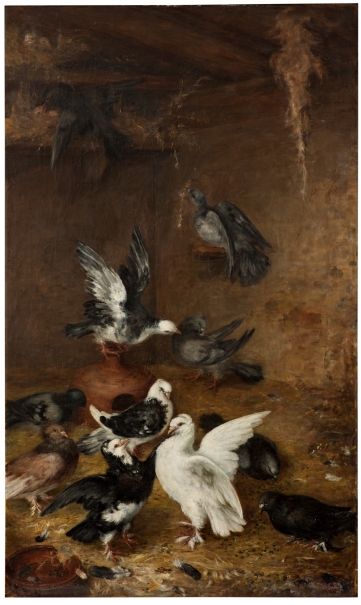
1901. Oil on canvas.On display elsewhere
This popular scene depicts a group of pigeons next to the pieces of a broken earthenware pot containing the remains of their food. The action place under the roof of a dovecote, among whose wooden beams some birds nest.
This work belongs to the costumbrista trend which was typical of early 20th-century Spain. Under the appearance of a simple popular scene, the work contains an allegory of the complicated web of human relationships, identifying the pigeons´ behaviour with common human traits, such as love, hatred and pride. The composition exhibits loose brushstrokes and dark brown colours. It starts from the central white pigeon, which proudly puffs up its feathers in dispute with another one. From a technical point of view, this pigeon acts as the central and luminous point of the canvas.
This painting dates from 1901 and was awarded the third-class medal at the National Exhibition of Fine Arts of the same year. Although the Museo de Arte Moderno was not obliged to buy it, the canvas was acquired in the same year. On 7 October 1904, its deposit at the University of Granada was authorised by Royal Order. In 1971, it became part of the Museo del Prado´s collections, which included the Museo de Arte Moderno along with its deposits. Signed by Ginés in the lower right-hand corner, the work also includes its corresponding number from the catalogue of Museo de Arte Moderno (54), accompanied by the initial of the artist´s surname, in the usual formula of the museum´s inventory mark.
The artist Adela Ginés (1847–1917) was born in Madrid and was trained as a painter and sculptor at the San Fernando School of Fine Arts as a pupil of Carlos de Haes and Sebastián Gessa. She made her debut at the Academy in 1881 and entered her works on numerous occasions in the National Exhibition of Fine Arts as a landscape painter and painter of genre scenes. There, the artist was awarded several honourable mentions in painting in 1887 and 1895, and in sculpture in 1892, some third-class medals in painting in 1897, 1901 and 1912, and in sculpture in 1895 and 1899. Ginés became one of the most awarded artists in the history of the National Exhibition of Fine Arts (López-Fanjul Díez del Corral, M. in Obras maestras del patrimonio de la Universidad de Granada. II. Catálogo [Masterpieces of the heritage of the University of Granada. II. Catalogue], 2006, p. 160).