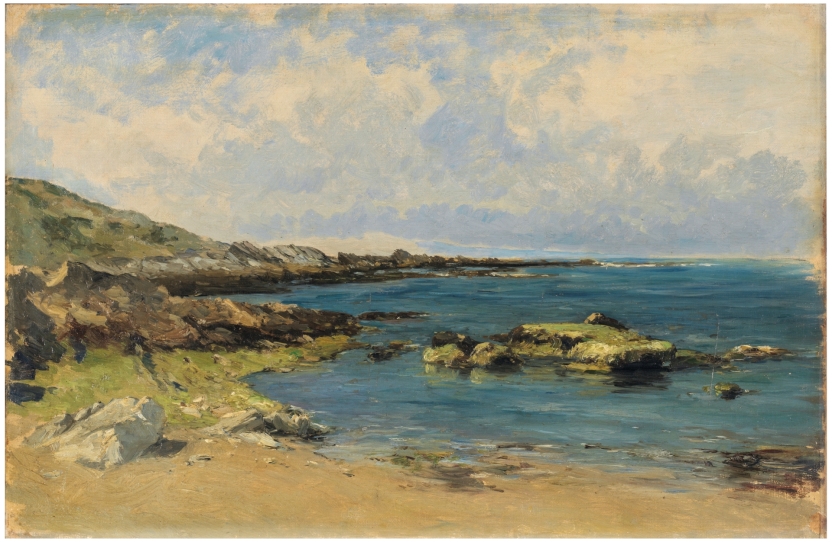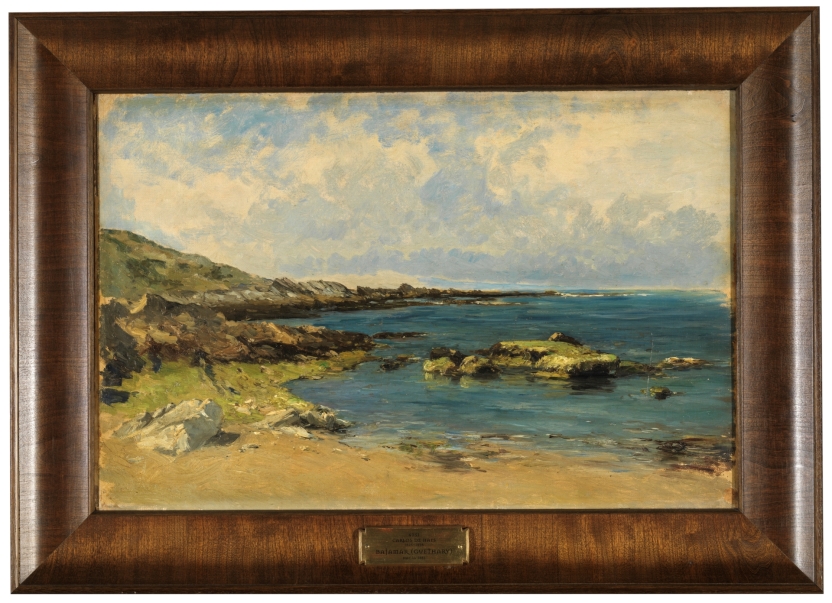
Low tide (Guethary)
Ca. 1881. Oil on canvas attached to canvas.Not on display
On the left, the rocky foothills of the Atlantic Pyrenees extend into the Cantabrian Sea, the picture culminating in a distant horizon, framed by the clarity of a very fine line that separates the land from an overcast sky filled with wispy clouds in constant movement. In the foreground, the low tide has revealed rocks covered with algae and lichen. Whilst, in the distance, there are small waves breaking on the shore of a calm sea.
For both Haes and for his pupil Morera, who accompanied him on this trip, the study of rocks was extremely attractive as a pictorial theme. On occasion the two would create hypothetical pictorial challenges for each other based on similar themes, as can be seen in both of their work on these beaches in the south of France. Despite all the possibilities that a maritime landscape could offer, this simple theme was the one that occupied haes most. He created endless examples of rock formations that emerge on the beaches when the water comes in at low tide. Even on the occasions when he extended his field of vision to a more extensive coastal environment, he always included rocks, meticulously portrayed, and covered with marine vegetation, an indispensable feature of the artist’s beach landscapes. The Prado has a small preparatory graphite drawing based on the theme of the rocks protruding from the water, drawn at a time when the tide is at its lowest. Although these rocks are the main feature, the line of mountain and coastline that form this landscape is already implied in an imprecise way and with mere rapid strokes.
Gutiérrez Márquez, Ana., Carlos de Haes en el Museo del Prado, 1826-1898 : catálogo razonado, Madrid, Museo Nacional del Prado, 2002, p.208