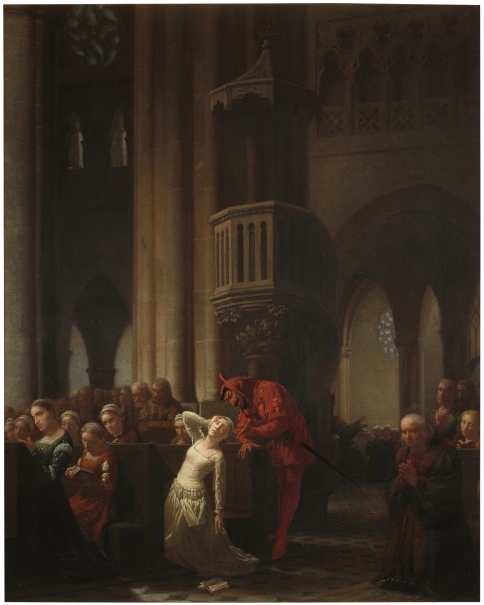
Margarete and Mephistopheles in the Cathedral
1867. Oil on canvas.On display elsewhere
Goethe´s Faust was a source of inspiration for numerous 19th-century Spanish painters who depicted the various protagonists in the most varied situations. Puebla chose to do so with Margarete in the cathedral.
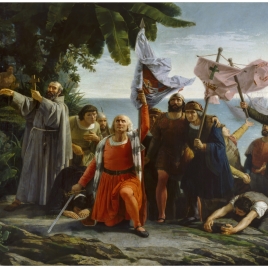
Inside a Gothic temple where the light filters through stained glass windows, Margarete, in the centre of the scene, suffers the insidiousness of Mephistopheles. The church is full of parishioners praying, oblivious to what is happening. One of them, the old man kneeling on the right, is none other than the model used by Puebla to represent the Admiral in The First Landing of Christopher Columbus in America (P006766).
Under the pulpit in the centre of the composition, Margarete, dressed in white, faints, dropping the prayer book to the ground. She has come to the temple in search of consolation after having yielded to the impulses of her heart in the face of Faust´s demands, but Mephistopheles – who appears completely dressed in red – is unwilling to let his prey escape. This same scene was also addressed in a similar way by Domínguez Sánchez and both recall the illustrations that Delacroix had made on the subject.
In the painting of Puebla, where a palette of brownish tones predominates, almost all that stands out are the brightly lit whites and the reds of the protagonists´ clothes. The drawing is very carefully rendered, especially the faces of the kneeling parishioners, some of which are portraits in their own right.Elorza Guinea, Juan Carlos, Dióscoro Puebla (1831-1901), Burgos, Junta de Castilla y León, 1993