The Return of the Fairies to the Lake
Ca. 1864. Oil on canvas.Not on display
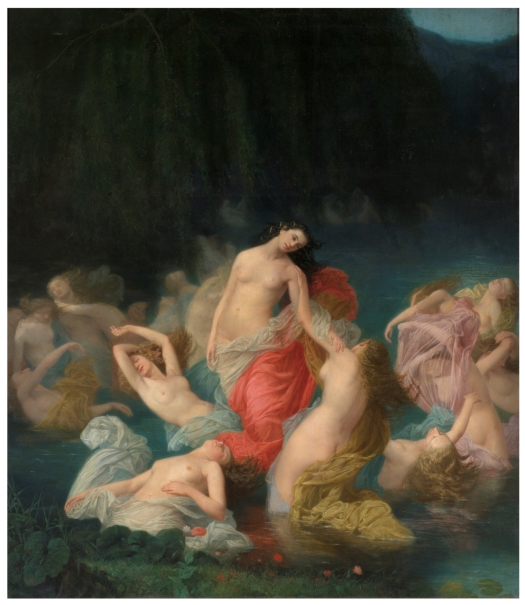
In a misty atmosphere and on the surface of a lake, a background full of vegetation of large trees with their branches over the water can be seen. The light which illuminates the composition peeps through the upper right-hand corner of the canvas. Several groups of fairies slowly enter the lake with contorted gestures. The central group of five figures in various poses is the most clearly defined. They are all partially nude and partially covered with different coloured cloths. The main figure is the least submerged and is curiously the only one with black hair entwined with ribbons of pearls. She is covered with a vaporous transparent cloth on which a red and pink cloak floats. With her left arm she holds another companion, who has long blonde hair and is partially draped with a golden cloak, as she begins to sink into the water. To the right of this figure and in front of her, two fairies with blonde hair dressed in bluish-white cloths are further sunk into the depths.
In the midground, on either side of the main group, are other groups of these fantastical beings with the appearance of women and endowed with powers surpassing those of mortals. They are associated with fields, hills, and fountains, among others, especially in Celtic mythology. In the literary and musical world of the early 19th century, especially since Wieland composed Oberon –inspired precisely by this character who was considered to be the king of the fairies– the theme became very popular.
The unusual composition is once again the pretext for a study of nudes and clothing –including wet cloth in the strictest classical tradition– especially those of the figures on the right. The figures on the left are less well attended to and are more the result of a sketch.
In the foreground of the painting, in the lower part of the lakeshore partly covered with water lilies and aquatic plants, Puebla has not resisted the extraneous inclusion of a series of country flowers, striking poppies that reinforce the colourful composition among them.
In all cases, the hair of the fairies is magnificently treated, especially the fairy with blonde hair immersed in the water, and their watery reflections are splendidly achieved. Without exception the flesh tones are pale, as befits fantastic beings from Norse mythology. The painting was entered, along with five others, in the 1864 National Exhibition of Fine Arts but was not awarded a prize. Pedro Antonio de Alarcón, a friend of Puebla´s, considered this a grave injustice and lashed out at Rosales, who had received a First Class Medal for his painting Queen Isabella the Catholic dictating her Will (P004625). The critic Baltasar Peón in the Gaceta de Madrid of 2 January 1865, in his chronicle of the exhibition, noted the presence of the canvas, simply stating that: ‘...although it is a fantasy painting rather than history, we give credit to The Return of the Fairies to the Lake (no. 306) by D. Dióscoro Puebla y Tolín for being a canvas of large dimensions’Elorza Guinea, Juan Carlos, Dióscoro Puebla (1831-1901), Burgos, Junta de Castilla y León, Consejería de Cultura y, 1993