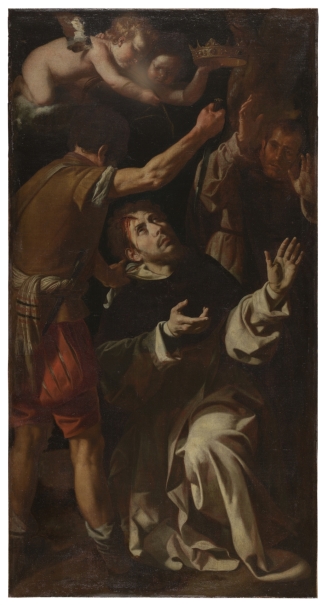
Martyrdom of Saint Peter Martyr
Ca. 1650. Oil on canvas.Not on display
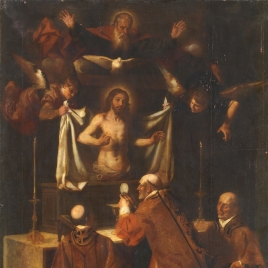
This canvas is one of the most significant works by Espinosa from a remarkably fortunate period of his artistic production, notably influenced by Pedro de Orrente both in his brownish colour palette and in his treatment of draperies and human models. This work comes from an altarpiece in the church of San Nicolás (Saint Nicholas) in Valencia, where Teodoro Llorente described it in 1887 and where it was seemingly kept until the Spanish Civil War. It used to be the central canvas of the group. In the predella, there were three horizontal canvases of small figures: The Birth of the Virgin, The Adoration of the Shepherds and The Birth of Saint John. All three bear a strong impression of Orrente’s work, and only the first and the third canvases can be observed in the church today. The central one is missing, and its only record appears in a photograph from before 1936.
The date of this group of paintings is unknown. Alcahalí (1897) affirmed – without supporting it with documentary evidence – that in 1640 Espinosa painted a Martyrdom of Saint Peter for the church of San Nicolás that could very likely be this work. At the moment it is not possible to verify that hypothesis, but in any case, this is a work of art that should correspond to the artist’s main output, between 1640 and 1660, perhaps closer to 1650, when the echoes of Orrente –who died in Valencia in 1645 – were stronger, along with the constant reminders of Ribalta’s world. The composition, quite closed – even excessively tight – is skilfully executed. The light provides coherence to the tight-fitting group as it intensely illuminates the saint’s head, hands and knees, leaving almost everything else around him in the shadows, except for the executioner’s strong arm gripping the machete with which he wounded the saint, as well as one of the child angels carrying the crown of glory. In the midground, another friar opens his arms in utter terror, fading into the shadows.
Garín LLombart, Felipe Vicente, Un mecenas póstumo: el legado Villaescusa, Madrid, Museo del Prado, 1993, p.74-76