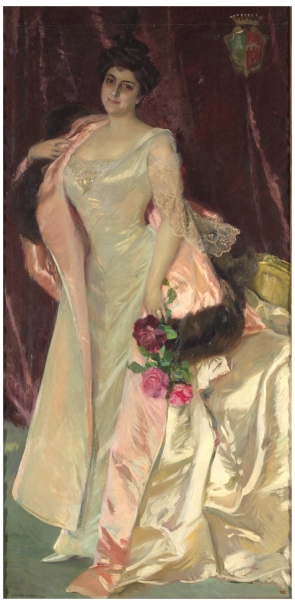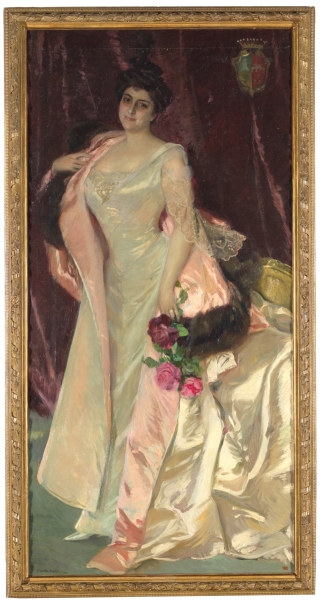
Mercedes Mendeville, Countess of San Félix
1906. Oil on canvas.Not on display
Sorolla was an extraordinarily gifted portraitist, and following his international success at the Paris Universal Exhibition of 1900, he became one of the most popular painters in the world. His portraits of women are endowed with great sensuality, emphasised in this by the chosen pose. The woman holds her rich satin cape adorned with fine furs gently on one shoulder. It reveals the wide neckline of her white satin dress with lace, which is very tight-fitting and emphasises the contour of her figure. Sorolla made at least eight preparatory drawings in study of the subject, and in these, the favoured pose of the final portrait is already evident. Despite having executed the drawings, the figure´s position on the canvas was a little tight, so that the painter had to add a strip of fabric, the seams of which are visible at the top. Nevertheless, the contrast between the figure´s great ease and range of movement, and the limited space available remains perceptible. The work was painted in a vertical format widely used in commonplace portraiture, as it serves to elegantly stylise the figures. Raimundo de Madrazo, an artist whom Sorolla admired and who in Paris in the same year, painted a portrait of Sorolla, had often used this format, as well as the technique of showing the sheen and reflections of the rich female fabrics. Sorolla´s virtuosity in this latter technique was superior to that of the artists of his time. In this case, he took full advantage of the contrast created between the whites and pinks which were enhanced by broad brushstrokes and the dark and warm tones of the background drapery. On this drapery, the coat of arms of San Félix appears. It is stamped with the crown of the count. The artist may have been inspired by the opulent sensuality of the countess, whom some authors considered to have been the model for one of the characters in The Chimera (La quimera), the novel by Emilia Pardo Bazán published in 1905. He depicted her with a wide helical movement that evokes to some extent the shape of the roses she holds, and makes her figure emerge from the cloak that surrounds her. The model´s pronounced sensuality is also evident in the other option that the artist depicted in his preparatory drawings. In that one, he depicted her reclining on a couch with one of her arms outstretched. The artist took the looseness of his brushstrokes to the extreme in the dress that rests partly on the yellow upholstered armchair behind her. The pronounced shading around the eyes, whose brightness stands out more intensely, enhances her facial expressiveness. The half-open lips and tilted head accentuate a certain coquetry. The countess herself was an amateur painter and in the second decade of the century she is recorded as a copyist in the Museo del Prado. The artist, who was paid seven thousand pesetas for the portrait, included it in his important personal exhibition at the Georges Petit gallery in Paris in 1906. Two years later, it was published in the catalogue of his exhibition in London.
Barón, Javier, Mercedes Mendeville, condesa de San Felix (1906). En Barón, J.: El retrato español en el Prado. De Goya a Sorolla, Madrid, Museo Nacional del Prado, 2007, p.188, n. 67