Miguel de Cervantes imagining El Quixote
1858. Oil on canvas.Not on display
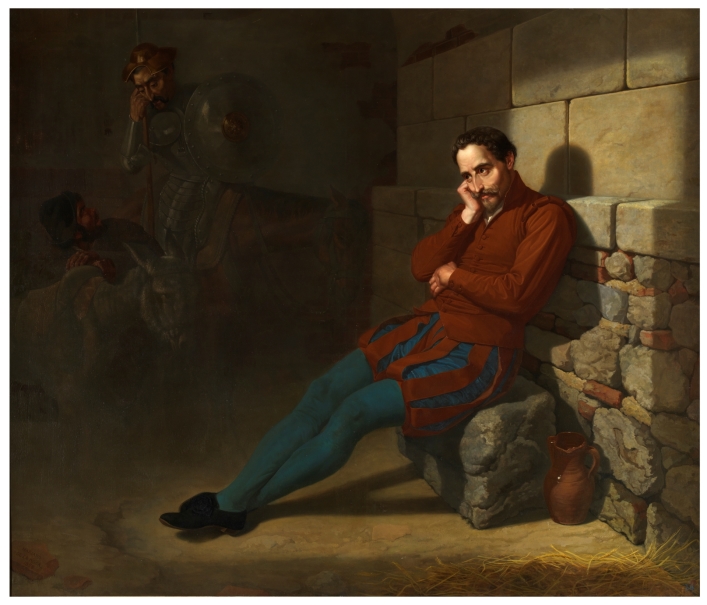
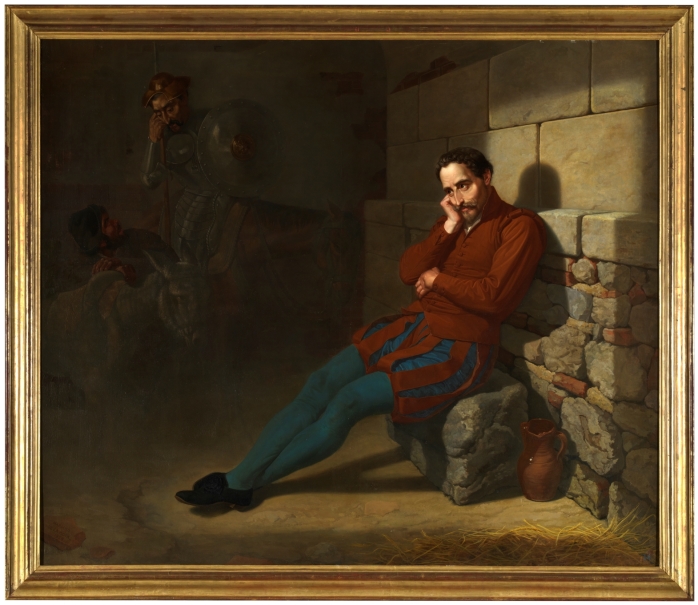
This painting – awarded a third-place medal in the 1858 National Exhibition – depicts the famous writer when he came up with the story of Don Quixote de la Mancha during his imprisonment in Argamasilla de Alba in 1602 after unsuccessfully requiring the payment of a debt (Pellicer, Vida de Cervantes [Life of Cervantes]). Many scholars support the idea that these facts took place somewhere in La Mancha, relying on tradition rather than on documentation. Nonetheless, they disagree on the reasons for his incarceration. Apart from Pellicer’s statement, there is also a possibility that it was as a consequence of a powder assignment in the Argamasilla saltpetre factory, for which Cervantes decided to use water from Guadiana River to the detriment of field irrigation by the locals. Furthermore, there is yet another theory according to which the author may have made a lewd remark to a lady whose relatives sought vengeance. With regards to the novel being written in prison, even Cervantes himself, when he stated that his book ‘was conceived in a prison, where all discomfort has its seat’, does not indubitably prove it, since he could very well have been alluding metaphorically to a state of mind, in solitude or deprivation, more prone to the development of the imagination.
Thus, the painting shows Cervantes in a pensive posture, seated on an ashlar and leaning against the prison wall, fantasising about his immortal characters as if in a reverie. He imagines – with such an abstracted gesture that is close to a self-portrait – the figure of Don Quixote with all the elements of his typical iconography, in a parallelism that is not unrelated to the assertion of the writer’s own idealistic and adventurous spirit. Don Quixote appears listening to Sancho´s explanations with his donkey, looking at him from above. With a ray of light skilfully shining on the author’s face – leaving the images of his reverie in the shadows – the artist seeks to allude to the overflowing, imaginative spirit of Cervantes, an effect of genuine originality. Although, to a large extent, these features remain hindered by the painter’s discreet qualities.
El mundo literario en la pintura del siglo XIX del Museo del Prado, Madrid, Centro Nacional de Exposiciones y Promoción Artística, 1994, p.126