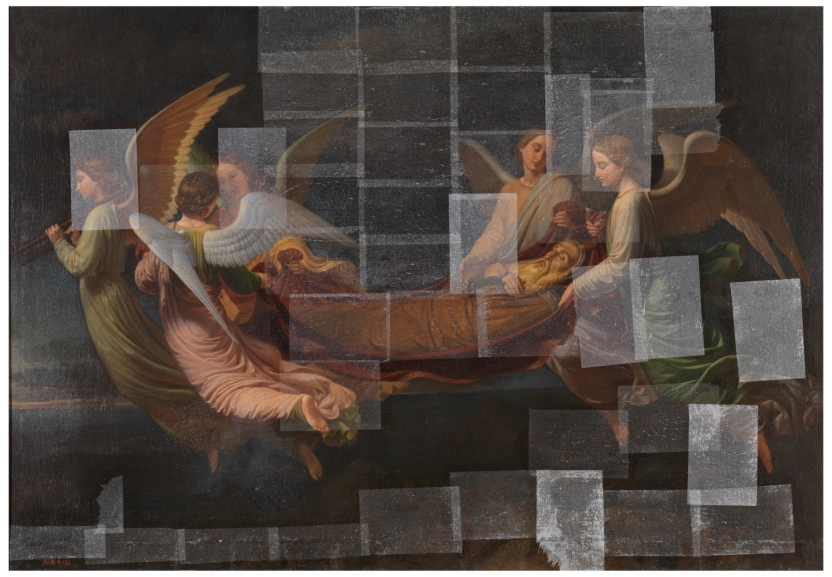
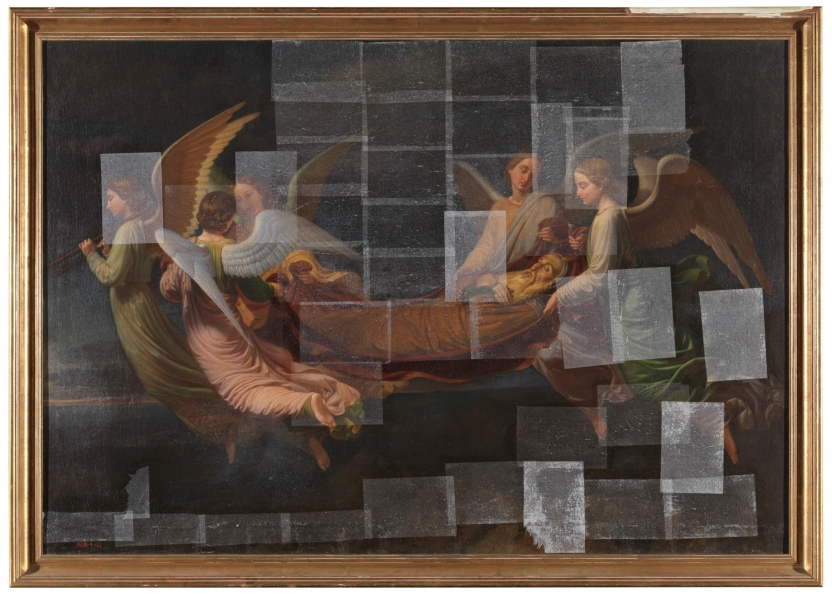
Moses carried by Angels
Ca. 1840. Oil on canvas.Not on display
Upon Espalter’s arrival in Madrid in 1842, The Transit of Moses was exhibited, together with other paintings by the artist, first at the Liceo as an artistic presentation (...) and then at the Academia de San Fernando. Its presence at the Madrid institution, along with other works, led to the staging of the famous controversy between ‘Murilloists’ and ‘Nazarenes’. The painting was severely attacked by an unknown Auguste Delorme, whose disparaging comments clearly sided with the most forceful opponent of purism, the Andalusian painter Antonio María Esquivel (1806–1857). But the immediate consequence of this harsh blow was the reasoning and justification of the new style imported from Italy by the vehement pen of Pedro de Madrazo, who extolled the painting as the most eloquent example of his theoretical presuppositions: ‘The composition of the beautiful painting which depicts the angels carrying the body of Moses to burial is one of the most poetic and flattering conceptions of the soul of a true artist. A whole poem could be written about it, and it would give us great pleasure, if our newspaper would allow it, to describe that group of five beautiful, light, pure, aerial angels full of life, and the dead, heavy and inert body of a man, crossing in mystical silence the misty air that the spirits cut through with their buzzing wings, forming a sort of serene boat that admirably symbolises the passage from earthly life to the afterlife. Nothing more gorgeous than those angels full of majesty, grace and nobility: nothing more grave and holy than that old man with his hands folded on his chest, and whose venerable countenance reveals the calm of the just’. (García Navarro 2007, 152).
The death of the prophet Moses, quoted in Deuteronomy (34:5-6) and Exodus (2:11-12), does not refer to the iconography depicted in the painting. It is likely that the scene is inspired by a medieval pious legend that narrates how the angels transported the body of Moses to the plains of Moab, on the edge of the Promised Land.