The Christian Era
1871. Oil on canvas.On display elsewhere
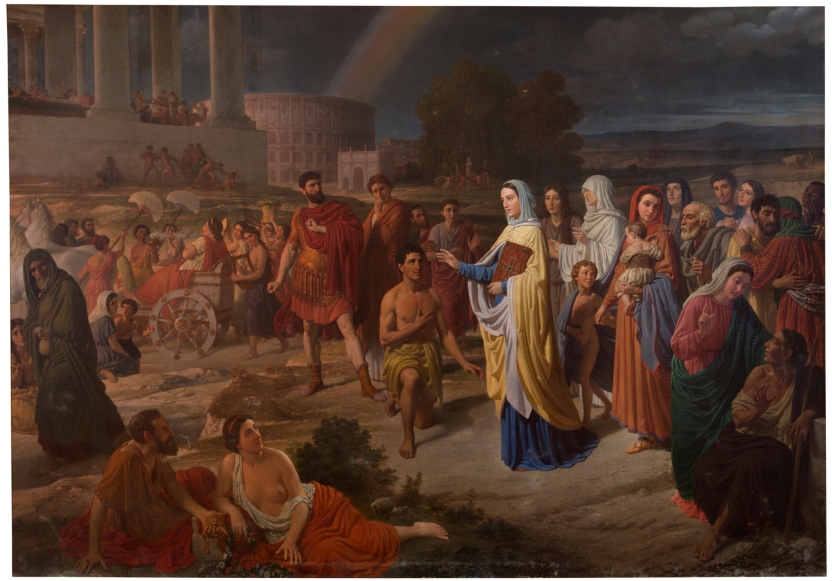
“The Christian Era is depicted in this work as a simple and modest young woman carrying the Gospel while gesturing with her hand as a sign of preaching the new message. Behind her, Faith can be seen epitomized as a female figure covered with a white mantle and leading a repentant young woman by the hand. Next to Faith is Charity, a healthy young woman who is holding a baby in one arm while holding the hand of an older child covered with her mantle. At the same time, Charity is guiding a poor old man who leans on her shoulder. To the left of Charity is Hope, who is comforting a poor woman dressed in rags, to whom she promises heavenly reward for enduring the hardships and miseries of this life.
Fraternity is depicted as a wealthy man and a commoner embracing each other. Behind Faith is a mother or a widow who has lost a loved one, taking solace in faith. Beside her are a young couple representing the sanctity of marriage. The young woman is overflowing with joy, for she is now a spouse freed from slavery. On the right is an African man whose gaze turned heavenward and enraptured gesture, tells of the universal and equalising reach of the Gospel. Lastly, on a hill in a field, a man can be seen tilling the soil, not only a representation of the Gospel’s ennobling of labour, but also an allusion to its allegorical sewing of the message.
The young man kneeling in the centre of the painting, is a slave who in joyful serenity embraces the faith, inspiring feelings of kindness and generosity in his heart. Behind him, the Emperor is frowning at the New Era for he opposes it; he represents Pride. The matron who can be seen by his side represents Envy. To her left, a young patrician stirred by the voice of Religion comes closer while ignoring his companion, who is trying to stop him. In the foreground, a maiden who was busy making wreaths of flowers can be seen. She has turned her head, and now is illuminated by Christianity. She is listening with admiration and interest to the word of the New Age, while a figure with a lustful expression tries to seduce her by offering her jewels, which she refuses. This character represents Lust. In the midground, a miser flees from Religion, ignoring the pleading voice of a poor girl who begs him for alms. Further away, another poor woman with a haggard face is sitting on the ground. Her son is pointing at the New Age, while inviting his mother to go towards it as though he senses the blessings that the New Age will bring.
Further away, on a flat path, a matron sits leaning back on a luxurious carriage drawn by two horses. She is surrounded by slaves who offer her all kinds of material pleasure. She represents Idleness. Two stoics seem to look with contempt at the luxury displayed by the matron. On a higher area under a colonnade, several groups of people can be seen. Some of them indulge themselves in an orgy –representing Gluttony– while others, bored with that party, enjoy the spectacle of an athletes’ fight, urging them on with gestures and gifts. These fighters represent Anger. Further away, underneath a grove of trees, a bacchanal around the statue of the god Bacchus is depicted. In the background is a circus where many Christians were to be martyred. A rainbow, the symbol of peace, appears in the cloudy sky. Lastly, the sky begins to clear up on the side from where the Christian Era is coming.” (Cat. ENBA)
Díez, José Luis (dir.), Pintura del Siglo XIX en el Museo del Prado: catálogo general, Madrid, Museo Nacional del Prado, 2015, p.163