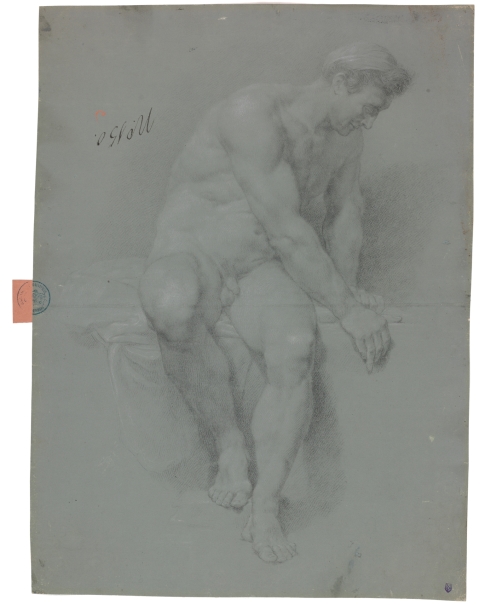
Nude Figure Study
1765 - 1768. White chalk, Black chalk on green paper.Not on display
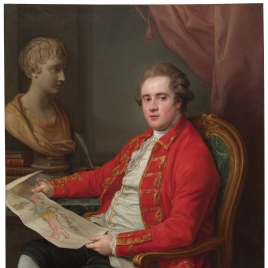
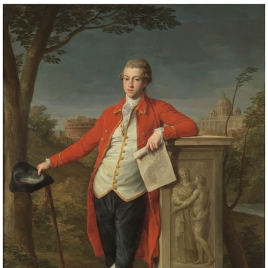
Pompeo Batoni was the leading exponent of Roman classicism during the second half of the eighteenth century along with Anton Raphael Mengs. Following initial training in his native Lucca, Batoni studied in Rome, immersed an atmosphere of classicism and rigorous academicism. There he was especially appreciated as a portrait painter, for works such as Francis Basset, 1778.
The present work, like Mengs’s paintings, is drawn from a life model, as practised in Roman academies at that time. Artists could do so at official or private academies, or even in independently organised classes. Batoni participated in an academy held at the home of Sebastiano Conca, and as a teacher at the Accademia Capitolina del Nudo, also known as the Accademia del Disegno, where, according to Edgar Peters Bowron, he supervised the life classes. Thus Batoni made drawings of this type as a student, but also throughout his career.
This Museo del Prado drawing is very similar to a group of works dating from the 1760s and 1770s that Batoni created independently, rather than as studies for his paintings. Others with the same technique and style are now at the Kupferstichkabinett in Berlin and the Gabinetto dei Disegni of the Accademia Brera in Milan.
As Manuela Mena Marqués points out, this drawing comes from the Workshop of the King’s Chamber Painters at Madrid’s Royal Palace. The number 150 at the upper left corner bears witness to this provenance. The same number appears on another drawing by Batoni at the Museo del Prado and on others by late eighteenth-century Spanish painters then at that workshop, which indicates that the works were acquired by the museum as a single lot. This provenance suggests that the drawing was probably used as a model by royal painters, perhaps meaning that it was sent, or brought, from Rome by an artist.
Unlike Baroque artists who made academic drawings with red chalk, Batoni used a technique of preparing the paper with a thick coat of greenish tempera to give the rough surface of the paper a velvety finish. He then drew on it with a very sharp black pencil and enhanced the forms and highlights with white chalk. This technique required considerable dexterity, as it was impossible to erase errors without destroying the prepared Surface.
Carlos Varona, María Cruz de, 'Pompeo Batoni. Academic drawing'. Italian masterpieces from Spain's royal court, Museo del Prado, National Gallery of Victoria Thames & Hudson, 2014, p.268