Pablo de Valladolid
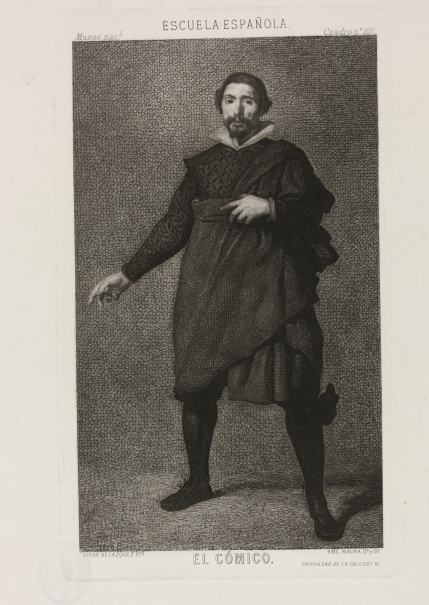
1869. Taille douce: etching and engraving, Art printing on wove paper.Not on display
The work belongs to a set of seven prints (G121–G127) of paintings by Velázquez that were carried out by Bartolomé Maura shortly after he settled in Madrid. They are very likely the first prints he engraved while in the capital. In this series, the artist emulated the editions produced in Paris, spearheaded by Cadart and the Societé des Aquafortistes in the 1860s. This led Maura, along with three other engravers, to found the Sociedad del Grabador al Aguafuerte (Society of Etching Engravers). The engraver’s choice of Velázquez’s paintings was firstly due to his admiration for the painter and secondly because of the acquisition policy being employed at the Calcografía Nacional during those years, under which preference was given to prints reproducing paintings from the Spanish school. Therefore, it is logical that once the prints, engraved in 1869 and 1870, were finished, he offered them to the Calcografía Nacional, which acquired them and commissioned Juan Gangoiti to engrave the lettering before putting them up for sale (Vega, J. in: Catalogue of Prints, 1992, p. 135, núm. 606).
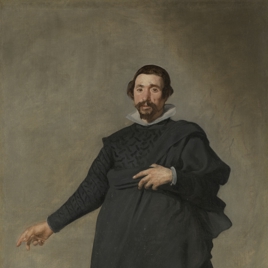
In addition to its technical and artistic quality, this work is important because it sheds light on the state of knowledge about the figure portrayed in it. The oldest surviving references to Pablo de Valladolid (around 1587–1/12/1648) are dated after his death and are found in various inventories that include his name in the description of paintings by Velázquez. One example is in the inventory of the Marquess of Leganés in 1655, who owned copies or versions of the jester paintings in the Royal Collection; another is the 1701 inventory of the Buen Retiro Palace, from which the portrait of Pablo de Valladolid in the Museo del Prado (P001198) is taken. In the subsequent inventories of 1772, 1794 and 1814 in the Buen Retiro Palace, as well as in the first published Prado catalogues, all references to the subject of Velázquez’s painting had disappeared, and from that point onwards the matter had been forgotten. In the Museum catalogue of 1843, Pedro de Madrazo theorised that the Prado painting could be the ‘portrait of a famous actor at the court of Philip IV’ owing to the subject’s declamatory expression – a suggestion which would later have far-reaching repercussions. This led to the canvas being known in those years as The Comedian, a name suited to this engraving executed by Maura in 1869. References to Pablo were revived in the 1872 Prado catalogue, in which Madrazo related the portrait of what was previously thought of as an anonymous figure cloaked in black to the description in the Buen Retiro’s 1701 inventory. He proposed that the painting be identified as ‘a portrait of a jester or man of pleasure to King Philip IV, called Pablillos de Valladolid’. From this publication onwards, texts identifying the jester in engravings and photographic collections of Velázquez’s painting became widespread.
Cueto Martínez-Pontrémuli, José Luis, La testamentaría de Pablo de Valladolid. Una nueva aproximación a su vida. Boletín del Museo del Prado, 2019-2021, p.112, fig. 2