Peaks of Europe
Ca. 1874. Oil on paper attached to cardboard.On display elsewhere
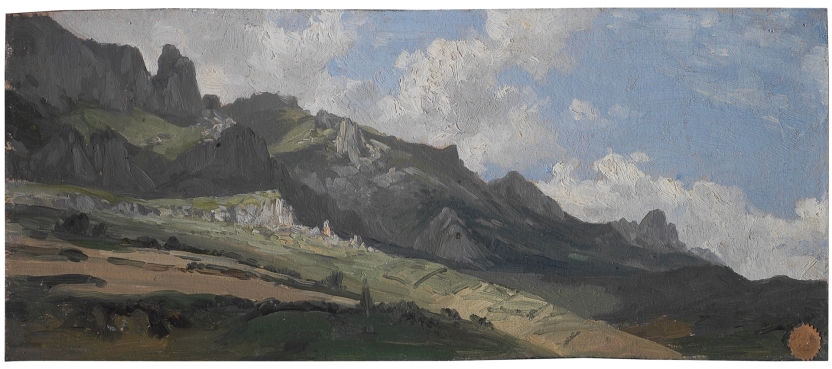
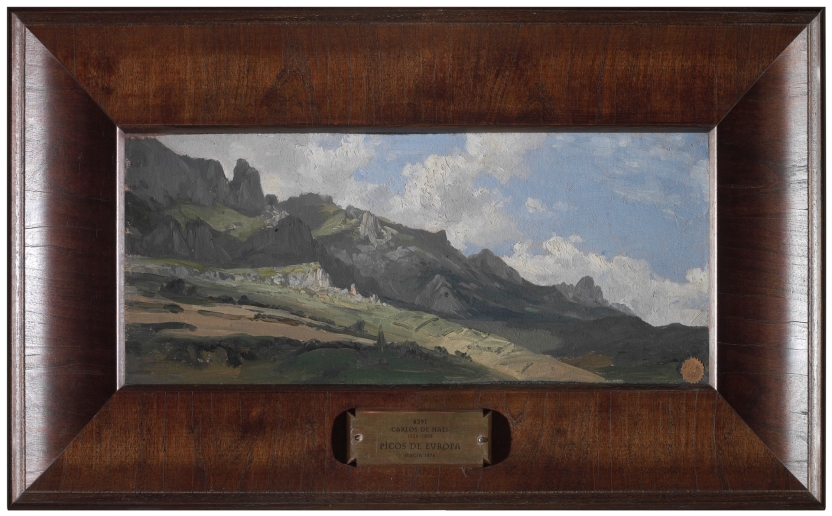
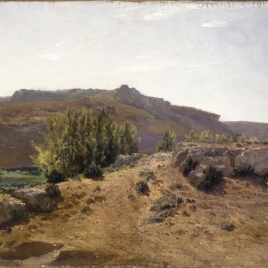
Given the landscape format of the work, Haes painted what is a panoramic view of the mountain range. The beginning of a mountain slope stands out in the foreground in a strong chiaroscuro. In the background, the steep peaks mark a diagonal that divides the painting into two scalene triangles, giving almost the same proportions to the sky and to the earth. The vibrant, thick brushstrokes reinforce the size of the rock shapes, whose outlines are clearly drawn against the the bright sky covered with lively, moving clouds.
The painting is set to the south of Pajares in the province of León. The Artist painted it from the hill that divides the Casares and Cubillas valleys. The clarity of this work provides a realist document of unquestionable value within Haes´s output, and it is well known that these small-format studies, taken directly from life, most characterise the artist´s realism. An assertion supported in this case by Haes’s specificity in his representation of the terrain. Thus, from left to right, this massif known as the Cornión stands out, as well as the Torres de las Tres Marías at an altitude of around 2,500 metres, the Peña Chagos, the Peña Turrón and the Peña Las Cangas.
Gutiérrez Márquez, Ana., Carlos de Haes en el Museo del Prado, 1826-1898 : catálogo razonado, Madrid, Museo Nacional del Prado, 2002, p.96