Portable oratory with the penitent Saint Jerome
Ca. 1520. Gilded, Carved, Polychromed.Room C
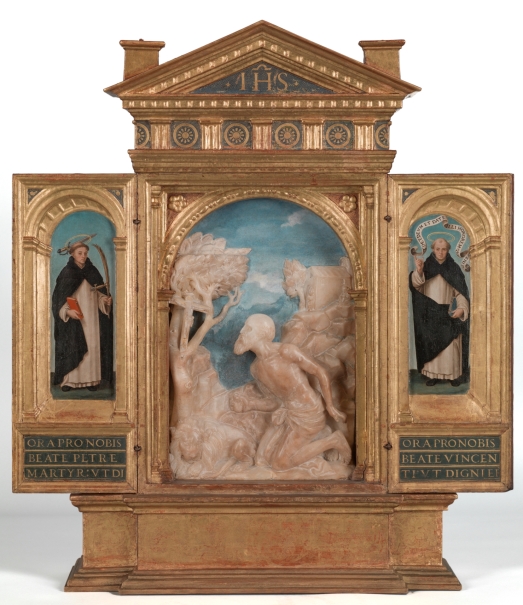
This exceptional portable oratory combines two delicate works by Damián Forment and Juan de Juanes, two essential artists during the Renaissance in the Kingdom of Aragon. The central representation of this joint work is the alabaster piece where Saint Jerome appears in his penitential retreat in the desert, although it has been transformed into a rocky landscape as can be perceived by the tree in the foreground from which a crucifix hangs and before which the saint appears kneeling while beating his chest with a stone. On a promontory in the background, a hut with a couple of hermits alludes to Saint Jerome as having inspired the first hermitages and monastic life.
Both the technical and stylistic characteristics of this relief correspond to Forment’s production between 1520–5. This composition presents the sculptor’s typical compositional approach with regards to the disposition of the main figure and the rest of the levels that make up the scene. He combined anecdotal details with naturalistic notes, along with thorough anatomical knowledge for the depiction of the figure of the saint. This figure was sculpted with a careful outline and a morbid carving, like that Foment employed, for example, in Saint Sebastian in the high altarpiece in Poblet. The outline of the tree and the stony background share similarities with Agony in the Garden in the cathedral of Huesca (between 1520-34), and the saint’s head is similar to one of the magi in The Adoration of Montearagón in the Museo Diocesano de Huesca and even to Saint Joseph’s head and one of the shepherds of The Oratory of the Adoration of the Magi in Sobradiel (Zaragoza), published by Carmen Morte in 2012. Like The Oratory with the penitent Saint Jerome, this work employs a classical structure with two swing doors carved in polychrome wood, subsequently done, which had the same purposes: to protect, to enhance, and to provide the alabaster with devotional usefulness.
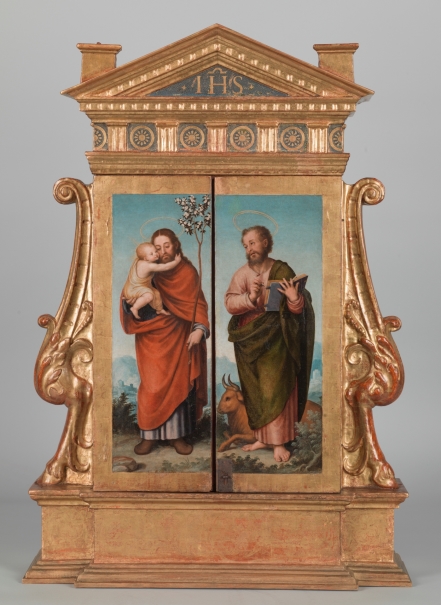
Around 1560, Juan de Juanes incorporated the alabaster element into a delicate architectonical structure: a tempietto with a semi-circular arch in its central body. This structure makes the use of wood necessary in the upper part of the alabaster piece. This wood addition was eventually hidden when a cloudscape was painted and a mountain landscape was extended as a part of the relief’s background. A moulded base in sgraffito supported the arch which is finished with a pediment over an architrave. On the sides, large half-lyre volutes were placed. The tempietto closes with two doors in which four saints appear: in the outer side, Saint Joseph with the Child and Saint Luke, and in the inner side, under two skew arches, Saint Vincent Ferrer and Saint Peter Martyr.
The original provenance of the oratory must be linked with Adriano López de Dicastillo, a name that appears written in the back of the tempietto. It can be possibly associated with Adrián de Sada y López de Dicastillo, son of Adrián de Sada (from Sos, Zaragoza) and Mariana López de Dicastillo (from Navarra). Since he married Jerónima Azcona y Trillo (from Tudela) on 30 July 1598 in Zaragoza, it is clear that López de Dicastillo was not the commissioner, but a member of his own family or of his wife’s could have commissioned it.
Ruiz Gómez, L, 'Damián Forment y Juan de Juanes. Oratorio de san Jerónimo penitente' En: Museo Nacional del Prado. Memoria de actividades 2018, Madrid, Ministerio de Cultura y Deporte,, 2019, p.76-78