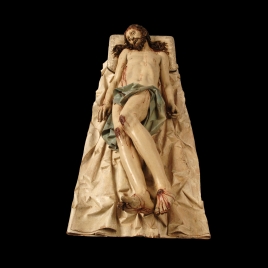
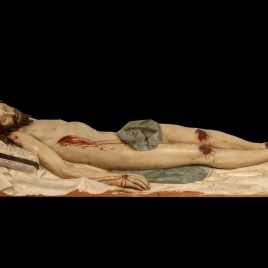
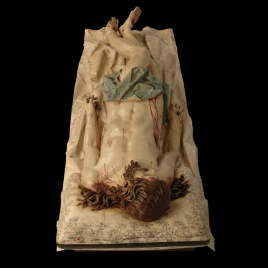
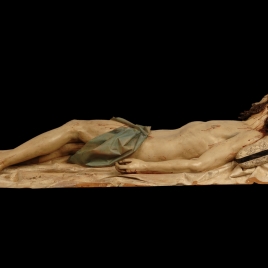
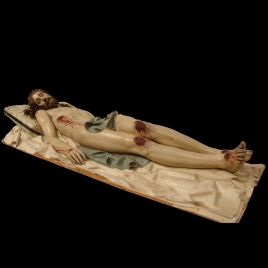
Recumbent Christ
1625 - 1627. Wood, Cork, Antlers, Vitreous paste.On display elsewhere
Elegant and transcendental, despite the tragic nature of the subject represented, are his recumbent Christs, which convey to viewers the pathos-inspiring languor of death without forsaking the dignity of his divine status. Here death is a dreamlike state, a wait that is portrayed not as corruption but as the transition to another dimension. Examples of Fernández’s highly refined but almost serial production, the result of having established an extraordinarily successful type, include one he produced for the Professed Jesuit House in Madrid for which a date of around 1625–27 has been correctly proposed, the year the polychrome artists Diego de la Pena (fl. 1625–30) and Jerónimo de Calabria (c. 1581–1634) undertook to work on two sculptures for the Madrid Jesuits.
Arias Martínez, Manuel, Darse la mano. Escultura y color en el Siglo de Oro, Madrid, Museo Nacional del Prado, 2024, p.272-276