formularioRDF
The itinerary <em>TITULORECORRIDO</em> has been successfully created. Now you can add in works from the Collection browser
<em>TITULOOBRA</em> added to <em>TITULORECORRIDO</em> itinerary

Close Continuar a ficha de la obra Continuar a ficha de la obra
20-05-2026
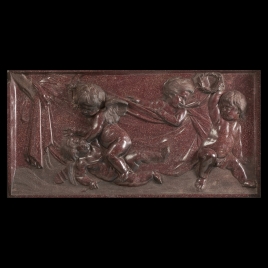
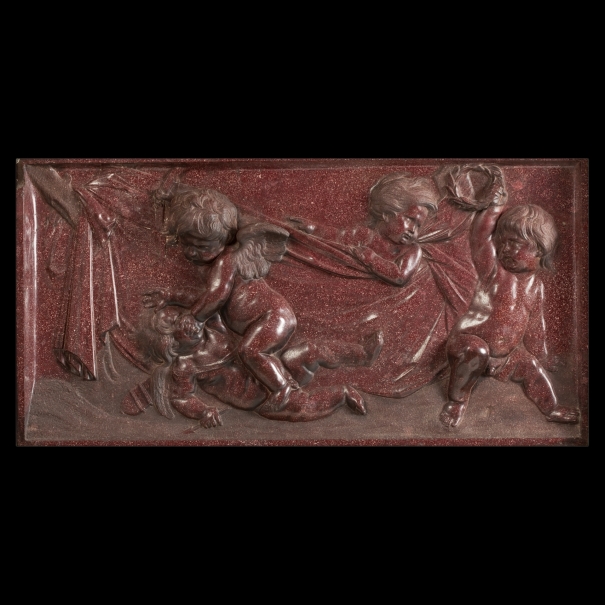
Tomaso Fedele -Sculptor- (Replica: François Duquesnoy)

Sacred Love defeating Profane Love

Ca. 1630. Bronze, Porphyry.
Room 011B

Nowhere is the fascinating world of diplomatic gifts and their language – the way an object can be turned into a persuasive instrument, able to dictate decisions and shape opinions – more intriguingly apparent than in this superb relief.

There is a wealth of documentation on its production and origin, and on its entry into the Spanish royal collection as a gift from Cardinal Francesco Barberini (1597-1679) to King Philip IV. It is a copy, made by Tommaso Fedele, of a composition by the Flemish sculptor François du Quesnoy (1597-1643) that was to enjoy considerable success. The original patinated plaster model on which the Prado piece was directly based is now in the Fundação Calouste Gulbenkian in Lisbon, while the Galleria Doria Pamphilj holds the marble version made by Du Quesnoy for the garden of the Villa Pamphilj or del Bel Respiro in Rome.

For this faithful reproduction of Du Quesnoy’s composition, Fedele chose to use porphyry, an unusual rock which in the seventeenth century had regained the special symbolic dignity it had been accorded in the ancient world. Echoes of the imperial past are conveyed through its very materiality, its compact solidness, and above all its characteristic reddish-purple colour, associated with power.

The imperial purple turned any item into an exceptional, valuable piece of art in its own right; and its worth was enhanced when the workmanship was of the quality that a seasoned master like Fedele brought to his carving. The skilled artistry, that prodigious tenerezza so admired by Giovan Pietro Bellori coupled with the subtle differentiation of textures – the rough ground, the interplay of polished facets to mark the shadows cast on other surfaces, thus achieving a nuanced lighting that belies the uniformity of the stone – combine to make this piece a wonderful present; a gift fit for a prince.

François du Quesnoy’s composition reflects his meticulous study of classical sources, reinterpreted here in a masterly manner. During their time in Rome, both he and Nicolas Poussin (1594-1665) examined the whole range of gestures displayed by those putti, whose representation – as the personification of innocent sentiments – was spared from moral constraints and censure. Close analysis of ancient statuary and of highly influential paintings such as the 1518 Worship of Venus by Titian (c. 1488-1576) – which by the 1620s was in the Villa Ludovisi in Rome – provided the basis for a formal composition which achieved great success and was widely circulated.

The theme of the struggle between Sacred Love and Profane Love is a classical topos which echoed down the centuries, highlighting the permanent relevance of that clash of opposites between which human nature is torn: the spiritual versus the carnal. We could trace the subject back to its earliest origins, highlighting numerous instances in western art; but here we need only focus on the period when this kind of relief was being produced to see how current the idea was in contemporary thought.

Illustrated publications aimed at an international readership – such as Amoris divini et humani antipathia, with verses in French, Spanish, and Flemish, first published in Antwerp in 1629 – clearly show that the notion of constantly-warring passions was topical at the time, and that cultured seventeenth-century society focused particularly on its development through love-related emblems. At the same time, though tackled with a less sophisticated rhetoric intended to convey a plainer message, the theme was popular in allegorical devotional prints, including an engraving by Hieronymus Wierix (1553-1619) – that served as a source for later reliefs and paintings – which shows Divine Love triumphing over Cupid, like a conventional Archangel Michael trampling the devil underfoot.

Given this context, it is easy to see why the eternal battle between the spiritual and the earthly was a recurring motif in both literature and the fine arts.

Arias Martínez, Manuel, 'Tommaso Fedele. El Amor sagrado venciendo al Amor profano'. En: Guido Reni, Madrid, Museo Nacional del Prado, 2023, p.328-330 nº 66
Technical data

Imagen del carrusel
Imagen del carrusel

Related artworks

Inventory number
E000300
Author
Tomaso Fedele -Sculptor- (Replica: François Duquesnoy)
Title
Sacred Love defeating Profane Love
Date
Ca. 1630
Technique
Sculpted
Medium
Bronze; Porphyry
Dimension
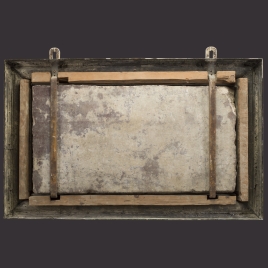
Height: 57 cm; Weight: 216 Kg; Width: 113 cm; Depth: 18 cm
Provenance
Gifted by Cardinal Francesco Barberini to King Philip IV; Royal Collection (Galería del Mediodía at the Real Alcázar, Madrid, 1686; Galería de Retratos at the Real Alcázar, Madrid, 1700, nº 33; Palacio Real Nuevo, Madrid, 1747, nº 13; New Royal Palace, Madrid, "Intervención de Oficio de Furriera", 1773, nº 71; New Royal Palace, Madrid, 1789, bajos relieves de pórfido medidas sus alturas con las peanas, nº 825; New Royal Palace, Madrid, 1794, nº 825).

Bibliography +

Passeri, Giambattista, Vite De'Pittori,Scultori Ed Architetti Che Anno Lavorato in..., Gregorio Settani, Roma, 1772, pp. 106.

Barrón, Eduardo, Catálogo de la escultura. Museo Nacional de Pintura y Escultura, Imprenta y fototipia J. Lacoste, Madrid, 1908, pp. 215-216, n.300.

Sánchez Cantón, Francisco Javier, Museo del Prado. Catálogo, Museo del Prado, Madrid, 1933, pp. 433.

Fransolet, M., François du Quenoy, Sculpteur d'Urbain VIII, Bruselas, 1941, pp. 72.

Ponz, Antonio, Viaje a España seguido de los dos tomos del viaje fuera de E..., V, M. Aguilar, Madrid, 1947, pp. 538.

Bottineau, Y, L'Alcazar de Madrid et l'Inventaire de 1686, aspects de la Cour d'Espagne au XVII siecle, Bulletin Hispanique, LX (2), 1958, pp. 149.

Faldi, I., Le virtuose operationi di Francesco Duquesnoy scultore incomparabile, Arte antica e moderna, 1959, pp. 52-62.

Lorente, Manuel, Sobre varias esculturas barrocas italianas del Museo del Prado, Archivo español de arte, 1963, pp. 43-45.

Fernández Bayton, Gloria, Inventarios reales. Testamentaría del Rey Carlos II, 1701-1703, I, Museo del Prado, Patronato Nacional de Museos, Madrid, 1975, pp. 135.

Bellori, Giovanni Pietro (1613-1696), Le vite de' pittori scultori et architetti moderni, Arnaldo Forni, Roma, 1977, pp. 161,271.

Colman, P., La Sculpture Au Siecle de Rubens Dans les Pays-Bas Meridionaux, Musees Royaux D'Art et D'Histoire, Bruselas, 1977.

Blanco, Antonio; Lorente, Manuel, Catálogo de la escultura. Museo del Prado (2ª ed.), Patronato Nacional de Museos, Madrid, 1981, pp. 217,218.

Fernández Miranda y Lozana, Fernando, Inventarios Reales Carlos III 1789-1790, I, Patrimonio Nacional, Madrid, 1988, pp. 86.

Martín González, J.J, Observaciones sobre el sepulcro español del siglo XVII, Academia. Boletín de la Real Academia de Bellas Artes de San Fernando, 1992, pp. 238.

Castro, Daniela di, Tommaso Fedeli, virtuoso del pórfido., Antologia di belle arti, 43-47, 1993, pp. 150-157.

Anes, Gonzalo, Las colecciones reales y la fundación del Museo del Prado, Amigos del Museo del Prado, Madrid, 1996, pp. 334.

Coppel Areizaga, Rosario, Catálogo de la escultura de época moderna. Museo del Prado: siglos XVI-XVIII, Museo del Prado; Fundación Marcelino Botín, Madrid, 1998, pp. 128,129.

Muñoz González, Mª Jesús, Los Relieves de Bacanales que decoraban el Alcázar, Archivo Español de Arte, 72, 1999, pp. 576-582 lám.24.

Borea, Evelina, L'idea del bello: viaggio per Roma nel seicento con Giovan P, Edizioni de Luca, Roma, 2000, pp. 400.

Boudon-Machuel, Marion, François du Quesnoy [1597-1643], Arthena, 2005, pp. 293-294.

Colomer, José Luis, La Adoración de los pastores de Pietro da Cortona. Regalos artísticos de Francesco Barberini a Felipe IV, Boletín del Museo del Prado, XXVI, 2008, pp. 6-22 [17-18].

Helmstutler Di Dio, K., 'Sculpted Diplomacy. State gifts of sculpture from Italy to Spain in the sixteenth and seventeenth centuries' En:, L'Arte del Dono. Scambi artistici e diplomazia tra Italia e Spagna, 1550-1650. Studi della Biblioteca Hertziana 8. Jornata di studi 14-15 enero 2008, Milan, 2013, pp. 51-65 [62].

Martínez Leiva, Gloria; Rodríguez Rebollo, Ángel, El inventario del Alcázar de Madrid de 1666. Felipe IV y su colección artística, Consejo Superior de Investigaciones Científicas, Madrid, 2015, pp. 556 nº 836.

Garcia Cueto, David, 'Potere e distinzione . I marmi policromi italiani nella Spagna del Seicento' En: Splendor marmoris: i colori del marmo, tra Roma e l'Europa, De Luca editori d'arte,, 2016, pp. 197-218 [209-210].

Azcue Brea, Leticia, Panorama artístico de la escultura cortesana y el coleccionismo escultórico nobiliario en la época de Felipe IV. Estado de la cuestión., en: La corte de Felipe IV (1621-1665) Reconfiguración de la Monarquía Católica. Tomo III, vol.IV. Arte, coleccionismo y Sitios Reales, Madrid, 2017, pp. 2871-3001 [2904 nt.88 f.5].

Pierguido, Stefano, 'La nascita di un genere: i putti', En: Bernini, Officina Libraria,, Milan, 2017, pp. 62.

Arias Martínez, Manuel, 'Tommaso Fedele. El Amor sagrado venciendo al Amor profano', En: Guido Reni, Museo Nacional del Prado, Madrid, 2023, pp. 328-330 nº 66.

Arias Martínez, Manuel, 'Tomasso Fedele after Francis du Quesnoy. Sacred Love defeating profane Love', In: Guido Reni, Museo Nacional del Prado, Madrid, 2023, pp. 328-330 nº 66.

Other inventories +

Inv. Felipe IV, Alcázar de Madrid, 1686. Núm. s. n..
Galería del Mediodía [...] Otro Bacanario de Porfido de medio relieue que es vn Juego de quatro niños de siete quartas de largo y vna Vara de alto marco de Bronze dorado.

Inv. Testamentaría Carlos II, Alcázar de Madrid, 1701-1703. Núm. 33.
ALAJAS DEL QUARTO DE SU MAGESTAD [...] Galeria de los Retratos [...] 33 / Yttem Ottro Bacanal de Porfido de medio relieue que es Un Juego de quattro Niños Y tiene Siette quartas de largo y Una Uara de alto con marco de bronze dorado tasado la Medalla en doze mill ducados de Vellon y el marco en Vn mill y doscienttos ducados que todo monta treze mill y doscienttos ducados que hazen Cientto y quarentta Y Cinco Mill Y dosçienttos Reales ... 145.200

Inv. Felipe V, Palacio Nuevo, 1747. Núm. 13.
{11451} 13 / Otra Bacanal de pórfido de medio relieve que es vn juego de quatro niños y tiene siete quartas de largo y vna vara de ancho con marco de bronce dorado

Felipe de Castro, Estatuas y bustos en la Intervención del Oficio de la Furriera en el Palacio Real, 1773. Núm. 71.
33.....13.....71.... Una Medalla o Bacanal de Porfido qe representa a Cupido, y Anteros con otros dos niños, guarnezido de un fuerte marco de bronce, dorado amolido escultura del famoso Francº Duquesnoy, demas de 5 ps de largo, y dos deancho sin incluir la moldura, nºs 33 y 13 del antiguo y moderno.

Inv. Carlos III, 1789-1790. Núm. 825.
Pº. MADRID / Vajos reliebes de Porfido medidas sus alturas con las Peanas ... 825 Otro Bacanal con un juguete de quatro niños de tres pies de alto y siete quartas de ancho, con su marco de bronce dorado á molido en ...... 135.000

Inv. Testamentaría Carlos III, Palacio Nuevo, 1794. Núm. 825.
Pº. MADRID / Vajos reliebes de Porfido medidas sus alturas con las Peanas [...] 825 / Otro Bacanal con un juguete de quatro niños de tres pies de alto y siete quartas de ancho, con su marco de bronce dorado á molido en ... 135.00

Museo Real de Pinturas a la muerte de Fernando VII, 1834. Núm. s. n..
YMBENTARIO Y TASACION DE LAS ESTATUAS BUSTOS Y DEMAS OBJETOS DE ESCULTURA PERTENECIENTES A S. M. QUE SE HALLAN EN LAS GALERIAS DEL REAL MUSEO [...] ESCULTURAS QUE SE HALLAN FIJAS EN LAS PAREDES DEL SALON HAVILITADO DE LA GALERIA [...] Id. una Medalla de Porfido apaisada de cuatro pies y cuatro pies y cuarto por dos y cuarto: que representa, cuatro niños los dos de ellos disputandose la posesion del arco y las Flechas, sin el marco. ... 100.000

Inv. Real Museo, Sección Escultura, 1857. Núm. 423.
423. Un cuadro de bajo relieve de porfido opaciado que representa cuatro niños dos de ellos disputándose la posesion del arco y las flechas. Esta colocado en un marco de bronce con sus molduras doradas y la escocia del centro es de verde antiguo. Ancho 3 pies, 3 pulg. Largo 5 pies, 3 pulg.

Inscriptions +

300.
Inscribed in black. Frame, front, lower bar

Exhibitions +

Guido Reni
Madrid
28.03.2023 - 09.07.2023

Roma Antica e Moderna. Il Seicento de Bellori
Roma
28.03.2000 - 26.06.2000

Location +

Room 011B (On Display)

Expuesto
Update date: 20-05-2026 | Registry created on 28-04-2015

Visor 360

Drag with the cursor to rotate the piece

Print on demand

Print artworks available in our catalogue in high quality and your preferred size and finish.

Image archive

Request artworks available in our catalogue in digital format.

Up