formularioRDF
The itinerary <em>TITULORECORRIDO</em> has been successfully created. Now you can add in works from the Collection browser
<em>TITULOOBRA</em> added to <em>TITULORECORRIDO</em> itinerary

Close Continuar a ficha de la obra Continuar a ficha de la obra
17-02-2026
Master of Hoogstraten See author's file

Saint Francis of Assisi receiving the Stigmata

Ca. 1510. Oil on panel.
Room 058

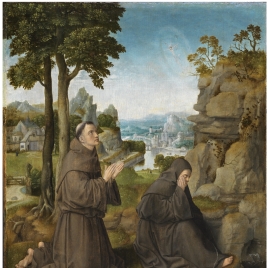
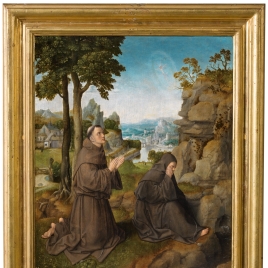
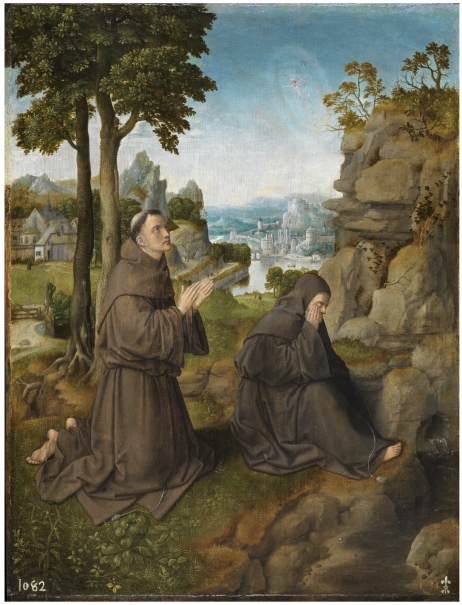
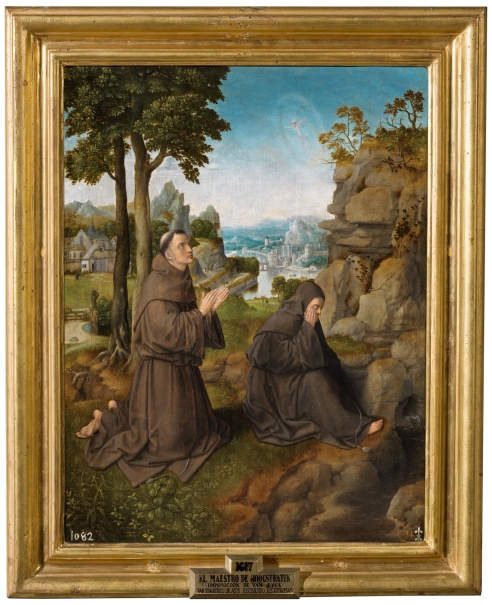
Saint Francis is kneeling on the grassy ground dotted with blue and white flowers, among which strawberries and plantain are recognisable. Rapt in prayer, he contemplates a vision of the Crucifixion that has appeared up above in the form of the Seraphic Christ surrounded by six coloured wings. In keeping with the iconographic tradition, Brother Leo, sitting in front of the saint, is dozing off and does not witness the miracle. The background landscape is compositionally very elaborate. On the left two trees counterbalance the rocks. Between both masses, above the ain figures, a landscape view opens up of a river with a city, where a bridge and several monumental buildings are visible, including a Gothic cathedral. The city has plausibly been identified as Dinant, as the collegiate church of Our Lady beside the river and the characteristic rocky crag topped with a castle, still visible today, are recognisable.

The work is based on the two versions of the same subject attributed to Jan van Eyck. One of them, on panel, is in the Galleria Sabauda in Turin and the other, of similar importance, greatly resembling it only smaller in size and painted on parchment mounted on wood, is in Philadelphia (Philadelphia Museum of Art, John G. Johnson Collection, inv. 314). The Prado work is not a direct copy of either of the two known versions of Van Eyck’s original, those in Turin and Philadelphia.

In general, this panel is executed with technical skill in places but is not very elaborate, painted almost hurriedly. Nevertheless, using only a few painting devices the artist achieves a very laudable overall result based on a recognisable model: Van Eyck’s work. That is perhaps the feature that it has in common with other paintings by the Master of Hoogstraten and that Friedländer identified as a basis for attributing it to him. When defining the characteristics of the oeuvre of this master created by him, he referred directly to a ‘spare and tentative’ formal idiom.

Until the Master of Hoogstraten is better defined, the elements described and these comparisons do not allow us to rule out a link between the artist who produced the paintings commonly grouped together under this conventional name and the artist, painters or workshop who made the Prado work. Whatever the case, this Saint Francis of Assisi receiving the Stigmata illustrates to what extent interest in owning Eyckian paintings through repetitions of the Bruges artist’s most famous compositions lingered on for years, becoming combined with other pictorial interests in the early 1500s, such as achieving much more elaborate depictions of landscape

Pérez Preciado, José Juan, Fifteenth-century netherlandish painting at the Museo Nacional del Prado. Catalogue raisonné, Madrid, Museo Nacional del Prado, 2024, p.204-211 nº.23
Technical data

Imagen del carrusel
Imagen del carrusel
Inventory number
P001617
Author
Master of Hoogstraten
Title
Saint Francis of Assisi receiving the Stigmata
Date
Ca. 1510
Technique
Oil
Support
Panel
Dimension
Height: 47 cm; Width: 36 cm
Provenance
Royal Collection (Isabella Farnese Collection, Royal Palace of La Granja de San Ildefonso, Segovia, 1746, n. 1082; La Granja Palace, Casa de Alhajas-otra pieza, 1766, n. 1082; La Granja Palace, 1794, n. 1082; Royal Palace of Madrid, cuarto del infante don Francisco-primera pieza, 1814-1818, n. 1082).

Bibliography +

Hymans, Henry, Les Musées de Madrid. Le Musée du Prado IV, V VI, Les écoles du nord., Gazette des Beaux-Arts. La chronique des arts, 10, 1893, pp. 223-236, 333-340 [334].

Voll, Karl, Die werke des Jan van Eyck. Eine kritische studie, Trübnet, Estrasburgo, 1900, pp. 109,133.

Weale, William H. James, The Van Eycks and their Art, John Lane, The Bodley Head / John Lane/ Bell&Cockburn, Londres / Nueva York / Toronto, 1912, pp. 166.

Goffin, Arnold, L'Art Religieux en Belgique. La Peinture des Origines a la Fin di XVIIme siècle, G.Van Oest, Bruselas / Paris, 1924, pp. 32.

Friedländer, Max J., Early netherlandish painting VII: Queentin Massys, A.W.Sijthoff; Praeger, Leyden-Bruselas; Nueva York, 1971, pp. 90.

Bermejo, Elisa, La pintura de los primitivos flamencos en España I, C.S.I.C., Instituto Diego Velázquez, Madrid, 1980, pp. 59.

Museo Nacional del Prado, Museo del Prado: inventario general de pinturas (I) La Colección Real, Museo del Prado, Espasa Calpe, Madrid, 1990, pp. nº1454.

Rishel, Joseph J., The Philadelphia and Turin paintings: The literature and controversy over attribution, Philadelphia Museum of Art, Filadelfia, 1997, pp. 3-12 [9-10].

Luber, K.C., Recognizing Van Eyck, BULLETIN PHILADELPHIA MUSEUM OF ART, 1998, pp. 24,47-48.

Borchert, Till-Holger (ed), The age of Van Eyck: the mediterranean world and early netherlandish painting 1430-1530, Thames & Hudson / Ludion, Londres / Gante-Amsterdam, 2002, pp. 242.

Borchert, Till-Holger, Le Siecle de Van Eyck: Le Monde Mediterraneen et les Primit, Ludion, Amsterdam, 2002, pp. 242.

Lumen Canariensis (El Cristo de La Laguna y su tiempo), Lumen Canariensis (El Cristo de La Laguna y su tiempo), Las Palmas, 2003.

Aterido Fernández, Ángel; Martínez Cuesta, Juan; Pérez Preciado, José Juan, Colecciones de pinturas de Felipe V e Isabel Farnesio. Inventarios Reales, II, Fundación de Apoyo de la Historia del Arte Hispánico, Madrid, 2004, pp. 407.

Maurer, Gudrun, Goya: lo bello y lo recóndito, La belleza encerrada: de Fra Angelico a Fortuny, Museo Nacional del Prado, Madrid, 2013, pp. 77.

Mena, M. Albarrán, V, La belleza encerrada: de Fra Angelico a Fortuny, folleto, Museo Nacional del Prado, Madrid, 2013, pp. 8 n.14.

Mena Marqués, M.; Albarrán, V., Azúa, F. de, La belleza cautiva. Pequeños tesoros del Museo del Prado = La bellesa captiva. Petits tresors del Museo del Prado, Museo del Prado - Obra Social "La Caixa", Barcelona, 2014, pp. 61.

Pérez Preciado, José Juan, "Restituir la paternidad de algunas tablas muy bellas". Sobre las atribuciones históricas de la pintura neerlandesa antigua en el Museo del Prado (1819-1912)., Boletín del Museo del Prado., XXXII, 2014, pp. 7, 23.

Pérez Preciado, José Juan, "Antes morir que discutir". Sobre las atribuciones históricas de la pintura neerlandesa antigua en el Museo del Prado (1912-33), Boletín del Museo del Prado, XXXVII (55-57), 2019-2021, pp. 190-211 [208].

Pérez Preciado, José Juan, Pintura flamenca del siglo XV en el Museo Nacional del Prado. Catálogo razonado, Museo Nacional del Prado, Madrid, 2024, pp. 204-211 nº.23.

Pérez Preciado, José Juan, Fifteenth-century netherlandish painting at the Museo Nacional del Prado. Catalogue raisonné, Museo Nacional del Prado, Madrid, 2024, pp. 204-211 nº.23.

Other inventories +

Inv. Isabel Farnesio, La Granja, 1746. Núm. 1082.
Una Pintura en tabla que parece de Alverto Duro, y representa Sn Fcº puesto de rodillas con Hauito Claustral, y su Compañero. tiene media vara, y tres dedos de alto; y otra menos quatro de ancho. Sin Marco...1

Inv. Testamentaría Isabel Farnesio, La Granja, 1766. Núm. 1082.
Casa de Alajas donde estan depositadas algunas cosas [...] Ôtra Pieza siguen las Pinturas [...] 1082 / Ôtro [quadro] en tabla de pie y medio de largo por dos de alto, que representa sn Francº quando recivio las Llagas, y otro Religioso detrás de el, de Pedro Peruchino, vale doscientos rrs

Inv. Testamentaría Carlos III, La Granja, 1794. Núm. 1082.
Otra [pintura] en tabla de dos pies de alto, por pie y medio de ancho marco dorado liso representa á Sn. Francº. con su Compañero: en quatrocientos reales. Alberto Duró ... 400

Inv. Fernando VII, Palacio Nuevo, 1814-1818. Núm. 1082.
Quarto del Infante Don Francisco / Primera pieza [...] {21901} 1082 / dos tercias de alto media vara de largo S. Francisco de rodillas y su compañero en el desierto = Durero

Catálogo Museo del Prado, 1854-1858. Núm. 1454.

Inv. Real Museo, 1857. Núm. 1454.
Patenier. / 1454. San Francisco y otro religioso. / Aquel está sentado meditando, este arrodillado en oración. (tabla.) / Alto 1 pie, 8 pulg; ancho 1 pie, 3 pulg, 6 lin.

Catálogo Museo del Prado, 1872-1907. Núm. 1525.

Catálogo Museo del Prado, 1910. Núm. 1617.

Catálogo Museo del Prado, 1942-1996. Núm. 1617.

Inscriptions +


Fleur-de-lys , used as a collection’s mark belonged to Queen Isabella Farnese. Front, lower right corner

MUSEO DEL PRADO / Núm. ... 1617 / Entrada ... 5 enero 1934 / Trabajo ... Limpieza / a cargo de ... Sr Amutio / Salida ... 28/2/934
Printed and handwritten label. Back, upper left corner

1454.
Inscribed in orange. Front, lower right corner

T.a N.o 1082. / S.n Frn.co de Asis. / 2.a
Handwritten label. Back, Upper central area

1082
Inscribed in white. Front, lower left corner

Exhibitions +

Captive Beauty. Small Treasures at the Prado Museum
Barcelona
16.07.2014 - 05.01.2015

Captive Beauty. Fra Angelico to Fortuny
Madrid
21.05.2013 - 10.11.2013

Stella peregrinatium. La Virgen de Prima y su tiempo [Lumen Canariensis]
Santiago de Compostela
06.02.2004 - 21.03.2004

Lumen Canariensis: el Cristo de la Laguna y su tiempo
La Laguna (Santa Cruz de Tenerife)
04.11.2003 - 15.01.2004

Jan van Eyck, de Vlaamse Primitieven het Zuiden [Jan van Eyck, los Primitivos Flamencos y el sur]
Brujas
15.03.2002 - 30.06.2002

Location +

Room 058 (On Display)

Expuesto
Update date: 17-02-2026 | Registry created on 28-04-2015

Visor 360

Drag with the cursor to rotate the piece

Print on demand

Print artworks available in our catalogue in high quality and your preferred size and finish.

Image archive

Request artworks available in our catalogue in digital format.

Up