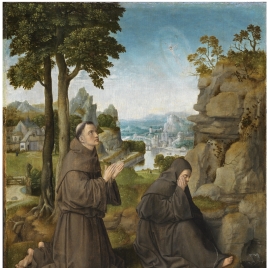
Master of Hoogstraten
This conventional name was coined in 1903 by Max Friedländer based on the traits shared by an “Adoration of the Magi” then in the collection assembled by Fritz Mayer van den Bergh, now in Antwerp (Museum Mayer van den Bergh, inv. MMB.0025), and several surviving panels of the altarpiece of the Seven Sorrows of the Virgin from the church of Saint Catherine, Sint-Katharinakerk, in Hoogstraten, now also in Antwerp (Koninklijk Museum voor Schone Kunsten, inv. 383–389), all originally ascribed to Gerard van der Meire, a legendary artist who never existed. This group continues to be the stylistic basis for the corpus of Works attributed to the Master of Hoogstraten. It was initially doubted whether this artist came from the Northern Netherlands, but both the style of the eponymous paintings and the use of a range of colours reminiscent of Gerard David situate him in Bruges. Dating him to the very late fifteenth century, Friedrich Winkler praised his expertise but also noted certain shortcomings, and identified distinctive features in his rendering of foliage, jewellery and landscape, as well as his tendency to depict blades of grass in his works. Georges Hulin de Loo drew attention to the evident influence of Antwerp artists such as Quinten Massys (1466–1530) and the so-called Pseudo-Blesius or Pseudo-Bles. Lastly, given the combination of influence visible in his works, Friedländer redefined his formal characteristics in great detail and established a complete corpus, assuming that he was one of the artists who emigrated from Bruges and settled in Antwerp.
The Master of Hoogstraten is a painter of generally small, not very firmly drawn figures, with expressions lacking in vigour, long hands and heavy draperies with little definition rendered in sweeping curves. He employs bright colours and depicts northern landscapes with a spontaneous appearance using a rather sober formal language. Despite evident borrowings from other turn-of-the-century artists, his style lacks the complexity and ambition of the landscapes of Joachim Patinir (c. 1480/85–1524) and the spatial organisation of Joos van Cleve (c. 1485–1540/41) or the contrasts developed by other masters, displaying a “comfortable and inviting warmth and closeness”. Given the absence of modern studies on him, Friedländer’s definitions remain the basis for establishing the distinguishing features of his output. The subsequent attempts to identify him with a specific painter, such as Passchier van der Mersch – a pupil of Hans Memling – according to V. N. Volskaja, or to continue to regard him as a Northern European artist specifically from Ouda, as Godefridus Johannes Hoogewerff argued, attest to the scant progress made in defining his true characteristics as an artist ((J.J. Pérez Preciado, "Fifteenth-century netherlandish painting at the Museo Nacional del Prado. Catalogue raisonné", Museo del Prado, 2024, p. 203).