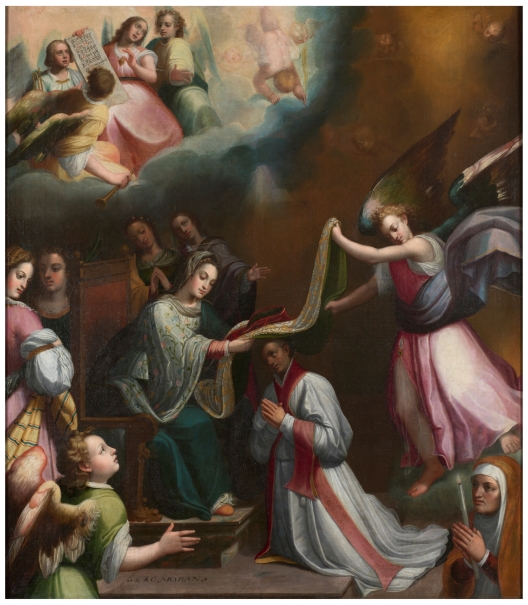
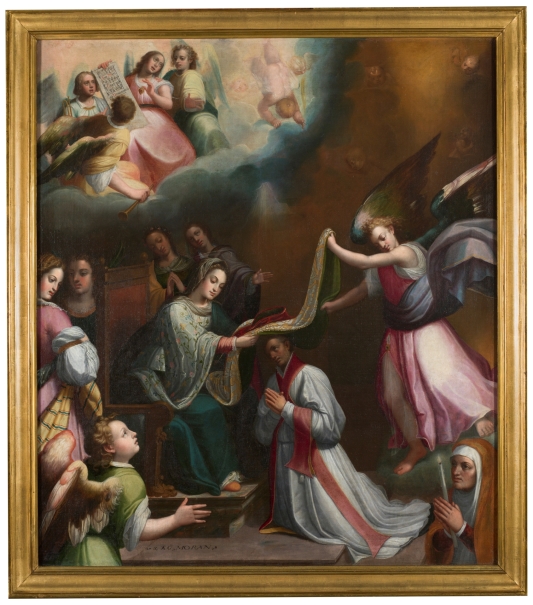
Saint Ildephonsus receiving the Chasuble
1603 - 1609. Oil on canvas.Not on display
This is the only signed work by the painter Santiago Morán the Elder, an appellation that distinguish him from his son, Santiago Morán Cisneros (c.1610–1663), an artist with little known production and linked to Vicente Carducho’s circle, as confirmed by The Presentation of the Virgin in the Temple, a painting in the Museo del Prado (P5769).
The works of Morán the Elder – who mainly worked as a portrait painter – are also scarce. The first known information about him dates from 1597 and links him in Madrid to Juan Pantoja de la Cruz, with whom he had a close relationship. In fact, Morán’s painting depended on him, not only in the figures, but also in pictorial construction and illumination. In 1609, after living in Valladolid for some time when the court moved there (1601–6), he succeeded Pantoja – who had died the year before – as a court painter for Phillip III the Pious in Madrid. As a portrait painter, the only painting that is attributable to him is The Infanta Margarita Francisca, Daughter of Philip III the Pious, now in the Museo del Prado (P001282). It is an example of the repetition of models in court-portraits by the painters who worked for the Spanish Crown.
Documentation has shown that, besides portraits, Morán made religious paintings, such as a series on the life of Christ and four stories about the Virgin that were painted in 1613 and were commissioned by the painter Mateo Serrano, who was restoring the paintings in the altarpiece of the church of the Annunciation in Robledo de Chavela in Madrid at that time. Saint Ildephonsus receiving the Chasuble is a canvas clearly parallel to Pantoja’s, signed in 1603 (P005424), with which it shares the rendition of faces, remarkably inexpressive in Morán’s canvas.
The painting illustrates the most common representation of Saint Ildephonsus’ life (607–667). He was one of the fathers of the Church, archbishop of Toledo and patron saint of this city, where his iconography was more extensively developed. As a staunch defender of Mary’s virginity, Saint Ildephonsus received a chasuble from her hands. The saint is kneeling, covered in his alb and receiving the glorious chasuble from the Virgin Mary and an angel. The painting also portrays the angels and maidens in the Marian retinue, as well as a heavenly choir and a widespread pictorial convention in late-16th-century Toledo: an old woman holding a lighted candle, which she kept until death, following a tradition established by José de Valdivieso in Auto de San Ildefonso from 1616, but which undoubtedly has a previous origin.
The canvas must have been produced after Pantoja’s and before being named a court painter by Morán.
Ruiz Gómez, Leticia, "Imposición de la casulla a san Ildefonso" en Memoria de Actividades 2016, Madrid, Museo Nacional del Prado, 2017, p.52-54