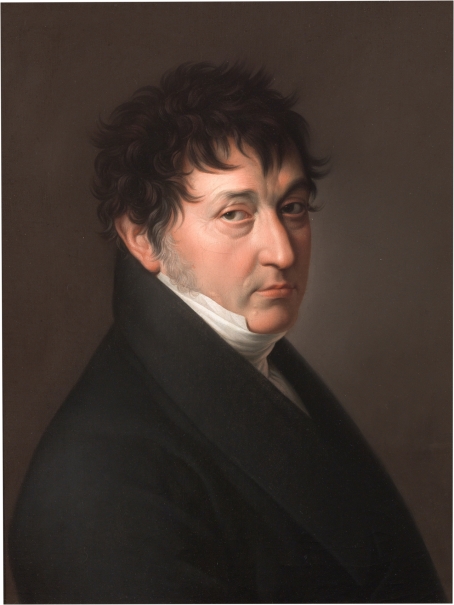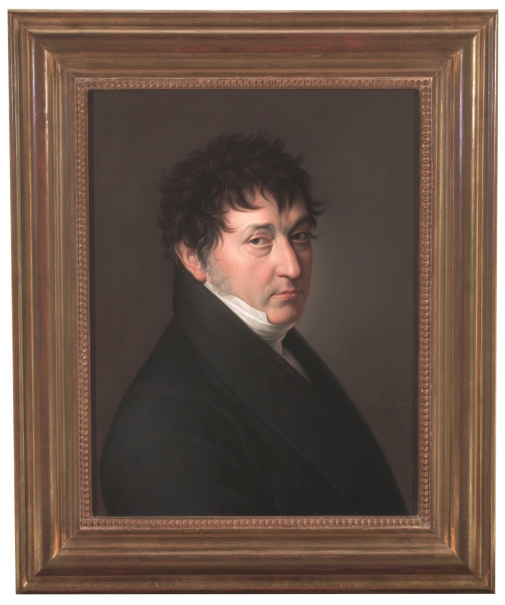
Self-portrait
1810 - 1813. Oil on canvas.Room 062A
A member of a dynasty of artists that began with his grandfather, the sculptor Pablo González Velázquez (1664-1727), Zacarías González Velázquez initially trained with his father, the painter Antonio González Velázquez (1723-94). In 1777, he joined the Royal Academy of Fine Arts of San Fernando, an institution to which he remained tied for the rest of his life, which included being named for various posts culminating in Director General, a title he held from 1828 to 1831. Likewise, his active appointment as court painter to the king was made official in July of 1802 (after he had held the title for a year in an honorary capacity), and he served in that role under Charles IV, Joseph I (Joseph Bonaparte) and Ferdinand VII. Within the parameters of official academicism, González was able to assimilate a neoclassical orientation without having left the country and he proved to be a versatile painter, producing cartoons for the Royal Tapestry Manufactory, decorating rooms in the royal palaces and churches with frescoes, in addition to executing numerous canvases of religious imagery and portraits. In this latter genre, his self-portraits stand out. Several have survived, dated between 1802 and 1823. Curiously, all are very similar with regard to composition, dress and pose, enabling us to recognise more easily the effects of time and circumstances on his person. In this self-portrait, which was owned by the artist´s descendants until it was acquired by the State in 1990, González appears to be around 50 years old. He wears a heavy, dark redingote and a white shirt with a high collar wrapped in a cravat of the same colour. It is a bust-length portrait before a neutral background, with the artist´s head turned in a three-quarter view. His expression is grave and serious, betraying a certain haughtiness that may perhaps be associated with the penetrating air that was, according to members of his family, characteristic of him. The expression is concentrated in his eyes, which have a sad and weary look, reinforced by the heavy bags under them. González´s interest in creating a highly individualistic image of himself surpasses the tendency toward idealisation that was typical of neoclassical art. He has not endeavoured to hide the creases beneath his eyebrows, nor the wrinkles in the corners of his eyes and at the centre of his brow, all signs of the painter´s age. The same may be said of the two moles near his mouth, a detail that makes it clear he used a mirror in his self-portraits, for portraits of him by others place those moles on the other side of his face, as in the painting signed by his pupil Antonio Mercar in 1828 (now in the Museu Nacional d´Art de Catalunya in Barcelona). In this work, he is unaccompanied by any attribute that would allow us to identify him as an artist, unlike his other known self-portraits or the portraits he painted of sculptors Pedro Hermoso (in the former Marquis de Casa Torres Collection) and Francisco Elías Vallejo (Royal Academy of Fine Arts of San Fernando, Madrid) around the same time; or, for that matter, the 1825 portrait of González´s brother Isidro (Royal Academy of Fine Arts of San Fernando, Madrid), by Vicente López (1772–1850). Thus, the viewer is obliged to focus on his face and head, which is endowed with a sculptural quality because of the light, which sharpens his outline against the neutral background as well as creating a sense of spatial depth. The lighting, the austere composition, sober palette and the painter´s attitude all evoke a melancholy spirit approaching that of romantic portraiture, yet the precise line and tight, minute brushwork, even in the application of shadows, root this painting in the academic current of which González was an outstanding exponent (Albarrán, V.: Portrait of Spain. Masterpieces from the Prado, Queensland Art Gallery-Art Exhibitions Australia, 2012, p. 198).