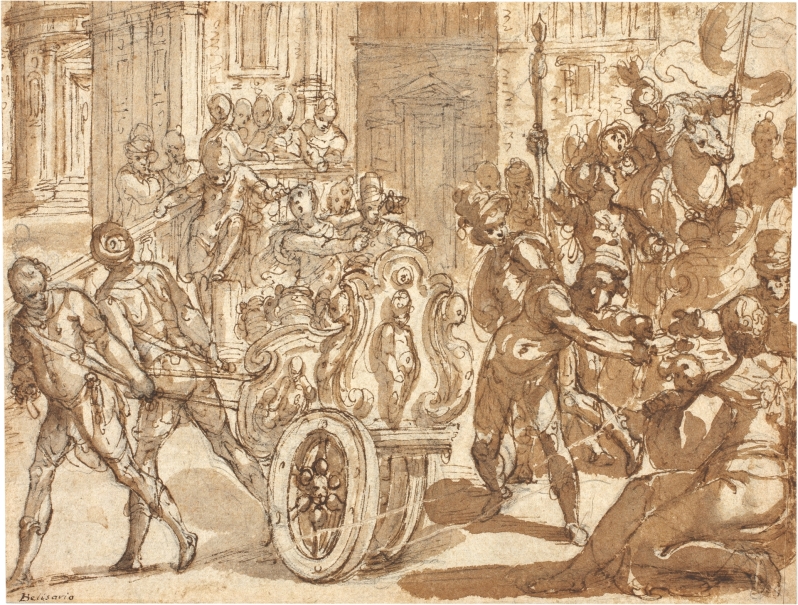
Soldiers Sacking a City
Second half of the XVI century. Grey-brown ink, Grey wash, Pencil, Pencil ground on paper.Not on display
The present, convincing attribution to the Roman Mannerist painter Giovanni de´ Vecchi, a late follower of the Zuccari is due to Florian Härb (2003). The unusual composition, with its over-abundant figures tightly packed within an oppressively narrow picture space, is in keeping with de´ Vecchi´s eccentric inventions. Epitomizing the artist´s florid imagination is the elaborate chariot in the center of the composition, its body absurdly over decorated with brackets, caryatids and the like. Borne along in this preposterous vehicle, its two wheels distorting to ovals to give a sense of speed as two soldiers pull it down the city street, is a mountain of booty.
Many of de´ Vecchi´s quirks of handling are evident in the drawing, for example the little bun-like faces of the figures, some with expressions of permanent surprise. A further stylistic trait is the use of two different shades of brown wash to denote foreground and background. This device, as well as the bun-like faces, are found in a number of the artist´s other drawings, for example the magnificent Last Judgement (New York and London, 2004, no. 8). In the Prado drawing a richer, slightly reddish brown tint is used for the soldiers and bewildered inhabitants in the right foreground, while the rest is in a lighter grey-brown. On several occasions, de´ Vecchi enlivened his designs with colored washes -purple, rose and yellow (Text drawn from Turner, N.: From Michelangelo to Annibale Carracci. A century of Italian drawings from the Prado, Art Services International-Museo Nacional del Prado, 2008, p. 124).