Still life
1849. Oil on canvas.Not on display
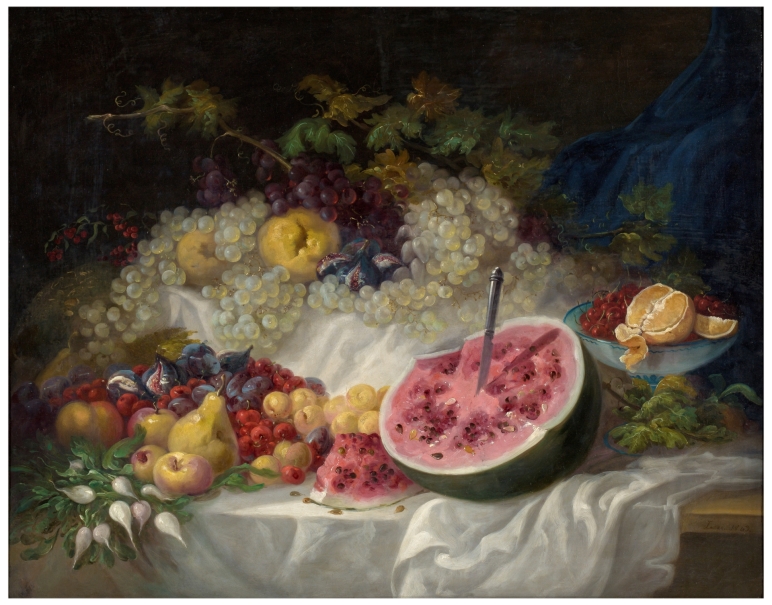
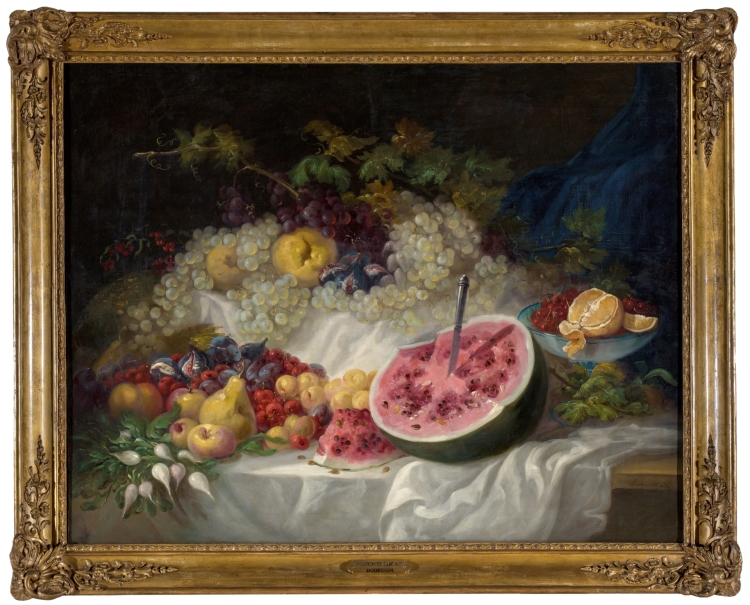
On a table covered with tablecloth lies an unorganised assortment of fruit, including grapes, pears, and apples among other fruit and blossom, the scattering dominated by a large half of watermelon, its smaller piece visible beside it, and a knife stuck in its centre.
The painting is richly expressive, almost entirely antithetical to the aesthetic of Goya’s still lifes, revealing both Velázquez’ turn away from the influence of the Arogonese master’s work, and his own move toward an evocation of the opulence of the 17th century Flemish school. Drawing inspiration from subject matter of the Flemish school, Velázquez adapts it to the passing of time, reducing the baroque prosopopoeia present in this work, despite its grandiloquent sensuality. The effect achieved, only a little short of horror vacui, seems to arise from a desire to overwhelm the spectator with this presentation of a mass possessed of no discernable design or symmetry in composition, iterating the artist’s attachment to a clearly nineteenth-century sensibility.
The artist, far removed from contemporary pictorial language, was attracted to genre scenes and the modern interpretation of eighteenth-century artistic ideals, bringing him popularity and renown. With his inclination towards the decorative still life, he brings the shine of his own talent, demonstrating a mastery of drawing and tonalities. At the same time, it reveals an ability to contrast brightly lit areas with somewhat dark spaces to achieve a preponderance of volumes over any other consideration, which determines the distinctive personality of the piece.
This painting with which thus work was paired, remains in a private collection in Madrid and has similar characteristics and the same provenance. By studying both canvases, it is noticeable how the painter successfully tackled the still-life genre, updating it without breaking with the past and achieving a pleasingly ornate effect. This is representative of the transition from the first half of the 19th century to the second, when Spain was at the height of the reign of Isabella II (1833–1868).
Luna, Juan J., El bodegón español en el Prado: de Van der Hamen a Goya, Madrid, Museo Nacional del Prado, 2008, p.154/155