formularioRDF
The itinerary <em>TITULORECORRIDO</em> has been successfully created. Now you can add in works from the Collection browser
<em>TITULOOBRA</em> added to <em>TITULORECORRIDO</em> itinerary

Close Continuar a ficha de la obra Continuar a ficha de la obra
02-06-2026
Anton Raphael Mengs

Aussig (Czech Republic), 1728 - Rome (Italy), 1779

Anton Raphael Mengs See author's file

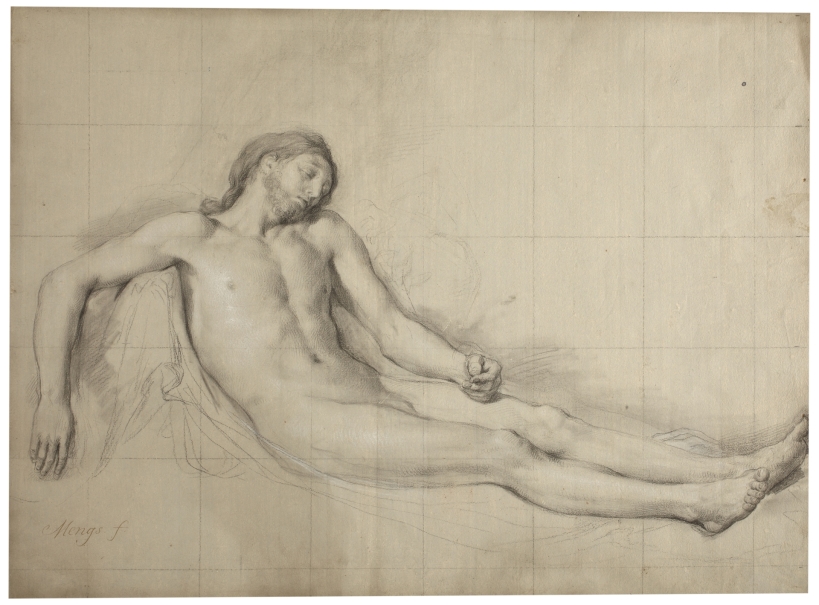
Study for the dead Christ

1768. Black chalk, Touches of white chalk on laid paper, grey prepared paper.
Not on display

Neoclassical painter Anton Raphael Mengs spent some eleven years in Spain -from 1761 to 1769, and again from 1774 to 1777- working primarily on the decoration of Madrid’s Royal Palace for King Charles III. For the king’s bedroom, Mengs made a series of easel paintings on the Passion of Christ -most importantly, Descent from the Cross, Patrimonio Nacional, on permanent loan to the Museu Nacional d’Art de Catalunya, Barcelona- which he completed in the winter of 1768-69. Study for the dead Christ, 1768, is a final study for that work, as can be seen by the grid for its transfer to a larger surface. The depiction of the main figure is a perfect example of this German painter’s mastery of drawing, and of the beauty and perfection of his figures, with unblemished skin, elegant and slender limbs and delicate hands with refined gestures.

Mengs drew on Raphael’s Christ falling on the way to Calvary, 1515-16 (Museo del Prado), both in his configuration of the Descent’s balanced composition and in the soft and expressive figures, which he conceived with a sculptural sense. Specifically, his composition of the main group is derived from a drawing by Raphael -now attributed to a follower rather than to the master himself- engraved by Sante Pacini (1735-c.1790) around 1770 (Museo Accademia Carrara, Bergamo). Following Raphael’s drawing techniques, Mengs prepared his paintings with numerous studies for both the composition and the individual figures, generating an abundance of drawings and ideas for future works. Various studies for the composition and figures in Meng’s Descent are now at the Museum Boijmans Van Beuningen, Rotterdam; the Academia de San Fernando, Madrid; the Uffizi, Florence; and the Musée des Beaux-Arts d’Orléans, among others.

In the Prado’s drawing, it is important to note how the depiction of Christ’s right arm differs from earlier surviving drawings, such as the one in Orléans. Study for the dead Christ is significant for its origin, fine state of conservation and quality. As the final drawing of the main figure in one of Mengs’s most important religious paintings, both in Spain and abroad, it must have had enormous value for collectors of his works. In Mengs’s time the collection of his works was already a veritable phenomenon, and it is likely that painter and director of the Museo del Prado José de Madrazo (1781-1859), from whose descendants this study was acquired in 2006, may have obtained it from Bernardo Iriarte, one of the artist’s enlightened admirers who owned a drawing on the same subject by Mengs and from whose collection Madrazo acquired numerous works (Cenalmor, E.: Italian Masterpieces. From Spain´s Royal Court, Museo del Prado, 2014, p. 264).
Multimedia

Technical data

Inventory number
D007826
Author
Anton Raphael Mengs
Title
Study for the dead Christ
Date
1768
Technique
Black chalk; Touches of white chalk
Support
Laid paper; Grey prepared paper
Dimension
Height: 370 mm; Width: 495 mm
Provenance
Madrazo Collection, Madrid; Daza-Campos family, Madrid; acquisition for the Prado Museum, 2006.
Entry date
2006

Bibliography +

Matilla, José Manuel, No solo Goya: adquisiciones para el Gabinete de Dibujos y Estampas del Museo del Prado: 1997-2010, Museo Nacional del Prado, Madrid, 2011, pp. 166-169 nº.35.

Cenalmor, Elena, 'Anton Raphael Mengs. Study for the dead Christ', Italian masterpieces from Spain's royal court, Museo del Prado, National Gallery of Victoria Thames & Hudson, 2014, pp. 264.

Jordán de Urries de la Colina, Javier, 'Anton Raphael Mengs. Study for the Dead Christ', Anton Raphael Mengs, 1728-1779, Museo Nacional del Prado, Madrid, 2025, pp. 216-220 n.18.

Jordán de Urríes y de la Colina, Javier, 'Rafael Sanzio y taller. Caída en el camino del Calvario. Antonio Raphael Mengs. Estudio para Cristo muerto', Antonio Raphael Mengs, 1728-1779, Museo Nacional del Prado, Madrid, 2025, pp. 216-220 n.18.

Filigree +

Motive: Doble círculo con flor de lis


58 x 58 mm
Principal
30 - Verticales
30 mm.
En el centro de la mitad derecha de la hoja
Doble círculo con flor de lis
Filigrana empleada por papeleros italianos durante las últimas décadas del siglo XVII y todo el siglo XVIII. Se ha encontrado como contramarca de Serafini Fabriano o acompañada por diferentes iniciales. También se asocia con la marca del papelero de Fabriano, Pietro Miliani (1744-1817), y con la contramarca "Vittori".

Bibliography
Heawood, Edward, Watermarks, mainly of the 17th and 18th centuries, Paper Publications Society, Hilversum (Holland), 1950, pp. pl. 218, n. 1594 (año 1785).

Other inventories +

Inv. Nuevas Adquisiciones (iniciado en 1856). Núm. 2756.

Inscriptions +

Mengs f
Inscribed in pen and ink. Front, lower left corner

Exhibitions +

Anton Raphael Mengs (1728-1779)
Madrid
25.11.2025 - 01.03.2026

Italian Masterpieces from Spain's Royal Court. Museo Nacional del Prado
Melbourne
16.05.2014 - 31.08.2014

No solo Goya. Adquisiciones para el Gabinete de dibujos y estampas del Museo del Prado 1997-2010
Madrid
05.05.2011 - 28.08.2011

Update date: 02-06-2026 | Registry created on 28-04-2015

Visor 360

Drag with the cursor to rotate the piece

Other works by Anton Raphael Mengs

Print on demand

Print artworks available in our catalogue in high quality and your preferred size and finish.

Image archive

Request artworks available in our catalogue in digital format.

Up