Surroundings of Friesland (The Netherlands)
1878 - 1884. Oil on canvas.On display elsewhere
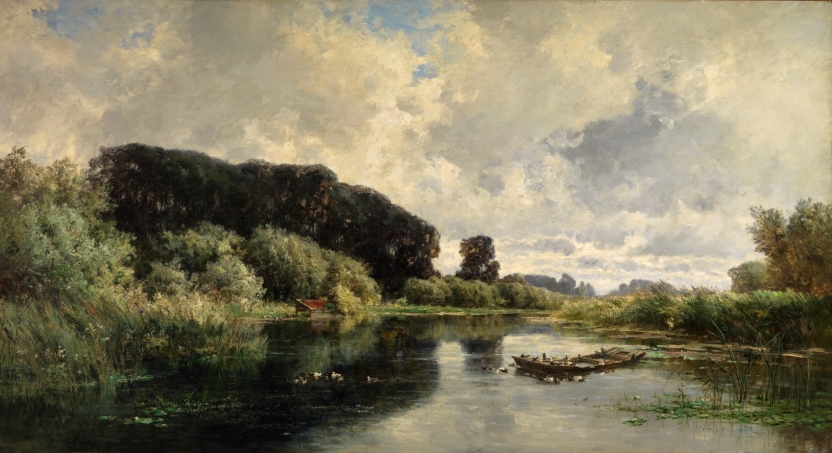
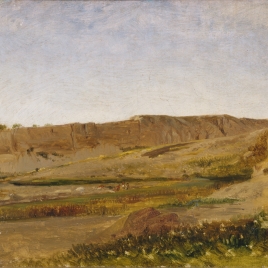
Between the two banks, which are covered with lush vegetation, there is a large lake. On the right bank, in the distance, there is a small shed for sheltering the birds. They are resting on the water or occupying a rickety barge, which is stranded among the reed beds. In the background on the left, there is a grove of leafy trees, which is offset by another, less compact grove on the right. These groves, along with the water in which they are reflected, establish sinuous lines of depth in a marked composition made up of triangular shapes. The sky is filled with abundant and moving clouds, which predict sudden environmental effects or changes. This peculiar environmental depiction is very recurrent in the painter´s later artistic works, particularly in his paintings focused on the Netherlands and Northern France, where these atmospheric phenomena occur relatively frequently.
Although the painting dates back from 1884, it is very likely to be the work that Haes unsuccessfully submitted in 1878 for the National Exhibition of Fine Arts and the Universal Exhibition in Paris, where he was awarded the highest prize. We know from Beruete that this work was the result of a long and painstaking craftmanship over time: "...It is no match for the ´Friesland Nearby´, which was awarded a gold medal at the 1878 Universal Exhibition in Paris, and, in my opinion, it is the most complete expression of this landscape painter´s talent. Haes worked on this painting, giving it a vibrant character, juicy colouring, and loose, masterly technique, unlike on any of his paintings-Not content with the success he obtained in Paris, he retouched and corrected it again, achieving with this work, done at different times, an impasto which other works of his do not have...’ Haes finished it in 1884 and submitted it, also unsuccessfully, to the National Exhibition of that year with the brief and generic title above. It is possible that after some retouching and corrections, Haes considered that this work depicted a different subject that did not correspond faithfully to what he had visualised and depicted years earlier. This hypothesis is reinforced by the fact that his presence at this exhibition was only symbolic, as the regulations in force disallowed prizes to be awarded to painters who had already won two first-class prizes at previous National Exhibitions. This was Haes´s case, so his possibility was to be nominated for a medal of honour. This was difficult to achieve for a landscape in competition with the highly valued history paintings.
Although the painting passed through the competition unnoticed, it was acquired by the State in 1884, at the end of the Exhibition. It was then transferred to the Museo Nacional de Pintura y Escultura. There, critics of the time gave it a fair rating: ‘...it was enough for the distinguished artist to execute the marvellous canvas, which is also at our Museo del Prado, depicting a lake among leafy poplar groves, to demonstrate "urbi et orbi" that he knew all styles, mastered all ways of painting and occupied the most honourable place in all artistic procedures in his own unquestionable right...’.
The Museo de Lérida holds a preparatory study entitled "Study for the painting of the Ducks of the Museo de Arte Moderno (Madrid). It focusses on the theme of the barge and the surrounding waterfowl.
Gutiérrez Márquez, Ana, Carlos de Haes en el Museo del Prado, 1826-1898: catálogo razonado, Madrid, Museo Nacional del Prado, 2002, p.332