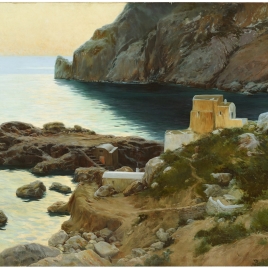
Tagus river in Toledo
1908. Oil on canvas.On display elsewhere
Andrade’s elusive silhouette slips through the interstices of his own brushstrokes. He may never be clearly perceived, and the viewer is limited to guessing where he is to be found, where his elliptical presence is sensed, in what specific excerpt of each of his landscapes this unredeemed voyeur has lodged himself, so that, once there, he may interpret the world. Indeed, there is an indisputable place where he can be found, and it is outside the painting. Because Andrade usually places himself where we are as spectators. And he does so in order to exchange his eyes with ours’ in a radical substitution of ‘seeing’ for ‘looking’. Andrade, like Auster’s Mr Vertigo, dwells with particular intensity in the empty spaces represented in his paintings. Particularly if these spaces are – irrespective of their scale – approaching a notion of ‘abyss’. This is probably due to the fact that nothing is better than the abyss to epitomize the romantic impulse for the ‘sublime’ (if we think of Friedrich as a paradigm). Perhaps, all those desires, fears, frustrations, catharsis that comprise fundamental traces of human identity are what Andrade stows in the vertiginous emptiness of his paintings once he pierces the membrane of its surface to settle – erratic and floating – in its interior. This is something that can be perceived with special intensity in several of his works, as in the case of this canvas.
Ángel Andrade: La Aventura del Paisaje 1866-1932, Cuenca, Obra Social y Cultural, 2004, p.39,67,68 y 290-291