formularioRDF
The itinerary <em>TITULORECORRIDO</em> has been successfully created. Now you can add in works from the Collection browser
<em>TITULOOBRA</em> added to <em>TITULORECORRIDO</em> itinerary

Close Continuar a ficha de la obra Continuar a ficha de la obra
02-06-2026

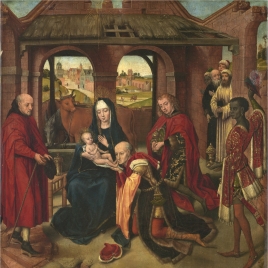
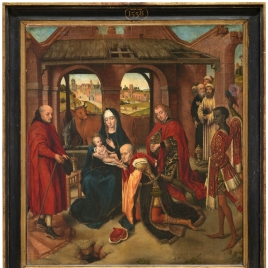
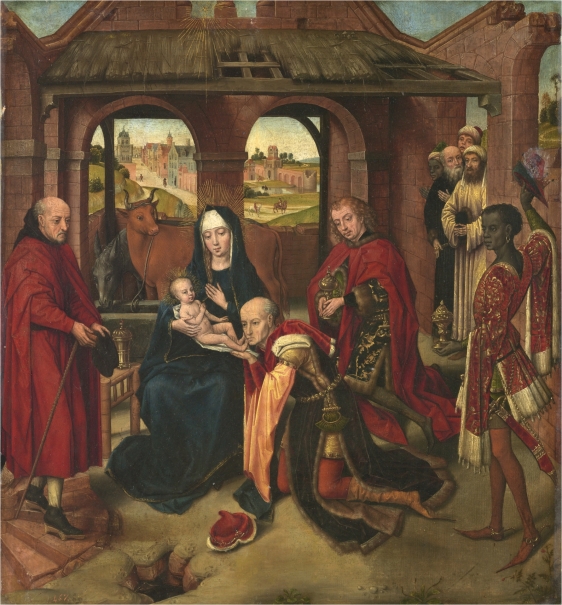
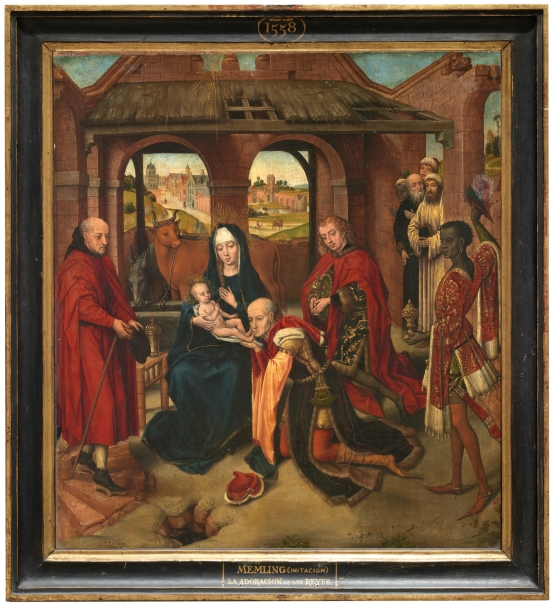
The Adoration of the Magi

1460 - 1470. Oil on baltic oak planks.
Not on display

The painting depicts the Epiphany or the Magi adoring the newborn Child. It is striking that the Child is not positioned in the centre; instead, the focal point appears to be the first magus who is kissing his feet. Mary, with the Child on her lap, presses her left hand against her chest; this pensive gesture alludes to the sacrifice of her son, lying on a white cloth that foreshadows the shroud. On the left, positioned more discreetly, Saint Joseph appears to be ascending some steps to make his appearance on the scene. He carries the flowering rod that identified him as Mary’s betrothed and a black hat. Between them on a small table stands a gold vessel, one of the Magi’s gifts. Joseph’s coarse attire contrasts with the first magus’s rich clothing, notably his gold belt with a purse, leather boots, velvet cape and the jewelled trimming on the sleeve and hem of his tunic. His hat is lying on the ground beside the chasm alluding to the “Cave of Treasures”, the spot where, according to this apocryphal text that was popular in the Middle Ages, the Magi’s gifts had been buried.

The Museum’s directors to catalogue it officially as an ‘imitation of Memling’ in 1913. From a formal viewpoint, the work is based on the central panel of the triptych executed by Rogier van der Weyden for the church of Saint Columba in Cologne, now in the Alte Pinakothek in Munich, but it also has a direct link with Memling’s own version in the Prado (P001557). Although undeniably a follower of Rogier van der Weyden, the Master of the Adoration of the Magi must be linked to another pupil, the Master of the Saint Catherine Legend.

In conclusion, taking as a basis Rogier van der Weyden’s Saint Columba Triptych, but also drawing inspiration from other works, the painter of the Adoration of the Magi adopts an approach to the theme of the epiphany that is stylistically very different from Rogier’s. He is generally more cautious or fearful, less prone – owing, perhaps, to his more limited abilities – to Van der Weyden’s displays of technical prowess to achieve a beautiful result, as is evident, for example, in the hat on the ground and the figure of the third magus. He also departs from Rogier in his excessive fondness for vertical lines – as in Saint Joseph’s clothing or the sleeves of the second and third magi – which to an extent diminishes the splendour of the Prado work. Indeed, where Rogier does employ vertical lines he does so boldly and powerfully, such as in the third magus’s trailing sleeve, forcing him to portray the figure from behind, whereas the Master of the Adoration does not dare to use such a risky formula and leaves part of the magus’s skirt visible to help mark the perspective.

Pérez Preciado, José Juan, Fifteenth-century netherlandish painting at the Museo Nacional del Prado. Catalogue raisonné, Madrid, Museo Nacional del Prado, 2024, p.156-164 nº.17
Technical data

Imagen del carrusel
Imagen del carrusel
Inventory number
P001558
Author
Master of the Prado Adoration of the Magi (Copy after: Rogier van der Weyden)
Title
The Adoration of the Magi
Date
1460 - 1470
Technique
Oil
Support
Baltic oak planks
Dimension
Height: 60 cm; Width: 55 cm
Provenance
Spanish Royal Collection (Real Monasterio de San Lorenzo, El Escorial, Madrid, capilla cuadrada del Tránsito), 1839
Entry date
1839

Bibliography +

Passavant, Johann David, Die christliche kunst in Spanien, Rudolph Weigel, Leipzig, 1853, pp. 131.

Crowe, J. A. , Cavalcaselle, G.B, The early Flemish Painters: notices of their lives and works., John Murray, Londres, 1857, pp. 299-300.

Ris, Louis-Clement de, Le Musee Royal de Madrid, Veuve de Jules Renouard, París, 1859, pp. 103-104.

Hulin de Loo, Georges, Hans Memling un Roger van der Weyden's studio, The Burlington magazine, 52, 1928, pp. 160-177.

Friedländer, Max J., Die altniederlandische malerei VI 1: Hans Memling und Gerard David, Paul Cassirer, Berlin, 1928, pp. 18-19,133.

Destree, Jules, Roger de la Pasture. Van Der Weyden.I II, G.Van Oest, Bruselas, 1930, pp. I: p.163.

Baldass, Ludwig von, Drei Jahrhunderte flämische Malerei, Pantheon, 5, 1930, pp. 130-136 [132].

Glück, Gustav, Drei Jahrhunderte vlämisher Kunst, Belvedere, 9, 1930, pp. 75-81 [77 fg.50].

Friedlander, Max J, Ein Jugendwerk Memlings, Pantheon, 7, 1931, pp. 185-187.

Friedländer, Max J., Die altniederlandische malerei XIV: Pieter Bruegel und nachträge zu den früheren bänden, A.W.Sijthoff, Leiden, 1937, pp. 102.

Memling Exhibition: organized by the Municipality in the Art Gallery of Bruges = Exposition Memling: Organisée par la Ville de Bruges au Musée Comunal de Bruges, Desclée, De Brouwer, Brujas, 1939, pp. 66 nº.21.

Friedlander, Max J., Noch etwas über das Verhältnis Roger van der Weydens zu Memling, Oud Holland, 61, 1946, pp. 11-19 [17].

Vollmer, Hans, 'Memling', Thieme, U. Beccker, F (eds) Allgemeines Lexikon der bildenden künstler von der antike bis zur gegeswart, Leipzig, 1950, pp. 347-377 [375].

Faggin, Giorgio T. (Corti, Maria), La obra pictórica completa de Memling, Noguer Rizzoli, Barcelona Madrid, 1970, pp. 93.

Friedländer, Max J., Early netherlandish painting VI 1: Hans Memling and Gerard David, A.W.Sijthoff, Praeger, Leiden, Nueva York, 1971, pp. 16,36,57 nº99c lám.125.

Sánchez Cantón, Francisco Javier, Museo del Prado. Catálogo de las pinturas, Museo del Prado, Madrid, 1972, pp. 782.

Onieva, Antonio J., La Mitologia en el Museo del Prado, Offo, Madrid, 1972, pp. 32.

Eisler, Colin T., Paintings from The Samuel H. Kress Collection: European Schools excluding Italian, The Phaidon Press, Oxford, 1977, pp. 58.

Deroubaix, Christiane, Un triptyque du Maître de la Légende de Sainte Catherine (Pieter van der Weyden?) reconstitué, Bulletin Institut royal du patrimoine artistique IRPA, 17, 1978-1979, pp. 153-174 [165-166].

Hull, Vida Joyce, Hans Memling's painting for the Hospital of Saint John in Bruges, Garland, Nueva York Londres, 1981, pp. 131 nº.24.

Garrido, Carmen; Hollanders-Favart, Dominique, Las pinturas del "Grupo Memling" en el Museo del Prado: el dibujo subyacente y otros aspectos técnicos, Boletín del Museo del Prado, V, 1984, pp. 151-171.

Museo Nacional del Prado, Catálogo de las pinturas, Museo del Prado, Madrid, 1985, pp. 775.

Hand, John Oliver; Wolff, Martha, Early Netherlandish painting. The collections of the National Gallery of art systematic catalogue, Cambridge University Press, Washington, 1986, pp. 155-161.

National Gallery of Art, Early Netherlandish painting, National Gallery of Art. Cambridge, Washington, 1986, pp. 155.

Brown, J.; Davies; D. Díaz,C. et al., Las colecciones del Rey. Pintura y escultura, Patrimonio Nacional, Madrid, 1986, pp. 147.

Castillo Aguilar, Sonsoles (Hernández Herrero, J ed.), IV Centenario del Monasterio de El Escorial. Las Colecciones del Rey. Pintura y Escultura, Dirección General de Cultura. Patrimonio Nacional, Madrid, 1986, pp. 147.

Museo Nacional del Prado, Museo del Prado. Inventario general de pinturas (I) La Colección Real, Museo del Prado, Espasa Calpe, Madrid, 1990, pp. nº467.

Vos, Dirk de, Hans Memling. L'Oeuvre Complet, Fonds Mercator / Ludion, Amberes, 1994, pp. 347-348.

Silva Maroto, Pilar, Pintura flamenca de los siglos XV y XVI: guía, Museo del Prado, Aldeasa, Madrid, 2001, pp. 68-69.

Campbell, Lorne y Stock, Jan van der, Rogier van der Weyden 1400-1464 : master of passions, Waanders Uitgeverij: Davidsfonds, Zwolle, Lovaina, 2009, pp. 364-369.

Hand, John Oliver, 'Maître de l'Adoration du Prado. 'Trois fragments d'un retable' En:, L'héritage de Rogier van der Weyden. La peinture à Bruxelles 1450-1520, Lannoo. Musées Royaux des Beaux Arts de Belgique, Tielt, 2013, pp. 128-131 n.14.

Pérez Preciado, José Juan, "Restituir la paternidad de algunas tablas muy bellas". Sobre las atribuciones históricas de la pintura neerlandesa antigua en el Museo del Prado (1819-1912)., Boletín del Museo del Prado, XXXII, 2014, pp. 13.

Pérez Preciado, José Juan, "Antes morir que discutir". Sobre las atribuciones históricas de la pintura neerlandesa antigua en el Museo del Prado (1912-33), Boletín del Museo del Prado, XXXVII (55-57), 2019-2021, pp. 190-211 [208].

Pérez Preciado, José Juan, Pintura flamenca del siglo XV en el Museo Nacional del Prado. Catálogo razonado, Museo Nacional del Prado, Madrid, 2024, pp. 156-164 nº.17.

Pérez Preciado, José Juan, Fifteenth-century netherlandish painting at the Museo Nacional del Prado. Catalogue raisonné, Museo Nacional del Prado, Madrid, 2024, pp. 156-164 nº.17.

Other inventories +

Catálogo Museo del Prado, 1854-1858. Núm. 467.

Inv. Real Museo, 1857. Núm. 467.
Hammeling (Juan ó Hans) / 467. Adoracion de los magos. (e.) (tabla.) / Alto 2 pies, 1 pulg, 6 lin; ancho 1 pie, 11 pulg, 6 lin.

Catálogo Museo del Prado, 1872-1907. Núm. 1425.

Catálogo Museo del Prado, 1910. Núm. 1558.

Catálogo Museo del Prado, 1942-1996. Núm. 1558.

Inscriptions +

Adoración de los Santos Reyes / al niño Dios. / Este cuadro procede del Escorial y / estaba en la capilla cuadrada del Transito / qe está detrás de la silla prioral / Lucas de Olanda
Handwritten label in black ink. Back, lower area

Museo del Prado/ núm. 1558/ Adoración de los Magos/ Entrada 15 marzo de 1929/ Trabajo: Restauración y limpieza/ a cargo de D. Vicente Jover y Picó/ Salida 5 Abril 1929
Handwritten label in black ink. Back, Upper area

Exhibitions +

The Heritage of Rogier van der Weyden Painting in Brussels 1450-1520
Bruselas
10.10.2013 - 22.11.2013

Roger van der Weyden. Master of Passions
Lovaina
18.09.2009 - 06.12.2009

Update date: 02-06-2026 | Registry created on 28-04-2015

Visor 360

Drag with the cursor to rotate the piece

Print on demand

Print artworks available in our catalogue in high quality and your preferred size and finish.

Image archive

Request artworks available in our catalogue in digital format.

Up