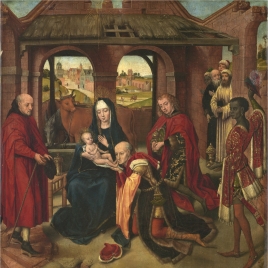
Master of the Prado Adoration of the Magi
act.1460, 1470This designation was coined by modern historians based on the establishment in 1928 of a group of three works by an anonymous artist with formal links to followers of Rogier van der Weyden: the “Adoration of the Magi” in the Museo del Prado, an “Annunciation” of which all that remains is a fragment displaying the Virgin, which was formerly in a private collection and is now housed in the Burrell Collection in Glasgow, and a “Presentation in the Temple” then located in the Czernin collection in Vienna and currently in the National Gallery of Art in Washington. Georges Hulin de Loo believed that together all three would have made up a version of Van der Weyden’s “Saint Columba Triptych” which was executed by Memling during his early years, after he first came into contact with Rogier’s workshop. Soon afterwards, Max Friedländer, although somewhat reluctantly – for he failed to see Memling’s hand in those paintings – ended up incorporating other works into the group, such as the “Nativity” then in circulation on the art market and now in Birmingham Museum and Art Gallery, and a “Rest on the Flight into Egypt” then in a private collection in Paris and currently in the Burrell Collection in Glasgow, coming round to the idea that the ensemble had been painted by a young Memling.
However, despite being initially accepted by many authors, Memling’s authorship was progressively questioned and alternative names were suggested, all of them pupils of Rogier such as Vrancke van der Stockt (before 1420–1495), to whom a few of the works were eventually ascribed.
These doubts led Martha Wolff to attribute the group to a conventionally named artist she called the Master of the Prado Adoration of the Magi given the prominence of the Madrid panel within the group. This artist must have worked in Van der Weyden’s workshop during the final years of the master’s career as his paintings repeat many motifs from Rogier’s body of work, though he appears to have been equally familiar with the oeuvre of Hans Memling. In Van der Weyden’s studio he would likewise have been in very close contact with the Master of the Legend of Saint Catherine, with whom his pictures have much in common (J.J. Pérez Preciado, "Fifteenth-century netherlandish painting at the Museo Nacional del Prado. Catalogue raisonné", Museo del Prado, 2024, p. 155).