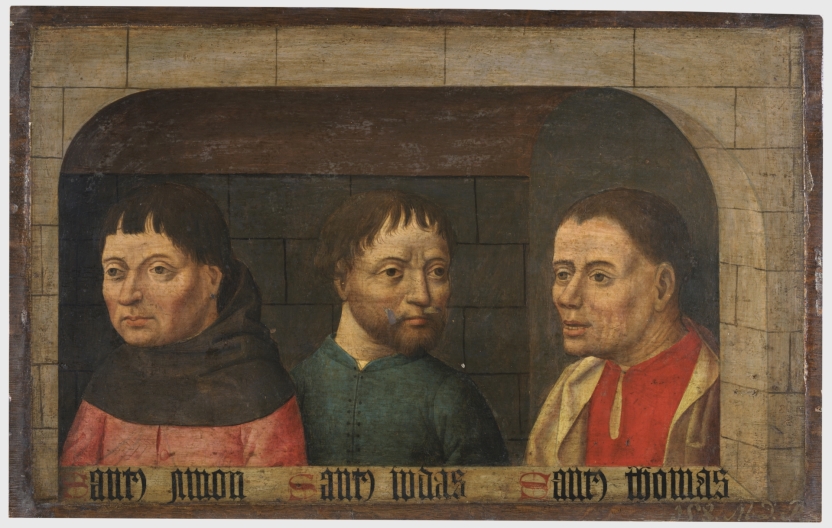
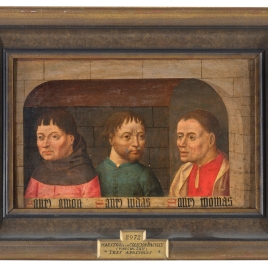
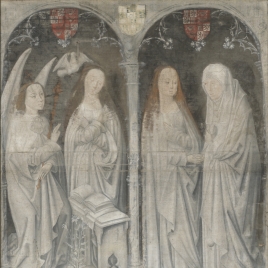
The Apostles Simon, Judas and Thomas
After 1481. Mixed method on panel.Not on display
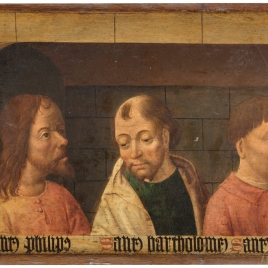
The panels displays a group of three bustlength apostles inside a sort of niche or vaulted stonework gallery. It is highly likely that the two panels (this work and P002971) come from the predella of the ltarpiece in the funerary chapel of Alonso Sánchez de Logroño in the monastery of San Benito el Real in Valladolid, whose coat of arms is displayed on the central panel.
So far a thorough technical study has only been conducted on the Prado panels, demonstrating that they were executed in the Netherlands. This proves in principle that the ensemble is an imported work, as scholars have lately maintained, and not the result of the influence of Flemish painting on a Spanish artist. The altarpiece’s predella at least was executed by a follower of Memling in Northern Europe as opposed to in Spain. Memling’s influence is especially visible in the handling of the figures. Also characteristic of Memling is the interest in integrating the figures into the setting, be it a landscape or architecture – as in this case, where the apostles are suggestively placed in a vaulted gallery.
The Prado panels belonging to the dismembered altarpiece from the monastery of San Benito in Valladolid were painted in the Netherlands by an artist linked to the workshop of the Master of the Saint Lucy Legend. Their poor execution compared to the master’s main paintings suggests that they were produced by a member of the studio, whereas the central panel of the retable is much closer to the standard of expertise associated with this artist. This circumstance opens up new avenues that may shed light on a painter referred to until now as the Pacully Master or Master of Saint Ildefonso. However, extensive research, from the approach of his connection with the Master of the Saint Lucy Legend, would be required to clarify the corpus of works that have been ascribed to the various names by which he is known. In addition, it may be confirmed that the retable was commissioned directly from Bruges by a client in Castile, though unfortunately it remains to be clarified how the assignment came about and who the intermediary was who made it possible.
The patron, Juan Alfonso de Logroño, was a canon of Seville cathedral and a servant of archbishop García Enríquez Osorio. An important cultural figure who possessed a large library which and commissioned the writing of two books about Saint Isidore. This connection would account for his efforts to create a chapel dedicated to Saint Ildefonso, a follower of Saint Isidore of Seville, for his brother Alonso’s tomb at the monastery of San Benito El Real in Valladolid – a church under Alonso’s patronage and to which he had given his important library – and above all the commissioning of the altarpiece on this subject. Whatever the case, the retable shows that artistic creations from the Netherlands were sought after in Castile and imported.
Pérez Preciado, José Juan, Fifteenth-century netherlandish painting at the Museo Nacional del Prado. Catalogue raisonné, Madrid, Museo Nacional del Prado, 2024, p.246-251 nº.29