Annunciation and Visitation
Before 1471. Tempera on twill / twill weave canvas.Not on display
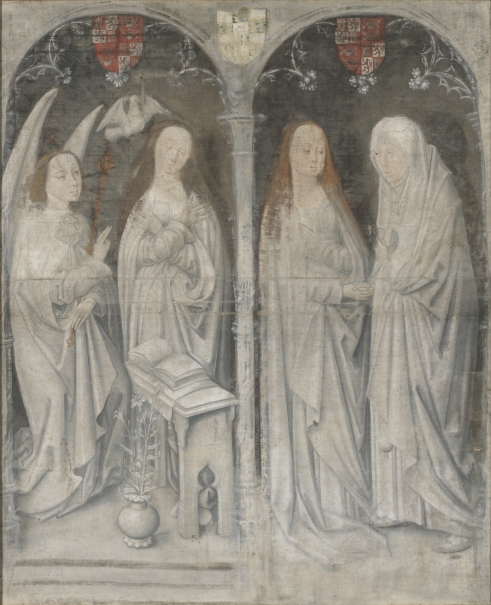
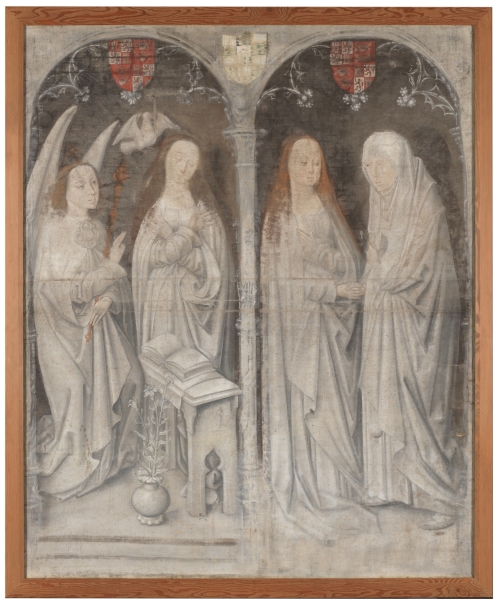
The picture illustrates two biblical scenes from the life of the Virgin, the Annunciation and the Visitation, painted on the canvas in grisaille. The monochrome of the whitish-grey figures and the fact they are located beneath two arches separated by a central column créate an interplay between real scenes and sculptural representations that was very much to the liking of Rogier van der Weyden, as in the Durán Madonna in the Prado(P002722), and the Master of Flémalle, as in the Saint James the Elder and Saint Clare wings of the Betrothal of the Virgin, also in the Prado (P001887).
The heraldic shields provide essential information about the painting’s possible origin. The escutcheon above the central column is that of the Velasco family and the scenes are topped with the arms of the Manrique family, quartered with those of Castile and León. Although the central shield is almost completely devoid of colour, the two side escutcheons preserve their very vivid shade of red. Despite their different condition, the escutcheons are not later additions as the technical study confirmed that they were included in the initial design. Their presence suggests that the work was linked to these families, specifically to Pedro Fernández de Velasco (c. 1399–1470) and his wife Beatriz Manrique de Lara,great-granddaughter of Henry II – a parentage that would account for the inclusion of the royal arms alongside hers on the escutcheons. Based on these facts, some authors such as Bermejo speculated on the possibility the work was commissioned by the couple’s son, Pedro Fernández de Velasco y Manrique, first hereditary constable of Castile (c. 1425–1492). Others, like Felipe Pereda, consider it more likely to be linked to Beatriz Manrique herself, a great patron of the arts, whose commissioning of two Flemish altarpieces for the funerary chapel in the church of the convent of Santa Clara de Medina de Pomar is documented in her will of 1471.
The links and aesthetic interests make it possible to continue to associate this tüchlein with the city of Bruges and with the circle of certain followers of Memling: iconographically it has much in common with the models of the Master of the Saint Ursula Legend, whereas, as was pointed out some time ago, it is formally much closer to the oeuvre of the Master of the Saint Lucy Legend, who collaborated with Memling on a few of his representations. The painting must have been executed before 1471 given its plausible link with the works painted for the church of the convent of Santa Clara in Medina de Pomar, notably the Flemish pieces commissioned by Beatriz Manrique de Lara according to her will made that year. However, this circumstance and the possible connection with the Washington Mary, Queen of Heaven as pictures belonging to the same ensemble continue to be very likely but as yet unproven.
Pérez Preciado, José Juan, Fifteenth-century netherlandish painting at the Museo Nacional del Prado. Catalogue raisonné, Madrid, Museo Nacional del Prado, 2024, p.239-245 nº.27