Bibliography +
Passavant, Johann David, Die christliche kunst in Spanien, Rudolph Weigel, Leipzig, 1853, pp. 141.
Ris, Louis-Clement de, Le Musee Royal de Madrid, Veuve de Jules Renouard, París, 1859, pp. 100-101.
Waagen, Gustav Friedrich, Über in Spanien vorhandende Bilder, Miniaturen und Handzeichnungen I, Jahrbücher für Kunstwissenschaft, 1868, pp. [48-49].
Robinson, John Charles, Memoranda on fifty pictures selected from a collection of works of the ancient masters, Whittingham and Wilkins, Londres, 1868, pp. 55.
Justi, Carl, Juan de Flandes, ein niederlandischer hofmaler Isabella der Katholichen, Jahrbuch der königlich preussischen kunstsammlugen, 8, 1887, pp. 157-169 [168-169].
Hymans, Henry, Les Musées de Madrid. Le Musée du Prado IV,V VI, Les écoles du nord. Les primitifs, Gazette des Beaux-Arts. La chronique des arts, 9, 1893, pp. 374-391 [383 y ss].
Lefort, P., Hymans, H., Lostalot, A., Mabilleau, L., Maindron, M., Les Musées de Madrid. Le Prado, San Fernando, L'Armeria, Gazette des Beaux Arts, Paris, 1896, pp. 51, 53-56.
Tschudi, Hugo von, Der Meister von Flémalle, Jahrbuch der königlich preussischen kunstsammlugen, 19, 1898, pp. 23-26.
Huysmans, J.K., Trois Primitifs, Leon Vanier, Paris, 1905, pp. 123.
Hasse, C., Roger van der Weyden und Roger van Brügge mit ihre schulen, J. H. Ed. Heitz (Heitz & Mündel), 1905, pp. 80-82.
Voll, Karl, Die Altniederländische Malerei von Jan van Eyck bis Memling: ein
entwicklungsgeschichtlicher Versuch, Pöschel & Kippenberg, Leipzig, 1906, pp. 97-98.
Fierens-Gevaert, Hippolyte, Les primitifs flamands (La peinture en Belgique: musées,
églises, collections etc) I, G.van Oest, Bruselas, 1908, pp. 66-61.
Justi, Carl, Miscellaneen aus drei Jahrhunderten spanischen Kunstlebens I, G. Grote, Berlín, 1908, pp. 331-334.
Hulin de Loo, Georges, Jacques Daret's Nativity of Our Lord, The Burlington magazine, 19, 1911, pp. 281-225 [225].
Lafond, Paul, Roger van der Weyden, G.van Oest, Bruselas, 1912, pp. 99.
Laford, Paul, Roger Van Der Weyden, G.Van Oest & Cie, Bruselas-Paris, 1912, pp. 99.
Winkler, Friedrich, Der Meister Von Flemalle Und Rogier Van Der Weyden. Studien zu ihren Werken und zur Kunst ihrer Zeit mit mehreren Katalogen zu Rogier, J.H.Ed.Heitz (Heitz & Mundel), Estrasburgo, 1913, pp. 146.
Conway, William Martin, The Van Eycks and Their Followers, John Murray, Londres, 1921, pp. 112-114.
Friedländer, Max J., Die altniederlandische malerei II: Rogier van der Weyden und the Meister of Flémalle, Paul Cassirer, Berlín, 1924, pp. 72-73,108.
Schmarsow, August, Robert van der Kampine und Roger van der WEyden. Kompositionsgezetze des Mittelalters in der Nordeuropäischen Renaissance, Abhandlungen der Sachsischen Akademie der Wissenschaften zu Leipzig Philologisch-Historische Klasse. 39.2, Leipzig, 1928, pp. 41-44.
Destrée, Jules, Le Maître dir de Flémalle: Robert Campin, La revue de l'art ancien et moderne, 53, 1928, pp. 82-84.
Renders, Emile, The Riddle of the Maitre de Flemalle, The Burlington magazine, 54/55, 1929, pp. 285-305 [303].
Carpenter, William Hookham, Mémoires et documents inédits sur Antoine Van Dyck, P. P. Ru, imprimerie de J.-E. Buschmann, éditeurchez K. Fuhr, Paris.Bruselas, 1930, pp. 119.
Renders, Emile, La solution du problème: Van Der Weyden, Flémalle, Campin. I, Firme Charles Beyaert, Brujas, 1931, pp. T.II pg.31,32,87.
Tolnay, Charles de, Zur Herkunft des stils der van Eyck, Münchner Jahrbuch der bildenden Kunst, 9, 1932, pp. 320-338 [331-332].
Sánchez Cantón, Francisco Javier, Museo del Prado. Catálogo, Museo del Prado, Madrid, 1933, pp. 391-392.
Tolnay, Charles de, Le Maître de Flémalle et les frères van Eyck, Editions de la Connaissance, Bruselas, 1939, pp. 17,25-26, 55-56 nº2.
Lozoya, Juan de Contreras y López de Ayala, Marqués de, Historia del arte hispánico, Salvat, Barcelona, 1940, pp. 274.
Beenken, Hermann, Rogier van der Weyden, Bruckmann, Munich, 1951, pp. 21-22.
Stoute, Ph, Bourgondische Pracht, Riksmuseum, Amsterdam, 1951.
Baldass, Ludwig, Jan Van Eyck, Phaidon Publishers Inc, Londres, 1952, pp. 17.
Lassaigne, Jacques, La Peinture Flamande. Le Siecle de Van Eyck, Albert Skira, Genova, 1957, pp. 24.
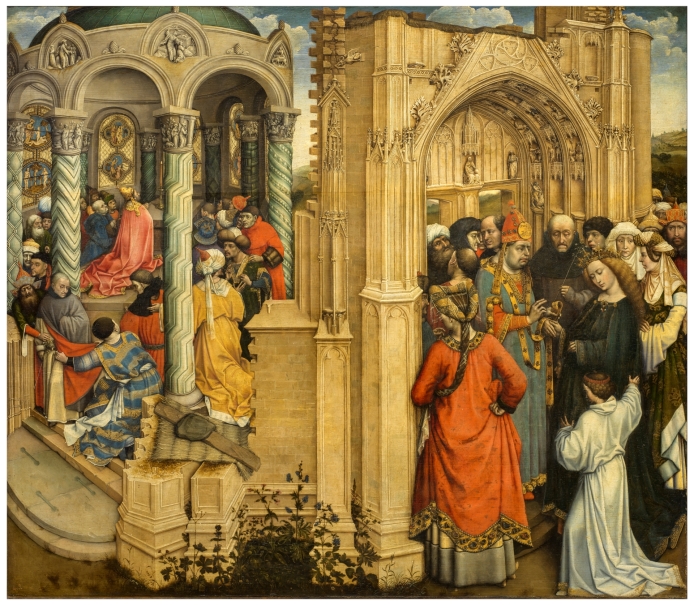
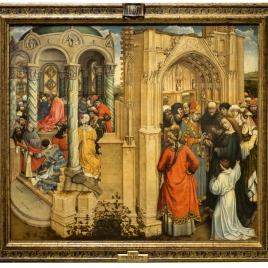
Fischel, Lilli, Die Vermählung Mariä des Prado zu Madrid, Bulletin des Musées Royaux des Beaux-Arts de Belgique., 7, 1958, pp. 3-17.
Birkmeyer, Karl M, The Arch Motif in Netherlandish painting of the Fifteenth Century: Part One, The Art bulletin, 43, 1961, pp. 1-20 [10-11].
Tüngel, Richard, 400 Jahre Kunst, Kultur, und Geschichte im Prado, Schweizer Verlagshaus, Zurich, 1964.
Dohmann, Albrecht, Die Altniederlandische Malerei des Funfzehnten Jahrhunderts, E.A.Seemann BuchUnd Kunstverlag, Leipzig, 1964, pp. lám.58.
Frinta, Mojmirs, The Genius of Robert Campin, Mouton & Co, La Haya-Paris, 1966, pp. 61-64 lám.60.
Friedländer, Max J., Early netherlandish painting II: Rogier Van der Weyden and the Master of Flémalle, Leyden, 1967, pp. 70,90,97 nº51 [o.r.nº84].
Sonkes, Micheline, Le dessin sous-jacent chez Roger van der Weyden et le problème de la personalité du Maître de Flémalle, Institut royal du patrimoine artistique IRPA. Koninklijk Instituut voor het Kunstpatrimonium, XIII, 1971-1972, pp. 161-206 [198-200 f.20].
Panofsky, Erwin, Early netherlandish painting: its origins and character T.I (Text) T.II (Plates), Icon Editions, Nueva York, 1971, pp. T.I: 136,160-162,175; T.II: Lám.86.
Smith, Graham, The Beretrothal of the Virgin by the Master of Flemalle, Pantheon, 30, 1972, pp. 115-132.
Davies, Martin, Rogier Van Der Weyden: an essay, with critical catalogue of painting assigned to him and to Robert Campin, Phaidon, Londres, 1972, pp. 256-257 l.147-149.
Sánchez Cantón, Francisco Javier, Museo del Prado. Catálogo de las pinturas, Museo del Prado, Madrid, 1972.
Campbell, Lorne, Robert Campin, the Master of Flémalle and the Master of Meróde, The Burlington magazine, 116, 1974, pp. 634-643 [641-643].
Bermejo, Elisa, La pintura de los primitivos flamencos en España I, C.S.I.C., Instituto Diego Velázquez, Madrid, 1980, pp. 83-84.
Musper, H.T., Netherlandish Painting From Van Eyck To Bosch, Harry N.Abrhams Inc., Nueva York, 1981, pp. 13/ lám.11.
Menéndez Pidal, Ramón, Historia de España. Vol. XVII. La España de los Reyes Católicos, Espasa Calpe, Madrid, 1983, pp. 258.
Erlande-Brandenburg, Alain, L'art gothique, Éditions d'Art Lucien Mazenod, Paris, 1983, pp. 436.
Harbison, Craig, Realism and symbolism in early flemish painting, THE METROPOLITAN MUSEUM OF ART BULLETIN, 41, 1984, pp. 594,595.
Museo Nacional del Prado, Catálogo de las pinturas, Museo del Prado, Madrid, 1985, pp. 112-113.
Carroggio, Fernando, Historia del Arte, Carroggio S.A., Barcelona, 1985, pp. 90.
Pächt, Otto, Van Eyck. Die Begrunder Der Altnieder Landischen Malerei, Prestel, Munich, 1989, pp. 66/ lám.41.
Firmenich-Richartz, Eduard, Rogier van der Weyden, der Meister von Flémalle. Ein Beitrag zur Geschichte der vlämischen Malerschuleder, Zeitschrift für bildende Kunst, 10, 1989-99, pp. 1-12, 129-144 [12].
Balis, A (dir.), La pintura flamenca en el Prado, Ibercaja Fonds Mercator, Amberes, 1989, pp. 24-27.
Museo Nacional del Prado, Museo del Prado. Inventario general de pinturas (I) La Colección Real, Museo del Prado, Espasa Calpe, Madrid, 1990, pp. nº409.
Asperen de Boer, J.R.J; Dijkstra,J.; Schoute, R.van, Underdrawing in Paintings of the Rogier van der Weyden and Master of Flémalle Groups, Waanders, Zwolle, 1992, pp. 12-15,88-95.
Les primitifs flamands et leur temps, La Renaissance du Livre, Belgique, 1994, pp. 213.
Pächt, Otto, Van Eyck and the Founders of Early Netherlandish Painting, Harvey Miller Publishers, London, 1994, pp. 66.
Dijkstra, Jeltje, Le Maître de Flémalle, Jacques Daret et Rogier van der Weyden»,, en Brigitte de Patoul y Roger van Schoute
(eds.), Les Primitifs flamands et leur temps, Bruselas / Lovaina la Nueva, 1994, pp. 311-361 [324].
Châtelet, Albert, Robert Campin, le Maitre de Flemalle La Fascination du quotidien, Fonds Mercator, Anvers, 1996, pp. 199-206, 299-300.
Garrido, Carmen, 'The Campin group paintings in the Prado', en Susan Foister, Susie Nash (eds) Robert Campin. New directions in scholarship, Turnhout, 1996, pp. 62-66.
Kemperdick, Stephan, Der Meister von Flémalle die Werkstatt Robert Campins und Rogier van der Weyden (Ars Nova, 2),, Brepols, Turnhout, 1997, pp. 100-112.
Panofsky, Erwin, Los primitivos flamencos, Ediciones Catedra, Madrid, 1998, pp. 162/ lám.54,55.
Vos, Dirk de, Rogier Van Der Weyden: The complete works, Harry N. Abrams, New York, 1999, pp. 78/ lám.89.
Silva Maroto, Pilar, Pintura flamenca de los siglos XV y XVI: guía, Museo del Prado, Aldeasa, Madrid, 2001, pp. 62-65.
Thürleman, Felix, Robert Campin : a monographic study with critical catalogue, Prestel, Munich, 2001, pp. 55, 279/ lám.36.
Thürlemann, Felix, Robert Campin: a monographic study with critical catalogue, Prestel, Munich, 2002, pp. 309-312 nº II D.I.
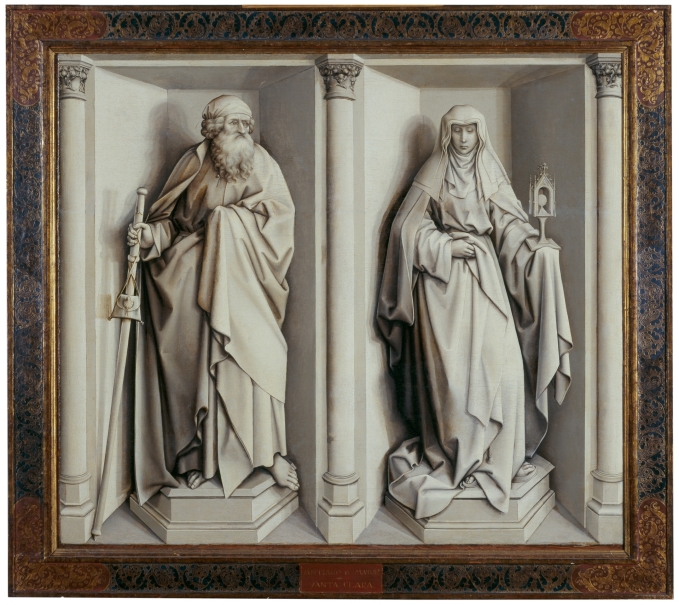
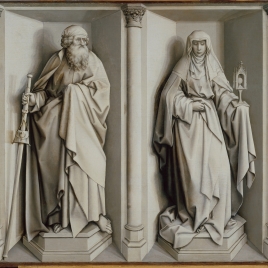
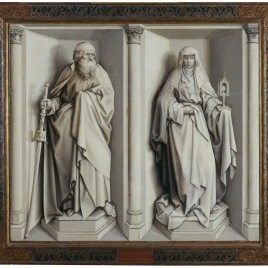
Alba, Laura, 'Santiago el Mayor y Santa Clara de Asis. Robert Campin.' (reverso de 'Los Desposorios de la Virgen'), G.Finaldi y C.Garrido. El trazo oculto. Dibujos subyacentes en pinturas de los siglos XV y XVI, Museo Nacional del Prado, Madrid, 2006, pp. 66-77 nº 1.
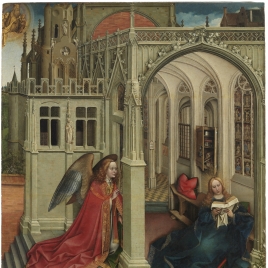
Nys, Ludovic, "Le maître de Flémalle à Gand: À propos du marriage de la Vierge et de L´Annonciation du Musée du Prado.", Campin in context.Peinture et société dans la vallée de l’Escaut à l'époque de Robert Campin.Actes du Colloque international U.Valenciennes,IRPA,2006, 2007, pp. 239-254 fig.10.
Kemperdick,S. Sanders, J., Der Meister von Flémalle und Rogier van der Weyden, Hatje Cantz, Ostfildern, 2008, pp. 224-233.
Campbell, Lorne y Stock, Jan van der, Rogier van der Weyden 1400-1464 : master of passions, Waanders Uitgeverij: Davidsfonds, Zwolle, Lovaina, 2009, pp. 135.
Alba, Laura, El Maestro de Flémalle en el Museo Nacional del Prado. Nuevas consideraciones técnicas, Boletín del Museo del Prado, XXVII, 2009, pp. 6-25.
Das Stundenbuch der Katerina von Kleve : MS M. 917 und MS M. 945, The Pierpoint Morgan Library, Faksimile Verlag, Munich, 2009, pp. /19.
Bertani, Guido; Garriido, Carmen, El nacimiento de una pintura, de lo visile a lo invisible, Consorci de Museus de la Comunitat Valenciana, 2010, pp. 68-77.
García-Frías Checa, Carmen, 'De la grandeza y variedad de la pintura que hay en esta casa' La colección pictórica de Felipe II en El Monasterio de El Escorial, De El Bosco a Tiziano: arte y maravilla en El Escorial, Patrimonio Nacional, Madrid, 2013, pp. 35-51 [40].
Greub-Fracz, Krystyna., Die Grisaillen des Genter Altars. Altniederländische Skulpt..., Michael Imhof Verlag, 2014, pp. 122, 136-142, 150 L.68 L.80.
Pérez Preciado, José Juan, "Restituir la paternidad de algunas tablas muy bellas". Sobre las atribuciones históricas de la pintura neerlandesa antigua en el Museo del Prado (1819-1912)., Boletín del Museo del Prado, XXXII, 2014, pp. 10, 14, 15, 23.
Reyniers, Jeroen, Onbekend maakt onbemind. Een vijftiende-eemus schiderij in de stijl van Rogier van der Weyden in de Antwerpse kathedraal., Revue belge d'archéologie et d'histoire de l'art, LXXXIV, 2015, pp. 57-123 [83 f.18].
Pérez Preciado, José Juan, "Antes morir que discutir". Sobre las atribuciones históricas de la pintura neerlandesa antigua en el Museo del Prado (1912-33), Boletín del Museo del Prado, XXXVII (55-57), 2019-2021, pp. 190-211 [208].
Pérez Preciado, José Juan, Fifteenth-century netherlandish painting at the Museo Nacional del Prado. Catalogue raisonné, Museo Nacional del Prado, Madrid, 2024, pp. 174-184 nº.19.
Pérez Preciado, José Juan, Pintura flamenca del siglo XV en el Museo Nacional del Prado. Catálogo razonado, Museo Nacional del Prado, Madrid, 2024, pp. 174-183 nº.19.