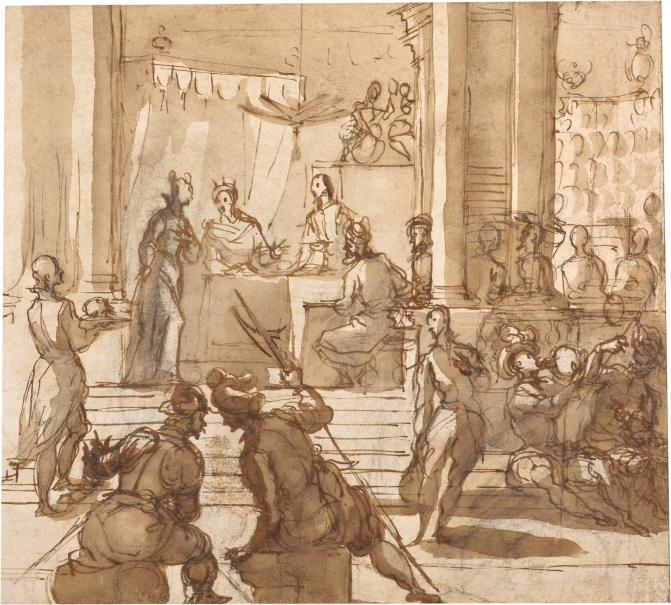
The Banquet of Herod
Early Finales del siglo XVI - XVII century. Wash, Pencil ground, Grey-brown ink, Pencil on paper.Not on display
Maganza´s work belongs to the mainstream of painting in the Veneto during the last years of the sixteenth century and the first decades of the seventeenth. His drawings, especially, reveal the influence of both Antonio Zelotti (1526-1578) and, more importantly, Hans Rottenhammer (1564/65-1625), the German-born painter who established a studio in Venice shortly before 1600, where he resided for a number of years. Rottenhammer, whose graphic skills Maganza was evidently keen to emulate, was among the most accomplished draftsmen then active in the city.
In this attractive and compelling study, there are several echoes of Rottenhammer´s unmistakable, slightly elongated figure types. On the other hand, the monumental scale of the setting and the complexity of the figural design show that Maganza was also looking to the example of Tintoretto (1519-1594) and Veronese (1528-1588). Further inspiration is owed to the work of an artist active beyond the Veneto: the Brescian, Girolamo Romanino (1484/87—c. 1560), whose memorable representations of richly clad knights and ladies helps explain the conception in the drawing of the group of soldiers carousing at the table in the right middle ground, as well as the pair in the left foreground, in sharp contra luce, seated with their backs to the spectator.
The religious subject matter seems to take second place to the representation of the imposing, dramatically lit domestic interior. Salome stands in front of Herod, to the left of the table, as a servant behind her carries in the platter with St. John´s head. Apart from the two soldiers muttering to each other in the foreground and the young man, to the right of center, who raises his left hand in a gesture of shock, the rest of the company seems oblivious to the event.
Turner, Nicholas, From Michelangelo to Annibale Carracci. A century of Italian drawings from the Prado, Chicago, Art Services International, 2008, p.164,312