The children of the Lara family
1832. Oil on canvas.Not on display
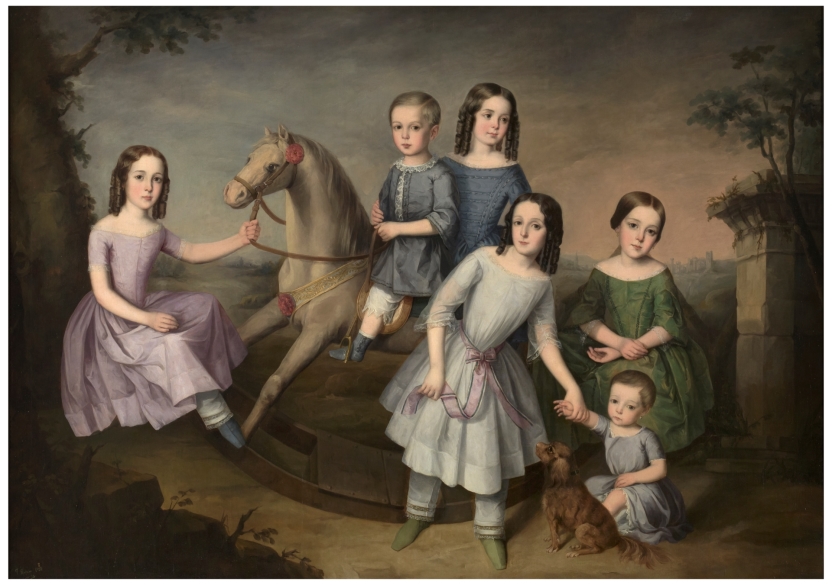
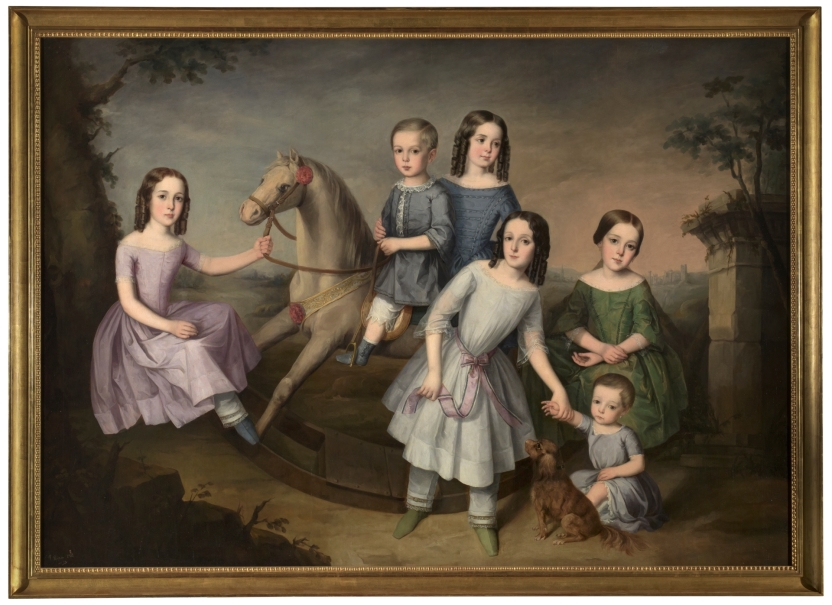
This painting – executed by Roldán when he was only 24 – is the first of his known group portraits of children. It is included in his catalogue not only as one of the finest examples of his entire career, but also as a highly significant work of art in a genre that was quite underdeveloped in Spain. This type of portrait – usually bourgeois – only enjoyed a certain degree of success in Spain: in Andalusia, a consequence of the direct influence of English taste in the region’s port and commercial cities. It was there where the main painterly devices that characterise them were established and that the painter accurately and efficiently deployed in this painting. As in English painting, figures are set in a peaceful and diaphanous landscapes. In this case, they are ennobled by archaeological remains and by the view of a city which could be identified as Carmona. The figures are displayed in a harmonious and fixed family hierarchy. They relate to each other with overly constrained gestures, although intended to give an appearance of unaffectedness. The children are accompanied by domestic animals – sometimes rams or lambs – or, as in this case, by toys (such as the rocking horse) in an undisturbed play atmosphere that softens their stiff poses and at the same time becomes a clear sign of the high social status to which they belonged.
The only boy occupies the central part of the composition, mounted on the rocking horse whose bridles are held by one of the older sisters, while another holds him at the horse’s haunches. His other siblings merely surround him. Proof of the widespread use of this model is the fact that Roldán later employed it when making portraits of his five offspring (private collection in Seville) and of the Desmaisières children in what may be considered his most mature work (private collection in Seville). All of these canvases are equally fundamental in understanding the extent to which this interesting variant of family portraiture was important in Andalusian painting. In this painting, Roldán employed his finest and most polished style – subject to the academic strictness in which he had been trained – that recalls the artistic approaches of his fellow countryman Esquivel, in which the children adopt cold and somewhat inexpressive attitudes. Nevertheless, Roldán moderates this impression with a meticulous and polished execution, a smooth gradation of colour and harmonious lighting, of Sevillian heritage. Vicente Palavicino y Lara (1880–1950), who bequeathed the painting to the Museum, was the only male child and heir of the 8th Marquess of Mirasol, Gonzalo Palavicino e Ibarrola (1845–1882), 10th Baron of Frignani and Frignestani and Chamber gentleman. It so happened that Gonzalo had married María Josefa de Lara y San Juan (1848–1871) and when he was widowed, he married her younger sister, María Luisa de Lara y San Juan (1851–1929), with whom he had all of his offspring. The two women were daughters of the brilliant Spanish serviceman Juan de Lara e Irigoyen (1808–1869), captain-general of the Philippine Islands, captain-general of Valencia, Aragón and New Castille, senator for life of the Kingdom and Knight of the Grand Cross of Saint Ferdinand, of Charles III and of Isabella the Catholic, and of whom Roldán himself painted a portrait as Minister of War (Museo del Ejército, inv. 20061, in Madrid). It is believed that the Lara children in the Museo del Prado were his eldest, since the children of Mirasol’s two wives are not included; in 1832 – the date of the painting – they were not yet born.
G. Navarro, C., Retrato de la familia Lara (1832). En Barón, J.: El retrato español en el Prado. De Goya a Sorolla, Madrid, Museo Nacional del Prado, 2007, p.114, n. 30