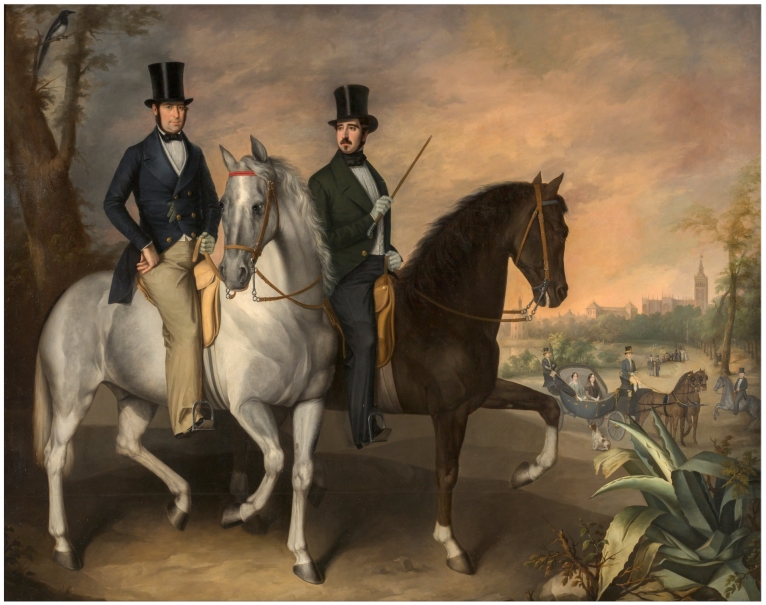
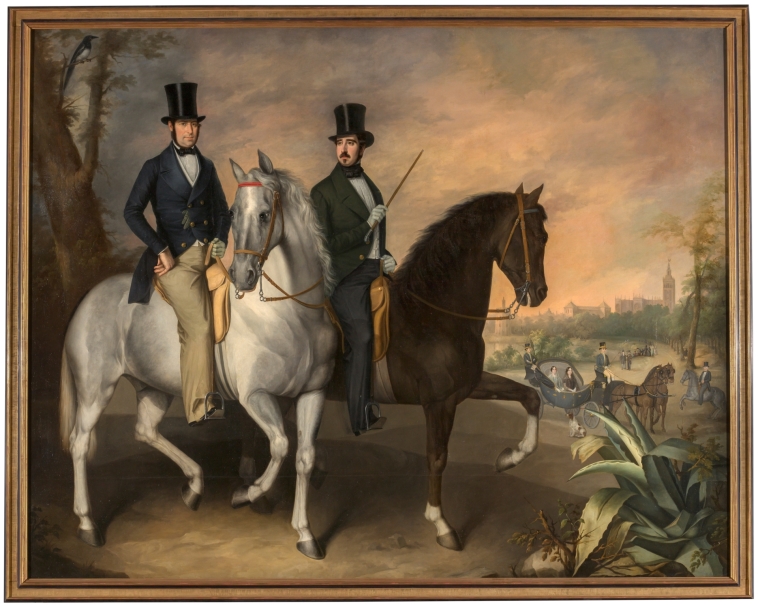
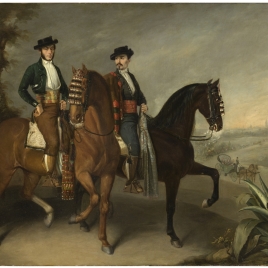
The Count of Pinohermoso and the Marquess of Molins, on horseback, on the outskirts of Seville
1848. Oil on canvas.Not on display
This double equestrian portrait shows, on the left, Juan Nepomuceno Roca de Togores y Carrasco (Murcia, 13 December 1801–Madrid, 25 March 1883), 7th Count of Villaleal and 3rd Duke of Pinohermoso, first-class grandee of Spain. Married on 9 October 1838 in Valencia to Inés Sanz de Vallés y Monserrat, Marchioness of Mascarell de San Juan, lady of the Queen and lady of the Order of María Luisa, and widow of Joaquín León y Frías. He was an officer of the Spanish Royal Guards, a distinguished hero and senator of the Kingdom and senior chief of the Palace. His brother, Mariano Roca de Togores y Carrasco (Albacete, 17 August 1812–Lequeitio, 4 September 1889), 1st Marquess of Molins – a title created on 15 September 1848, which was later granted grandeur of Spain – is next to him. He married María Teresa Roca de Togores y Alburquerque, Lady of Asprillas, in Valencia on 10th April 1833. When she died in 1842, he married María del Carmen Aguirre-Solarte y Alcíbar (Pulham, England, 21 July 1828–Madrid, 15 December 1899), lady of the Queen and lady of the Order of María Luisa, in Madrid on 10 May 1849. An outstanding writer, he belonged to several academies, was director of the Spanish Academy and presided over the Ateneo de Madrid. He also had a diplomatic career, as extraordinary envoy to England, ambassador in Rome – near the Holy See – and in Paris. He developed a political career, as minister of State, Navy, Commerce, Public Instruction and Public Works. The Prado keeps an anonymous portrait of this figure, who was also painted by other painters, such as Esquivel and Federico de Madrazo. Roldán had painted another large equestrian portrait, The Count of El Águila and the Marquess of La Motilla on horseback (collection of the heirs of the Marquess of La Motilla), of which the Prado keeps a smaller version. In this case the relationship between the sitters was political, as Motilla’s sister – Fernando Desmaisieres y Fernández de Santillán, named María Rosario – had married Fernando de Espinosa y Fernández de Córdoba, Count of El Águila, in 1838. The similarity of the composition is evident, as the attitudes of the horses and riders are the same and a barouche also appears in the background, with the two women (in the Prado painting Molins had not yet married Aguirre Solarte) and, in the background, the city, here depicted from further away from the Cruz del Campo, with a pita at one angle. Unlike the present painting, in which the figures appear in country attire on richly harnessed horses, the riders in the Prado painting are dressed in city attires. The work was painted in the same year that the Montpensiers – whom they knew very well, as Pinohermoso had been the Infanta’s steward, as well as that of Queen Isabella II – settled in Seville. The view here is taken from Delicias, with the Prado de San Sebastián on the right, outside the composition. In the background, the Torre del Oro, the palace of San Telmo and the cathedral can be seen. Ferdinand III the Saint and Beatrice of Swabia, direct ancestors of the sitters, were buried in said cathedral. Behind the barouche, towards the Guadalquivir River, small figures – one of whom is hauling the nets – enliven the composition, albeit dominated by the two equestrians. The artist succeeded in depicting the heads of the figures, whose graceful demeanour he was able to emphasise. Despite some roughness in the hands, imperfections in the white horse, and lack of adjustment in the perspective, the scale of the figures is appropriate. They vigorously stand out against an orange-coloured sky, used by Roldán himself in other works, as is the use of a tree leaning to the left, seen in the Portrait of the Lara family (P007722).
Barón, Javier, El retrato español en el Prado. De Goya a Sorolla, Madrid, Museo Nacional del Prado, 2007, p.116-117