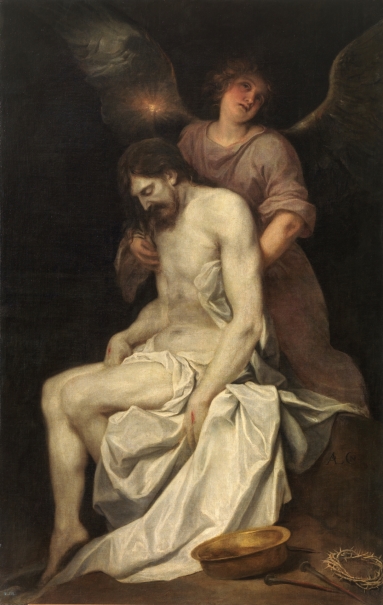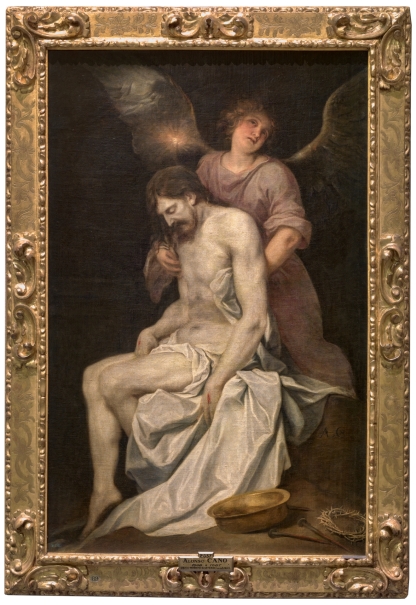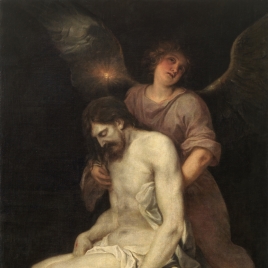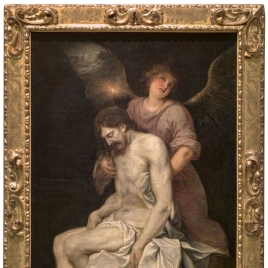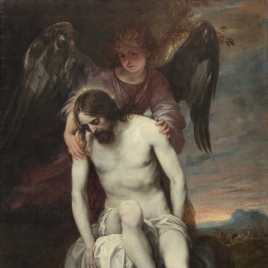
The Dead Christ supported by an Angel
1646 - 1652. Oil on canvas.Room 017A
In this painting, an angel with a sorrowful expression supports the body of Christ in an upright, seated position. The clearly visible wounds on Christ´s hands indicate He has already been crucified and has died. The bloodless colour of the limbs and bowed head add to a cadaverous appearance. At His feet, the washbasin, the two nails and the crown of thorns all evoke the recent crucifixion. The angel is thus presenting the body of Christ to the viewer, allowing us to contemplate each of its attributes.The work is typically dated to 1646-52, during Alonso Cano´s second period in Madrid, in which he was one of the court´s most active artists, creating works in fields as diverse as painting, drawing, sculpture and the design of altarpieces, Cano became established as one of the most forceful artistic personalities of seventeenthcentury Spain. The present painting is a typical example of his output during these years, showing Cano´s exploration of the expressive possibilities of light as a means of focusing our attention on a dramatic scene. Here, however -rather than insisting on the more pitiful aspects of the episode- Cano constructs a work whose primary purpose was to elicit deliberate, concentrated meditation.The painting exemplifies Cano´s taste for beauty, restraint, moderation and equilibrium, as well as his masterful application of soft, harmonious colours. It also depicts one of Cano´s preferred subjects: the naked human form. Occasionally, the protagonists of his works were female nudes but, given the enormous social and religious pressure against display of the female body, the majority of Cano´s nudes are male. The subject permitted painters like Cano to reflect on the classical ideal of the human body and the canon of proportions. Cano was also skilled at deploying flesh as an expressive vehicle, of which there is no better example than the body of the dead Christ in this painting, in which His formal perfection and the inert whiteness of His flesh contrast with the sentiment expressed by the angel and the darkness of the background, producing a work filled with calm and mystery.The dead Christ held by an angel is an example of an iconographic type with ancient roots in Western art. Its origins may be found in the so-called Christ of Saint Gregory, which represents the Saint´s vision of Christ flanked by two angels. It was a frequent subject among Italian artists of the Renaissance and the mannerist period, such as Antonello da Messina (c. 1430-79), or the followers of Michelangelo. It was also an iconographic subject circulated in prints, and it has been suggested that for this composition, Cano perhaps found inspiration in the mannerist prints of the Dutch artist-engraver Hendrick Goltiuz (1558-1617) (Portús, J.: Portrait of Spain. Masterpieces from the Prado, Queensland Art Gallery-Art Exhibitions Australia, 2012, p. 124).