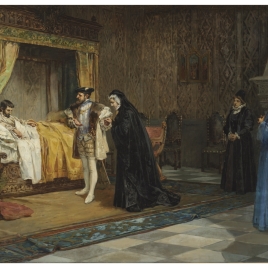
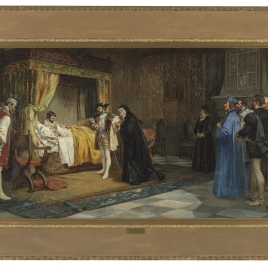
The Duchess of Alençon presented to her brother, King Francis I of France, by Emperor Charles V
1887. Oil on canvas.On display elsewhere
This painting depicts Marguerite of Angoulême, of France, Navarre and Orléans (Angoulême, 1492–Odos, France, 1549). She was the Duchess Consort of Alençon and Queen Consort of Navarre. In this work, she appears in the centre of the composition dressed in black, as she approaches the bed on which her brother, the King of France, François of Valois and Angoulême, known as François I, (Cognac, 1494–Rambouillet, 1547) lies. The king has been imprisoned in Madrid following his defeat to the Holy Roman Emperor Charles V at the Battle of Pavia (1525). Here the wounded, melancholic François, is characterised by an unusual iconography. Between the French king and his sister is Charles I (Ghent, 1500–Yuste, Cáceres, 1558), King of Spain (1516–1556) and Emperor of Germany (1520–1558), who introduces the Duchess to the King of France. The episode took place in 1525, in the Torre de los Lujanes (Madrid), so the scene is depicted indoors, with various characters being close witness to the events. All the historical traditions of Spain recount the kindness François I received during his detention in Madrid. The Spanish emperor himself visited the French king with the affection of a friend. Modesto Lafuente recounts François’ meeting with his sister in these words: “The following day, the emperor visited him once again. But what gave the bedridden monarch most comfort was the arrival of his sister, Princess Margaret. She had been informed that her brother was ill. Therefore, she travelled to offer him her sisterly care: She appears dressed in mourning clothes due to the recent death of her husband, the Duke of Alençon, as a result of his wounds during the battle of Pavia. The emperor received the princess with great courtesy and affection; then led her by the hand into the king´s chamber. The illustrious princess received from the emperor only but sweet words of hope and consolation as kind as those the Emperor had spoken to her brother”.
The encounter between the emperor and his illustrious prisoner is a recurring theme in Spanish painting. Several artists, such as Eduardo La Rochette, Lorenzo Casanova, Francisco Sans and José María Rodríguez de Losada tackled the theme. While other artists, such as Eduardo Rosales, thought of producing versions, but would eventually abandon the idea. More specifically, the meeting with the Duchess of Alerçon was treated by Justo García Villamala and Vicente Campesino y Mingo. The subject is rarer in French painting. The artist Alfred Johannot painted The Visit of Charles V to François I, which is set in a Gothic room. Manuel Arroyo was an heir to Rosales, whose painting Queen Isabella the Catholic dictating her Will (P004625) was here taken as a model: the composition, the clarity and restraint in the arrangement of the figures, the obsession with emphasising the tiling, the carpet, and the furniture. The execution, however, is far from the ease and directness exhibited in other of the master’s works.
The work was exhibited at the 1887 National Exhibition, where its artist was awarded a third-place medal. Nevertheless, Ricardo Blanco, the critic of La Regencia [The Regency], did not consider it worthy of the prize. Although the painting was well composed and geometrically drawn, it was not worthy of the prize awarded by the jury, as the lack of originality and expression and the softness of the colours far outweighed the qualities mentioned. Other contemporary critics, while not entirely dismissive of the painting, understood its somewhat reiterative and excessively conservative nature. Isidoro Fernández Flórez, in La Ilustración Española y Americana [Spanish and American Illustration] wrote: ‘The artist is surely better than his painting, since Mr. Arroyo y Lorenzo is a sensible, correct painter, a good draughtsman and a skilful teacher. But his work is old-fashioned in every aspect, and full of reminiscences in composition, figures and colour. It may do credit to his discretion, but it does not do credit to his personality. Vicente de la Cruz also expressed himself in a similar vein.
La época de Carlos V y Felipe II en la pintura de historia del siglo XIX [comisario, Carlos Reyero], Madrid, Sociedad Estatal para la Conmemoración de los Centenarios de Felipe II y Carlos V, 1999, p.Nº 13, p. 198-199