The Immaculate Conception
Ca. 1680. Oil on canvas.On display elsewhere
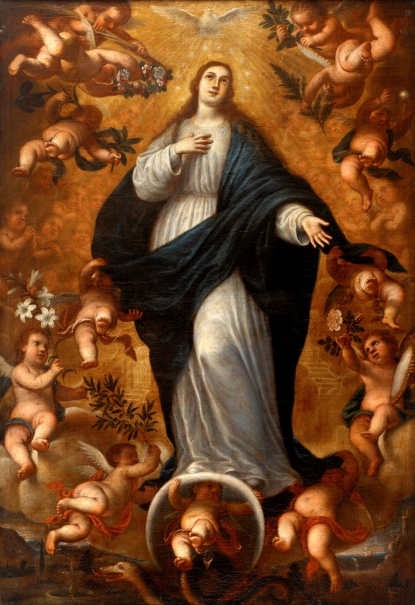
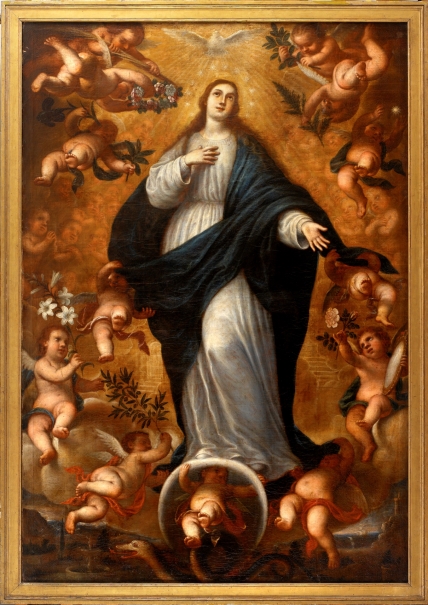
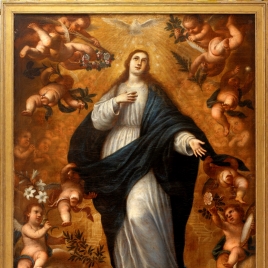
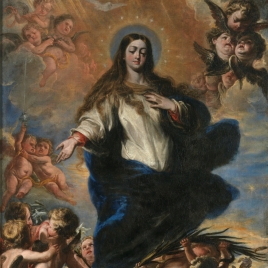
This work follows the model of the Immaculate Conception developed in Madrid by Juan Carreño, although it presents some differences. In the 1660s, the artist conceived an archetype that would hardly vary until his final years. Carreño widened the fusiform silhouette used by Rizi and transformed it to an almost rhomboidal shape that provided greater balance. This can be seen in one of his last and best-known versions, the one preserved in the monastery of La Encarnación (1683). Furthermore, by concentrating the fall of the fabrics around feet, the artist increases the figure’s consistency and poise. Carreño’s formula enjoyed great longevity, as it was not only imitated with surprising literalness during the 17th century, but his followers used it in the following century.
Without adhering so strictly to Carreño’s canon, other contemporary artists opted for the same closed profiles in their rendering of the Immaculate Conception, using a marked static tone in contrast to the usual scenes in which angels accompany the Virgin. Pedro Ruiz González and José García Hidalgo used a different model by Escalante, based on the inversion of the Virgin´s gesture and on some changes in the distribution of the Virgin´s clothing, which seem to be swaying in the wind. In the case of García Hidalgo, the Virgin’s clothing fits more closely to her body. He also chose a model in which Mary is depicted in an attitude of greater rapture and recollection, with her hands clasped on her breast, as can be seen in the work God the Father painting the Immaculate Conception (P008155) (Aterido, A. in El final del Siglo de Oro. La pintura en Madrid en el cambio dinástico [The End of the Golden Age. Painting in Madrid during the dynasty change]. 1685–1726, 2015, pp. 116–119).