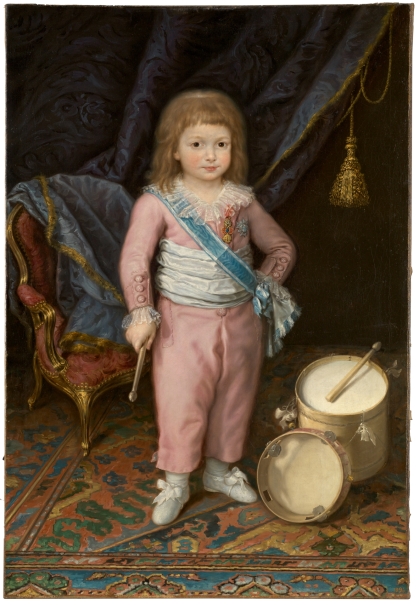
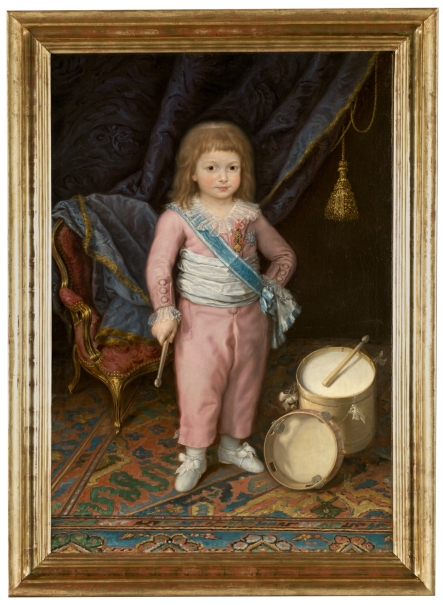
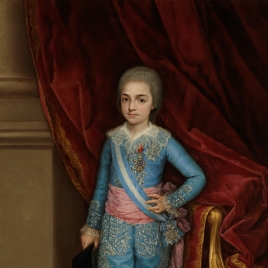
The Infante Carlos María of Bourbon with Drum and Tambourine
1791 - 1792. Oil on canvas.Room 039
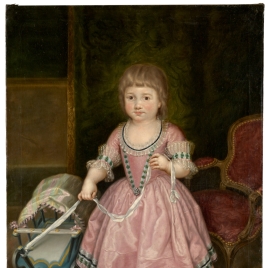
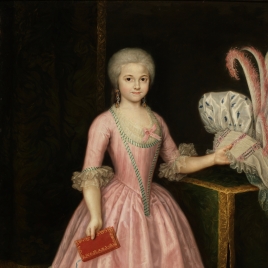
Considered to be the work of Antonio Carnicero (1748–1814), Arturo Ansón Navarro (2012) attributed the portrait to Ramón Bayeu for stylistic reasons and for its documented relationship with a series of portraits of the royal family painted by Bayeu around 1791. According to these documents, Ramón Bayeu, appointed court painter on the 20th of April 1791, painted portraits of several children of Charles IV and Queen Maria Luisa at the Royal Palace of Aranjuez in that year. By this time, six of the kings´ children were still alive. One of them, the Infanta Carlota Joaquina (1775–1830), Queen of Portugal from 1785, had already left the Spanish court. The others were the Infantas Maria Amalia (1779–1798) and Maria Luisa (1782–1824), Prince Ferdinand (1784–1833), the Infante Carlos Maria Isidro (1788–1855) and the Infanta Maria Isabel (1789–1848).
Livinio Stuyck, director of the Royal Tapestry Factory, referred to some of these portraits in a memorial addressed to Charles IV on the 13th of April 1791. He complained about the shortage of tapestry cartoons and Ramón Bayeu´s inactivity in this work. He also reported that Bayeu had excused himself by saying ‘that he was busy with the portraits of the Sereníssimas Señoras Infantas’, in addition to the painting of the altar of the Pious Schools in Lavapiés. Furthermore, in a letter to the Count of Lerena in the first half of May 1791, Francisco Bayeu asked him to mediate so that the king would increase his brother Ramón´s salary. He explicitly mentioned, as a special merit, that ‘Their Majesties saw the portraits that my brother has painted and liked them very much, and they ordered him to paint the other portraits of their Royal Family’. On the 22nd of July 1791 Ramón Bayeu was appointed court painter with a salary increased from 15,000 to 20,000 reales de vellón. Finally, ‘the portraits of the royal persons’ are recorded in an invoice issued by Ramón Bayeu on the 30th of June 1791 for the ‘expenses for colours, payment for grinding and other expenses incurred during the day at Aranjuez in the present year of 1791’ (General Archive of the Palace, Reigns, Charles IV, House, leg. 50, exhibition 1). From this documentation it can be deduced that Ramón Bayeu first portrayed the Infantas María Amalia (P6146) and María Luisa (National Heritage). Then, once he had received the approval of the king and queen, he portrayed ‘the rest of the royal persons’, specifically the Infante Carlos María Isidro (P4719), the Infanta María Isabel and Prince Ferdinand (P6145). This documentation, as well as the sash of the Order of Charles III that adorns the infante´s chest in his portrait allows us to date the portrait between May 1791 and June 1792. The sash still shows the old design and not the one modified in June 1792, with its three identical sashes. The age of the infante, three or four years old, corroborates the identification proposed by some researchers as Carlos María Isidro, born on the 29th of March 1788, and dismisses identifications such as the Infante Francisco de Paula (1794–1865) or Prince Ferdinand.