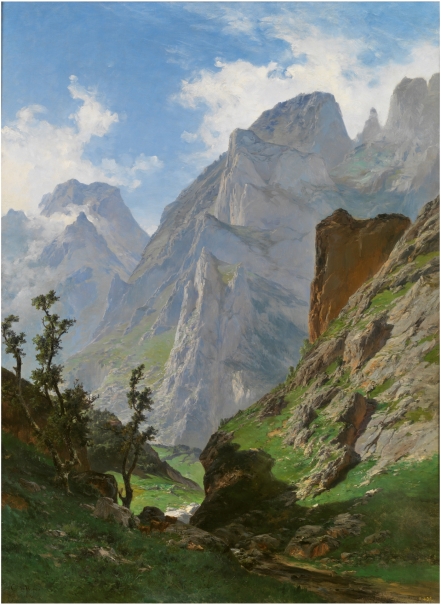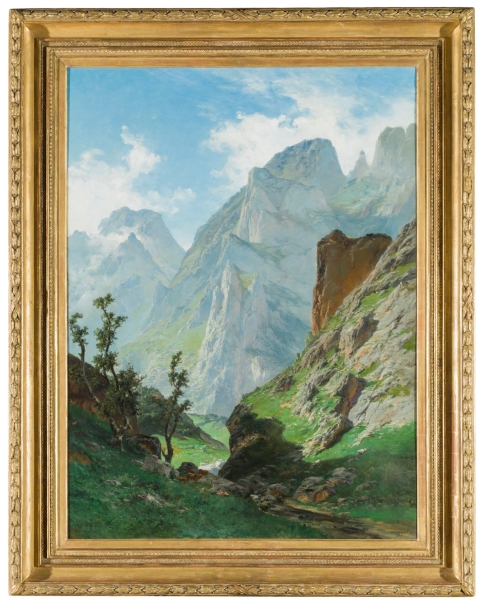
The Mancorbo Pass in Picos de Europa
1876. Oil on canvas.Room 063A
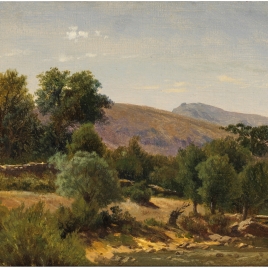
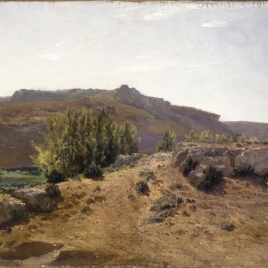
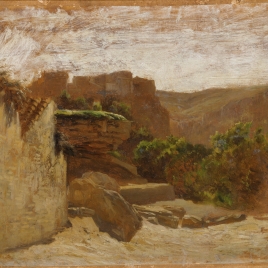
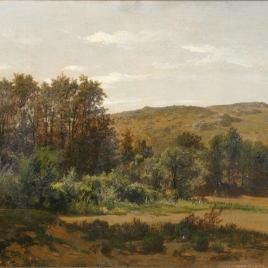
Universally considered the most emblematic painting of Spanish 19th-century realist landscape, this spectacular panorama of Picos de Europa is also Carlos de Haes absolute masterpiece. He painted it at the height of his career, with the confidence and ease of his most refined style. It is thus the maximum example of the powerful transformation that this great master of Belgian origin effected in landscape painting during his two-decades in Madrid before painting this work. In his classes at the Academy of San Fernando, his students were introduced to a new, sincere and direct manner of interpreting nature inherited from Haes’s origins in the Flemish school. Eschewing all artifice and fantasy, this approach definitively expulsed the purist idealization of romantic landscapes. The present work was presented by Haes at his moment of greatest renown and was shown at the National Exhibition of 1876 as an exceptional display of the most public aspect of his artistic production, intended both to gain recognition in official contests and, fundamentally, to appeal to his large base of private clients, who were responsible for his fame in those years. These public works are large composed landscapes, frequently with vertical formats and considerable dimensions, painted in the intimacy of his studio with a careful and exquisite touch that conveys the artist’s special capacity to transmit the monumental grandiosity of the elements of nature, and to choose the perspective and viewpoint that most favor their visual values. Unlike the romantic landscape painters, however, he developed these large paintings on the basis of vibrant oil studies painted on the spot, where he captured the true intensity of the live and direct impression of nature’s light and atmosphere. That was the method responsible for the radical changes that Haes brought to the creative process employed by Spanish landscape painters of that epoch. The place that appears in this painting lies at the foot of mount Andara, on the eastern side of Picos de Europa, above the village of Argüébanes in the Cantabrian county of Liébana. Haes fits the landscape’s geographical features into a clear structure of diagonal lines that brings out the stony peak rising from the back of the canal at the center of the composition, and flanked by the slopes of the two foothills in the foreground. The peak projects a shadow on the left foothill, that contrasts with the brightly illuminated face of the right one. Thus, in the purest Flemish tradition, he constructs this superb landscape with zones of light that emerge from the different planes that mark its spatial depth, leading the viewer’s eye from the stream in the foreground to the imposing and steep summit of the main peak as it majestically emerges before a clouded sky. One is immediately surprised by the artist’s extraordinary display of his mastery of the effects of light in a natural landscape. This is one of the keys to his success, and he nuances it with extremely subtle gradations in each part of the mountainous setting. His depiction of a cowherd with his flock in the shady part of the foreground brings a human dimension to the landscape, thus emphasizing the grandiosity of the mountain and nature’s supremacy over man. This is a final trace of the late Romanticism that Haes learned in his youth, and it is present in most of his large-format landscapes, as it also adds a picturesque touch to his panoramic views. With a great sense of spatial effects and perspective, he brings out the silhouettes of various narrow-trunked trees in the area backlit by the blinding brightness of the sun-drenched mountains in the background. On the other side, the rocky faces in direct sunlight are captured with all the wealth of his infinite nuances, thanks to a precise and accurate gaze and very controlled strokes that shape their forms with touches of light. These reverberate among the shadows projected by the stone outcroppings with a sincere and deeply felt realism that he interprets with a technique whose degree of refinement was very rarely attained by any Spanish landscape painter of his time. In this sense, Haes displays a truly astonishing capacity to imbue a large canvas patiently created in his studio with the believable and immediate realism of something one has directly before one’s eyes. And that ability to reproduce the real sensations of a landscape taken directly from nature constitutes the greatest attraction of these large composed canvases based on small plein air studies. The artist made those studies with a fresh and instantaneous approach and great speed, capturing the changing effects of light and atmosphere in just a few minutes. Haes’s special skill at making such studies underlies much of his pictorial mastery as a painter of large-format landscapes, and a comparison of the present work with the very interesting preparatory sketch he painted during is first stay at Picos de Europa is especially illustrative in that sense. That small oil study dates from the summer of 1874, when Haes first traveled to that part of northern Spain in search of mountain views. He was accompanied by two of his closest disciples: Aureliano de Beruete (1845-1912), who later became the great end-of-the-century Spanish master of landscape painting; and Philippine painter José de Entrala (1849-1886). From then on, Haes was fascinated with the wealth and variety of that mountain range’s different areas and settings, which he captured in innumerable oil sketches and drawings, many of which are now at the Museo del Prado. The sketch’s energetic and vibrant surface reflects all the spontaneity of a rapid approach that builds the relief and irregularities of the natural elements with direct touches of light. In the definitive canvas, this becomes a powerful, grandiose landscape that Haes unfolds before the viewer’s eyes like a great show of nature, transmitting a sensation of silent and harmonious quietude that invites an unhurried contemplation responsible for much of its lyricism (Text drawn from Díez, J. L.: El siglo XIX en el Prado. Museo Nacional del Prado, 2007, pp. 281-282).