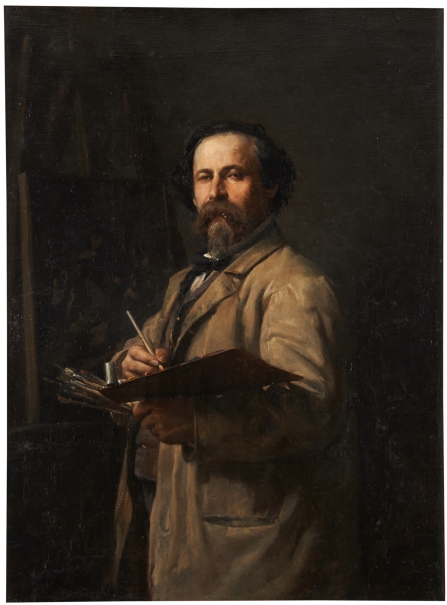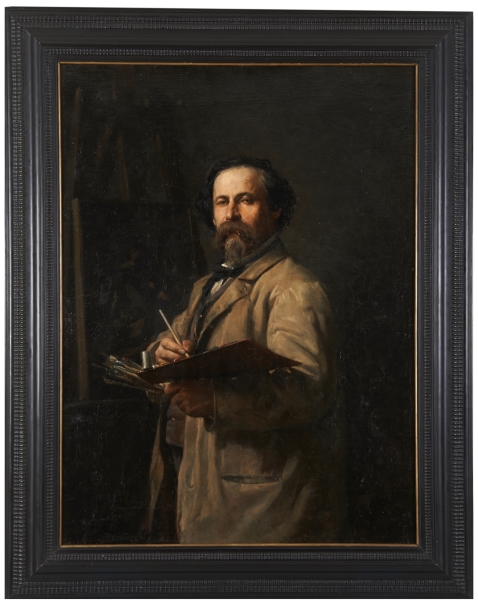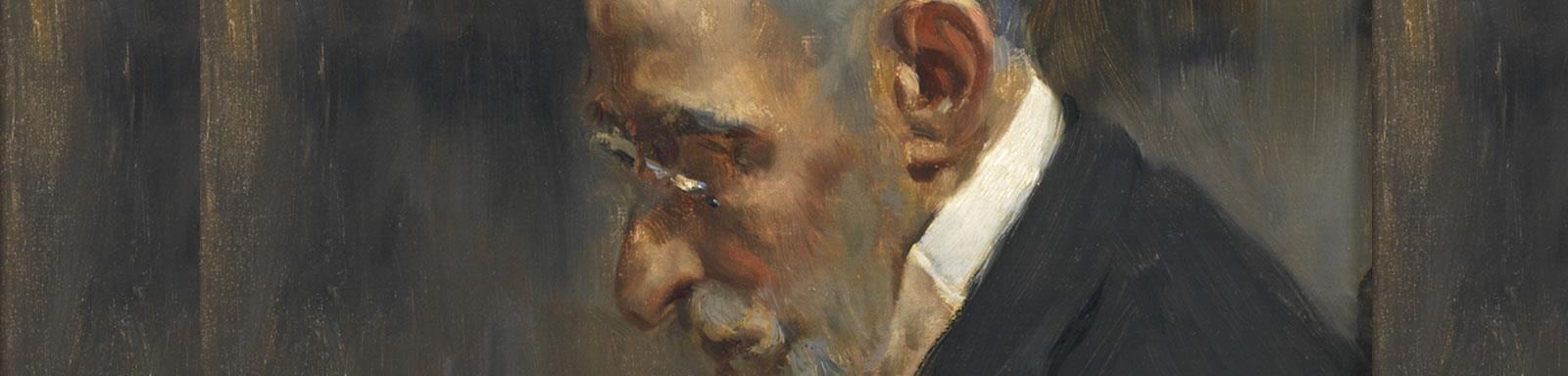
The painter Francisco Martínez Yago, the artist’s father
1867. Oil on canvas.On display elsewhere
The artist is portrayed in three-quarter length, almost from the knee up, and wearing working clothes in front of a small canvas, with a barely visible sketch, placed on an easel. He poses with a serious and somewhat haughty gesture, his gaze averted, while he dips one of his brushes in the palette he is holding in his left hand.
The artistic career of the modest painter Francisco Martínez Yago was strictly confined to Valencia’s sphere. He was born in the city of Valencia and during his youth he became a disciple of his fellow countrymen Francisco Llácer and Miguel Parra. They in turn followed in the footsteps of Vicente López, as well as of the Academy of San Carlos, of which the painter became a supernumerary member in 1844. He then became a caretaker from 1849 onwards. In addition to some altar canvases for churches in the region of Valencia, the artist was a protégé of the Count of Parcent, for whom he produced several paintings on mythological themes. Despite this, his professional work was mainly focused on the field of restoration, a speciality that would later be continued by his son Salvador, the author of this portrait.
This work was produced by Salvador Martínez Cubells during his early period as an artist. The modernity of his technique was probably surprising at the time, with a frank and direct touch, resolved with a broad, impasto execution that models the volume of the figure on broad planes. He demonstrated a great degree of correctness with accurate and precise brushstrokes. This closely are reminiscent of the realist discoveries achieved in these years by great Valencian painters of his generation such as Francisco Domingo Marqués. The painting was awarded the gold medal at the 1867 Valencia Regional Exhibition and the third-place medal at the 1871 National Exhibition of Fine Arts (no. 287).Artistas pintados: retratos de pintores y escultores del siglo XIX en el Museo del Prado, Madrid, Ministerio de Educación y Cultura, Dirección Gener, 1997, p.122-123 nº28