The painter Ventura Miera
1866. Oil on canvas.Not on display
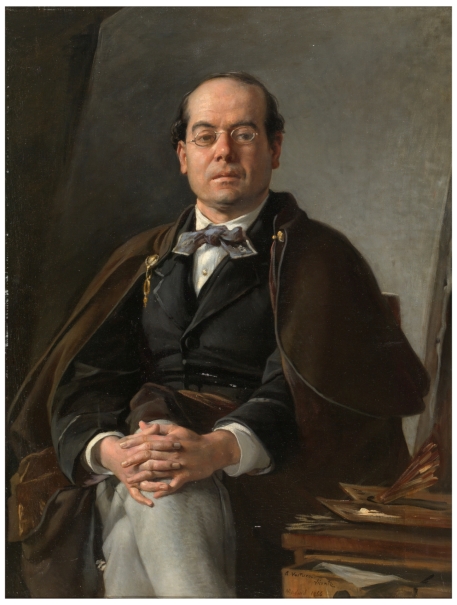
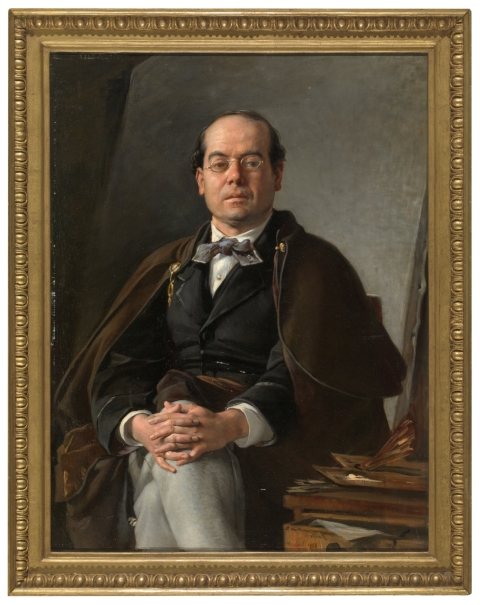
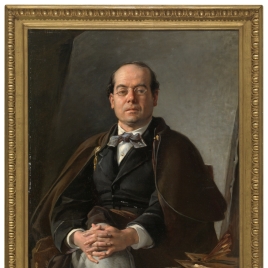
The portrayed person seats almost frontally –his torso slightly turned to his right– in a frame that excludes his legs. He clasps his hands on his right knee, which is mounted on the other in a magnificent exercise in foreshortening. This lends vivacity and even dynamism to this type of portrait, often very static. He wears a brown Spanish cloak with a metal clasp and button, a dark grey jacket and waistcoat, and a bluish-grey bow tie with a white border. Underneath he wears a white shirt, the cuffs of which are also visible; and his trousers are light grey, almost white. The face has that sense of immediacy that reveals the anecdotal nature of the slightly drooping lenses on the side turned slightly toward the viewer –a subtle asymmetry that reinforces the rupture of the static–. He gazes fixedly at the viewer, with a hint of impatient impertinence. The folding of the cape practically conceals the armchair, so that the portrayed person –whose fingers are also strikingly slender– has no other spatial framing than that provided by the unused canvas in its corresponding stretcher. Although it is still foreshortened, it effectively frames the figure of the painter. In addition to this attribute, the artist´s most striking instruments, the palette and brushes, rest on the small table in the lower right-hand corner. The signature appears in that corner, and in order not to go unnoticed, the artist places it in the open drawer from which papers peep out foreshortened.
The execution displays a certain energy, which is evident in the hands, shirt collar and bow tie, but above all in the inanimate objects in the lower right corner. The face, with its dark, somewhat sallow qualities, also has the furrow of a few brighter brushstrokes. This is noticeable on the left temple.
The portrayed person is the Madrid painter Ventura Miera López de la Fuente, a pupil of the San Fernando Academy and a disciple of Vicente López. It seems evident that the motivation for this painting is not an artistic status of the portrayed person but rather the friendship between the two painters.(Casado, E. in: ‘Vicente Palmaroli González. The painter Ventura Miera´, Painted artists. Portraits of 19th century painters and sculptors at the Museo del Prado. Museo del Prado, 1997, pp. 112–113.)