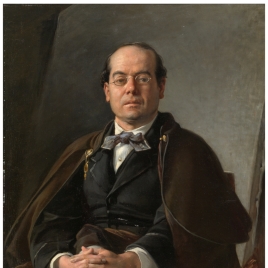
The sculptor Pedro Collado de Tejada
1858. Oil on canvas.On display elsewhere
Pedro Collado de Tejada (Madrid, 1829–1914?). Sculptor, son of the merchant José Collado y Mata (P04532).
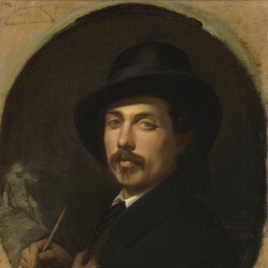
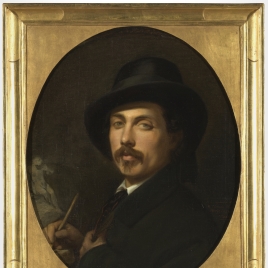
With the bust almost in profile in an oval frame, the face of the portrayed is nearly fully frontal, forcing him to turn his body almost ninety degrees. His gesture is elegant, evident in the way he embraces the lapels of his coat with his left hand. He is very neatly dressed, with a slightly tilted hat that is not very wide but has an ostentatious ribbon. The right hand holds the stick for modelling the clay, and the sketchy figurine on the left side complete that reference to artistic dedication. This figurine could be Narcissus at the moment of falling in love with his image reflected in the water. It is also the plaster statue which Collado de Tejada exhibited at the National Exhibition of 1958. This is the same year in which the artist signed and dedicated the portrait, and the date of its execution in Rome.
As a portrait ‘from artist to artist’, in this case a sculptor, the painter could never employ the same artifices and decorative resources that he uses to please a conventional client. On the contrary, his language must be absolutely direct and sincere, as the eyes of another artist will be the judge of his work.
Both, portrayed person and painter, were students at the San Fernando Academy School and also coincided during their stay in Rome. This is a portrait typical of Palmaroli´s early period, slow in his transition from purism to naturalism, although always undisguisedly in the orbit of his master Federico de Madrazo. His great concern for line is evident, and in this case, it is a synthetic portrait, with an earthy chromatic palette and strong contrasts in the lighting.
Artistas pintados: retratos de pintores y escultores del siglo XIX en el Museo del Prado, Madrid, Ministerio de Educación y Cultura, Dirección General de Bellas Artes y Bienes Culturales, 1997, p.86-87 nº11