The Virgin and Child
Ca. 1520. Oil on oak panel.Room 058A
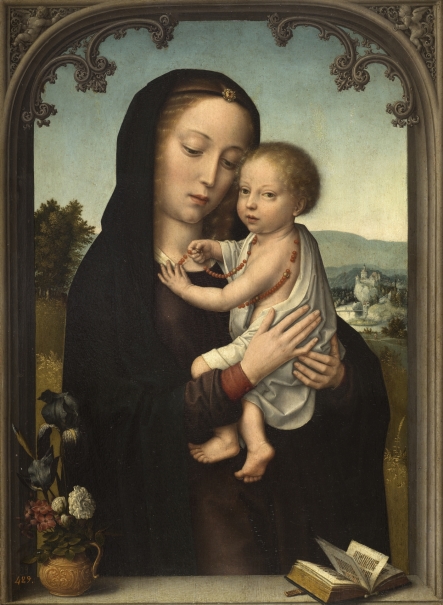
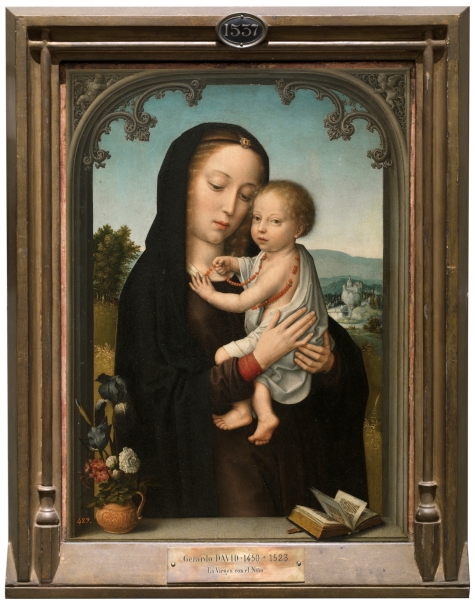
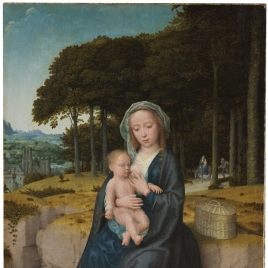
Mary is standing with the child in her arms; she is dressed in a white chemise whose red cuffs peep out from beneath her purple tunic and a dark blue mantle that partially covers her head, on which she wears a black headband with a gold brooch set with four pearls and a square ruby. The Child is draped in a thin White mantle and around his neck is a string of alternating red and gold beads; it may be inferred from their number that it is a rosary. Indeed, the Child holds some in his hands in a gesture characteristic of praying the rosary.
The work entered the Prado with the attribution to Lucas van Leyden it had had at El Escorial since at least 1820, when it was described by Padre Bermejo. It was officially attributed to Gerard David in the catalogue of 1920, albeit maintaining the comment that has appeared in the catalogue entry since 1873: ‘Its authenticity is not indisputable’. The question that remains unanswered is whether the workshop that produced the panel could be that of Gerard David. Even the possibility that the work was begun by David and later completed by a follower of his, who added the landscape and still life, is undermined by the characteristics of Mary’s face, which, despite a certain Davidian appearance, can only be attributed to a follower. Whatever the case, the Davidian appearance of the model is undeniable, and if the panel was not produced directly by his workshop it must have been executed by a follower with access to the artist’s models, no longer extant. In this connection, the possibility that this follower could be Simon Bening is very appealing, as this artist used David’s models on other occasions for his panel paintings. Even so, certain aspects prevent the Madrid work from being attributed securely to Bening. For example, such an attribution would not account for the profoundly Davidian appearance of the Child. It also remains to be clarified whether Bening was authorised to create and sell paintings in Bruges, where the work would have been executed.
All these factors and unresolved doubts make it impossible to establish a definite attribution of the work based on the information we currently have to go on.
Pérez Preciado, José Juan, Fifteenth-century netherlandish painting at the Museo Nacional del Prado. Catalogue raisonné, Madrid, Museo Nacional del Prado, 2024, p.122-127 nº.13