Crucifixion
Ca. 1510. Oil on panel.Not on display
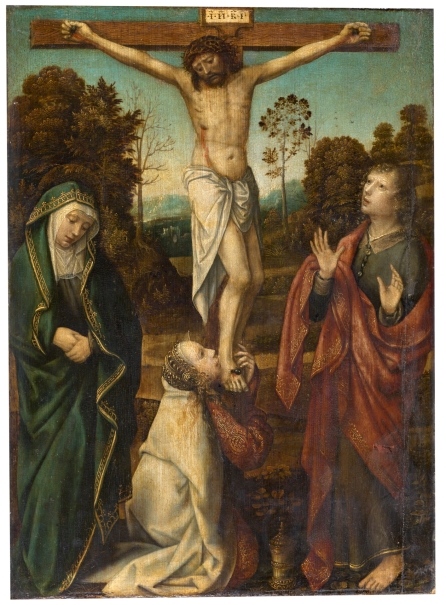
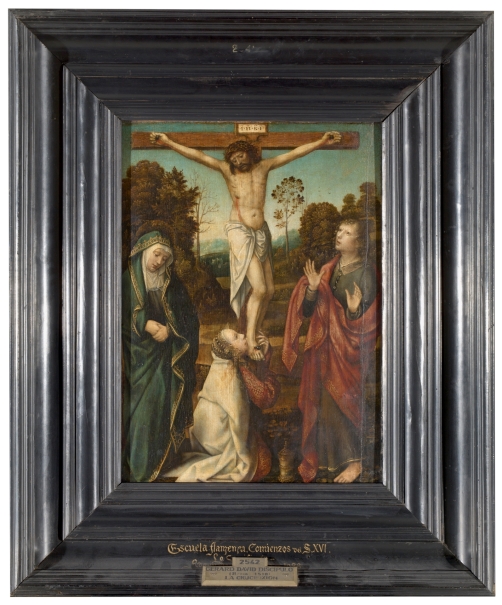
The work is a traditional depiction of the Crucifixion showing Jesus on the cross and the Virgin Mary and Saint John on either side, as well as Mary Magdalene kneeling before the cross and embracing Christ’s feet in accordance with another well-established iconographic tradition. The jar of ointment beside her, which identifies her, is the only element other than the figures and the landscape that serves as a setting, as there is no sign of the usual references to Mount Golgotha such as Adam’s skull. In the background is the hint of a city, where the towers of a medieval wall – a reference to Jerusalem – can be made out. The landscape is constructed of several planes with a path that winds its way to the city. One of the trees is withered – possibly an allusion to the tree of good and evil from the Bible account of the Creation of mankind, of which Christ’s cross may be a symbol of renewal. The landscape ends in the distance with mountains in shades of blue and white, which are unfortunately badly abraded. Some birds are visible beside a few lines – perhaps not original – of another withered tree.
The figures are dressed in traditional clothing, Mary in a white veil and blue cloak with rich gold borders and Saint John in a red cloak, also edged in gold, over a green tunic. The Magdalen’s brocade dress visible beneath her white cloak and, above all, her lavish headdress are particularly striking.
The subject of Christ on the cross with Mary Magdalene was often depicted by Gerard David and his bestknown followers. The provisional attribution of the work to this artist up until now therefore does not seem misguided, though the execution is far removed from that of the paradigmatic works produced by David and by his closest followers. Various elements of this painting seem closer to artists traditionally classified as belonging to Antwerp Mannerism and display less of a formal link with David and his followers: for instance, the Magdalen owing both to her inclusion at the foot of the cross and above all to her clothing. The cap recalls those depicted by other artists of the Antwerp Mannerist circle. Indeed, this Magdalen and her cap bear a significant resemblance to the same figure in the Crucifixion attributed to the Master of the Von Groote Adoration in Antwerp (Koninklijk Museum voor Schone Kunsten, inv. 325), albeit in reverse.
Pérez Preciado, José Juan, Fifteenth-century netherlandish painting at the Museo Nacional del Prado. Catalogue raisonné, Madrid, Museo Nacional del Prado, 2024, p.118-121 nº.12