The Vision of Saint Francis of Paola
Last quarter of the XVII century. Oil on canvas.Not on display
Saint Francis of Paola – born in 1416 in Paola, a small town in Calabria – was the founder of the Order of the Minims (or minor friars). It was called as such because its members, who added humility to the three convent vows of chastity, obedience and poverty, considered themselves the ‘last servants of the House of the Lord’. Saint Francis of Paola is closely linked to France, where he went at the request of Louis XI, King of France, to assist him in dying peacefully. He lived there for 26 years and died on 2 April 1508. He was canonised by Pope Leo X in 1519 at the request of the Francis I, King of France.
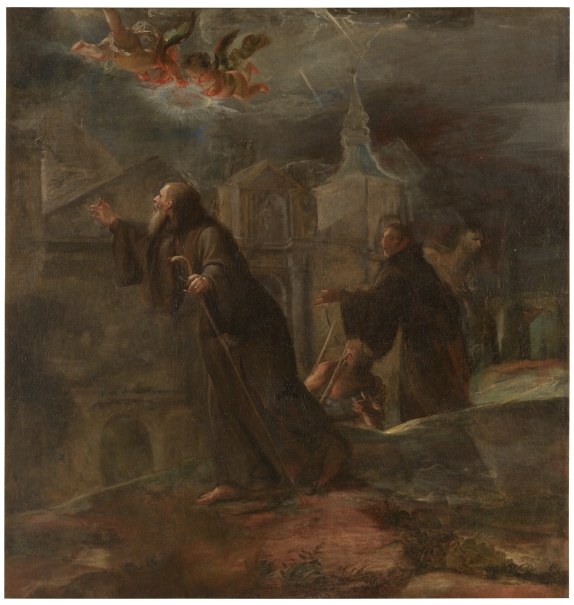
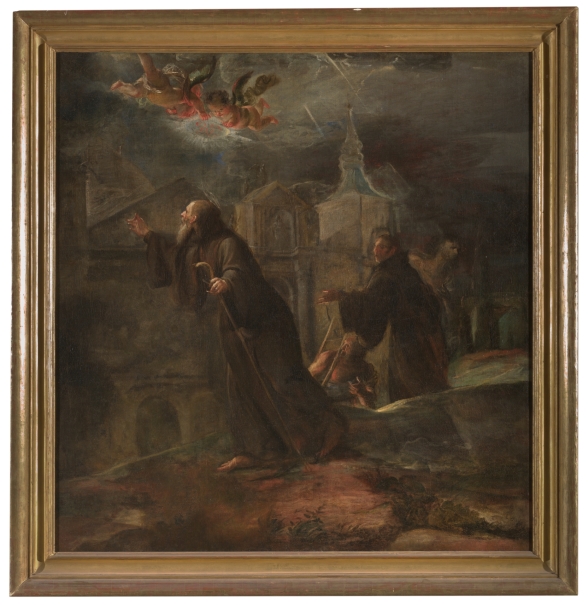
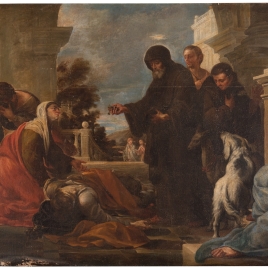
He is portrayed wearing the usual vestment of the Order: a hood, a long beard and leaning on a staff in the shape of a Greek tau. The figure of the saint, depicted in a pronounced diagonal, stops while traversing uneven terrain. He looks up and points to the sky on the left side of the scene. Behind him, a Minim friar carries one sick man on his shoulders while another one leans on the ground and support himself with a crutch. On the left, above the saint, two little angels, forcibly foreshortened, carry a rectangular tablet surrounded by luminous rays, upon which ‘CHARITAS’ is written. This is Saint Francis’s aphorism, which alludes to the frequent practice of this theological virtue. In the background, the brightest part of the composition, the painter has drawn some architectural elements. These clearly show a church doorway made up of two sections, rounded off by a pediment and figures of angels. An alcove containing an image of The Virgin and Child is also depicted. This façade and the tower on its right in particular are reminiscent of contemporary churches in Madrid. The constant presence of buildings throughout Donoso’s pictorial work is evidence of his extraordinary interest in and vocation for architecture and perspective.
The overall tone is earthy and ochre, lightening in the foreground; red is used sparingly, only to enliven the cloaks of the little angels at the top with brief touches. The light comes from above and, being directed, creates strong areas of shadow; the faces are also partially illuminated with bright, vibrant touches. The brushstrokes are summary, light and long, and the layer of colour, applied with great ease, is barely thick in certain areas, allowing the reddish undercoat to show through.
Pintores del Reinado de Carlos II, Madrid, Museo del Prado, 1996, p.72