The year of the famine in Madrid
1818. Oil on canvas.Room 066
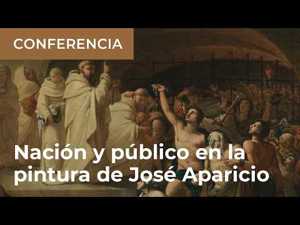
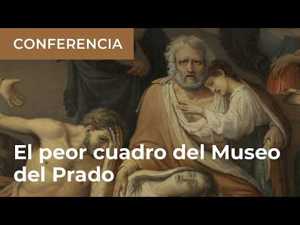
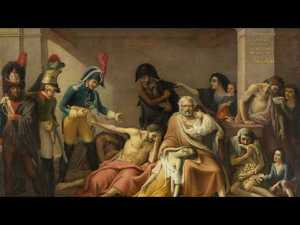
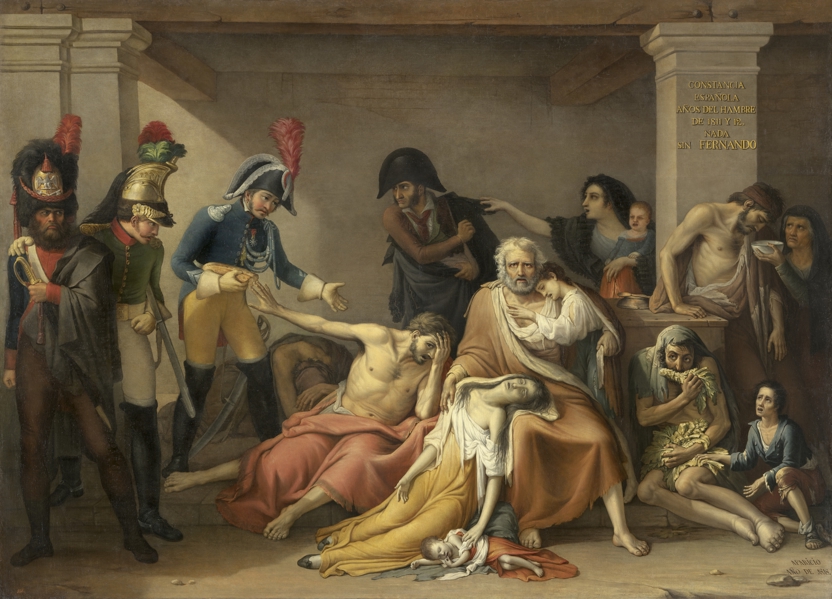
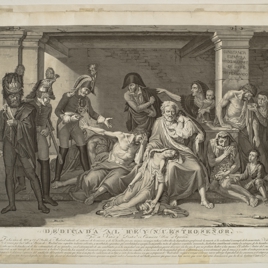
This painting is the most famous among those painted during the reign of Ferdinand VII. It was also the most widespread throughout the kingdom at the time, due to the propagandistic and flattering nature of its symbolic plot. This work is more than a history painting. Aparicio´s canvas represents a singular historical allegory, a genre in which the artist was a true specialist. The allegory depicts through the alleged solemnity of neoclassical aesthetics the dramatic situation of famine that the Villa de Madrid had to endure during the Napoleonic occupation (1811–1812). Likewise, it also shows the heroism and patriotic pride of its population when rejecting the help offered by the invading troops. A group of French soldiers offer food to a group of ragged and starving people from Madrid. The Artist executes the face of one of them with almost caricatured ferocity. An old man holds a boy on his shoulder while resting the the body of a dead, woman on his lap, her own hand resting on the body of her child lying beside her. There is a pilaster with an inscription in golden letters proclaiming the loyalty of the people of Madrid to their king. Next to it, other people eat fruit peelings and leftovers. Meanwhile, behind the main group, a handsome man with wide sideburns and a bicorn, leaps on the French soldiers. His wife holds him back as she carries her baby in her arms, crying for lack of food.
Aparicio used the same techniques in this painting as in previous similar works. He mixes traditionally dressed characters as a symbolic and supratemporal incarnation of the heroism of the people of Madrid. Through the recovery of the ancient world and its aesthetic language, he perfectly articulates immutable and universal moral values. These values oppose the figures of the French officers, easily recognizable by their uniforms. The patriotic and exhausted people of Madrid, despite the hunger, refuse the help of the French officers. Figures such as the dead woman, whose head is dislocated and whose face is crushed, are clumsily executed. The Artist also gives an intentionally repulsive aspect to other figures, such as the bearded man with dull feet, who devours peelings of greens and peas. Despite all this, the Artist treats the rest of the figures with unquestionable nobility, such is the case of the tormented young man who refuses French help by holding his hand to his forehead, or the old man who looks at the spectator. Other examples are the fragile figure of the small dead child on the ground or even the face of the young soldier offering the food.
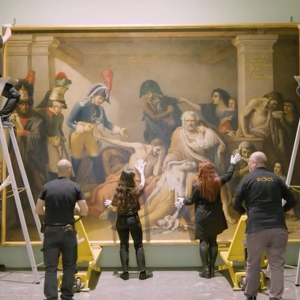
However, a lack of creative imagination was characteristic of most Spanish neoclassical painters, and of Aparicio. Xavier de Salas pointed this out when observing the old man, the main protagonist and axis of the composition. His figure gathers all the pathos and desolation of the scene and presents a more classical solemnity in the artist´s style and a resigned dignity in his attitude. However, Xavier de Salas found that the credit does not belong to Aparicio, since it closely evokes the painting "Count Ugolino and his sons" that Füssli painted in 1806 and disseminated through Haughton´s engraving. Other previous references have also been pointed out, such as the painting by Fortuné Dufau with the same subject as Füssli´s canvas. Following its turbulent public exhibition at the Academy of San Fernando during Ferdinand´s reign, the painting aroused the most passionate praise. However, contemporary critics have responded with the fiercest disparagements, in large part due to the disastrous state of conservation in which we have inherited the work. The painting has been crudely repainted in a very high percentage of its surface, affecting figures and main areas of the composition. For this reason, it has not been publicly exhibited for many decades. The painting was said to have been of higher value than other works such as "Las Meninas" or "Charles IV of Spain and His Family". However, when the inventory of the Real Museo del Prado was carried out on the death of Ferdinand VII, Aparicio´s canvas was valued at 60,000 reales, while Velázquez´s work was valued at 400,000 reales and Goya´s at 80,000 reales. The sketch kept in the National Library barely outlines the figures that make up the composition with light pen strokes.
Díez, José Luis, La pintura de historia del siglo XIX en España, Madrid, Consorcio Madrid 92 Museo del Prado, 1992, p.136-145 nº.4