formularioRDF
The itinerary <em>TITULORECORRIDO</em> has been successfully created. Now you can add in works from the Collection browser
<em>TITULOOBRA</em> added to <em>TITULORECORRIDO</em> itinerary

Close Continuar a ficha de la obra Continuar a ficha de la obra
02-06-2026
Juan Sánchez Cotán

Orgaz, Toledo, 1560 - Granada, 1627

See author's file

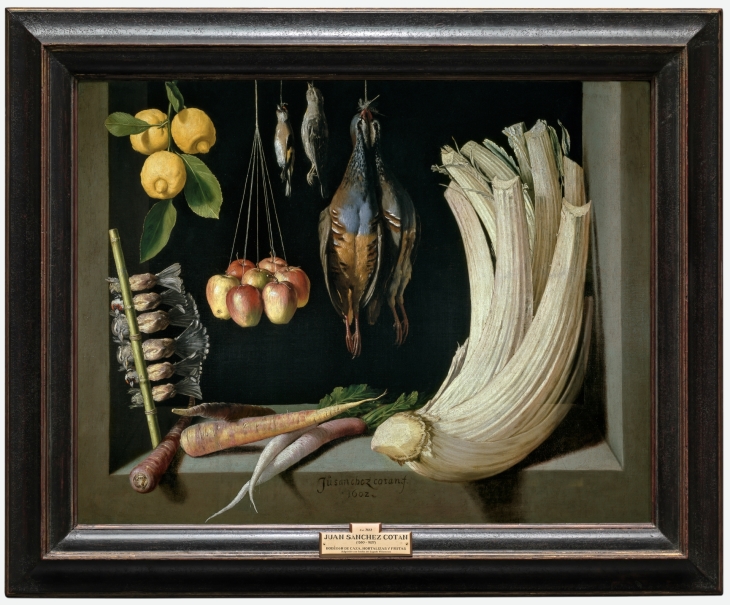
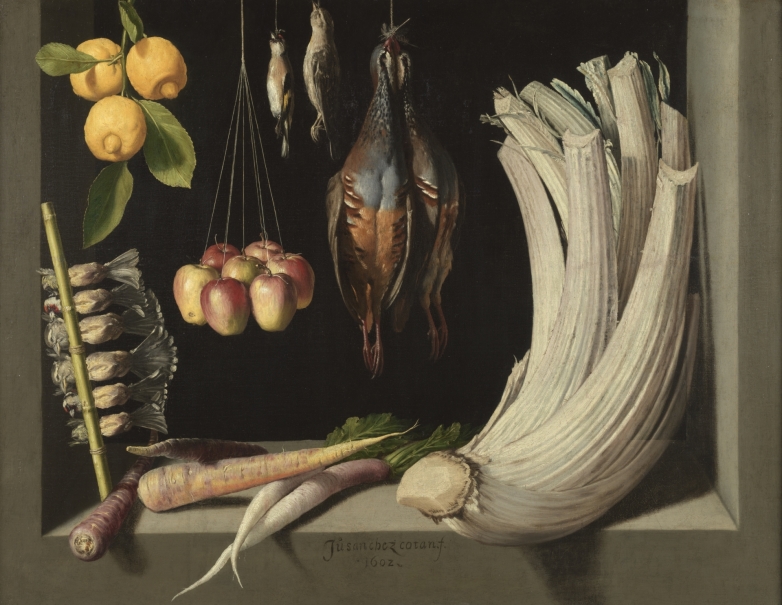
Still Life with Game, Vegetables and Fruit

1602. Oil on canvas.
Room 008A

Although Juan Sánchez Cotán pursued different genres of painting, portraits, and religious compositions, his main contribution to Spanish painting was the establishment of the still life, considered the most characteristically Spanish genre. However, such a statement is extremely reductive and does not take into account the variety of possibilities realised in this genre in Spain. Sobriety, intimacy, magical purity, mysterious intensity, elegance in simplicity or symbolic humility are the characteristics that have been used to describe the Spanish still life of the early 17th century. It is known that Sánchez Cotán was a disciple of Blas de Prado, once a distinguished painter, particularly well-known for his still lives. The Italian still-life painters Cario Antonio Procaccini, Pamphilo Nevulone, and especially Fede Galizia are also prominent references in the work of the Spanish painter.

Sánchez Cotán draws a geometric stony cavity, probably a cupboard for storing fresh food. Its black background strongly emphasises the chosen elements, meticulously painted and effectively illuminated by a lateral light that casts strong shadows. Apples and lemons, carrots and radishes, partridges and little birds, and a splendid thistle are arranged in a harmonious pattern to create a perfect illusion: a visual intrusion into everyday life which, with Sánchez Cotán, reaches a tenebrist force that foreshadows Caravaggio.

The still life is dated 1602, a truly early date in the production of this genre of painting. It coincides with the painter´s period in Toledo, when he was at the peak of his creative development, and a year before he left his acclaimed workshop to join the Carthusian order as a layman. In 1603 he compiled an inventory of his possessions in which he included a canvas of the thistle where the partridges are. This is the original of the other works and was painted by Juan de Salazar. The description seems to refer to this painting, and two interesting pieces of information are included in this short text: firstly, the addressee of the still life, Juan de Salazar, a miniaturist who worked at El Escorial like Sánchez Cotán, and who acted as his legal executor. The other remarkable detail is the fact that the work was unrelated to the others. This is clear evidence that the repetition of elements and compositional patterns was common practice, probably in response to the requirements of the customers, who had little concern for the concept of originality.

The painting belonged to the collection of the infante Sebastián Gabriel. The Museo del Prado acquired the canvas from one of his descendants, the Duke of Hernani, in 1991.

El Prado en el Hermitage, Museo Estatal del Hermitage: Museo del Prado, 2011, p.120-121
Technical data

Imagen del carrusel
Imagen del carrusel
Inventory number
P007612
Author
Juan Sánchez Cotán
Title
Still Life with Game, Vegetables and Fruit
Date
1602
Technique
Oil
Support
Canvas
Dimension
Height: 68 cm; Width: 88.2 cm
Provenance
Madrid, Infante Sebastián Gabriel de Borbón Collection, 1835; Madrid, Museo de la Trinidad, 1835-1861; Infante Sebastián Gabriel de Borbón, 1861; Alfonso de Borbón y Borbón, 1887-1934; Luis Alfonso de Borbón y Bernaldo de Quirós, II Duque de Ansola, 1934-1942; Manfredo Luis Borbón y Bernaldo de Quirós, I Duque de Hernani, 1942-1979; Heirs of Duque de Hernani y Ansola, 1991; Acquired from a Teresa Mariategui y Arteaga with funds of the Villaescusa Legacy, in 1991.
Entry date
1991

Bibliography +

Jordan, William B., Spanish still life in the Golden Age: 1600-1650, Kimbell Art Museum, Fort Worth, 1985, pp. 54, nº1.

Museo Nacional del Prado, La imitación de la naturaleza: los bodegones de Sánchez Cotá, Museo del Prado, Madrid, 1992, pp. 70-72.

Ainaud de Lasarte, Josep M., Tesoros de España. Pabellon de España. Expo'92. Sevilla, Electa España, Sevilla, 1992, pp. 85.

Still-life paintings by Juan Sánchez Cotán, Still-life paintings by Juan Sánchez Cotán, 1993, 1993.

Orozco Díaz, Emilio, El pintor Fray Juan Sánchez Cotán, Servicio de Publicaciones de la Universidad, Granada, 1993, pp. 221.

Pérez Sánchez, Alfonso E., De pintura y pintores: la configuración de los modelos visuales, Alianza, Madrid, 1993, pp. 84.

Garín LLombart, Felipe Vicente, Un mecenas póstumo: el legado Villaescusa, Museo del Prado, Madrid, 1993, pp. 58-61.

Buendía, José Rogelio, El Prado. Colecciones de Pintura, Lunwerg Editores, Barcelona, 1994, pp. 83.

Mann, Richard G., El Greco y sus patronos: tres grandes proyectos, Akal, Madrid, 1994, pp. 11.

Jordan, William B., El bodegón español de Velázquez a Goya, Ediciones el Viso, Madrid, 1995, pp. 31, nº3.

La Pintura Española, Electa, Milán, 1995, pp. 306.

Museo Nacional del Prado, La belleza de lo real: floreros y bodegones españoles en el, COLLECIONES DEL MUSEO DEL PRADO, Museo del Prado, Madrid, 1995, pp. 40-41, nº1.

Jordan, William B., Spanish Still Life From Velazquez To Goya, National Gallery, London, 1995, pp. 31, nº3.

Posada Kubissa, Teresa, Últimas adquisiciones: 1982-1995, Museo del Prado, Madrid, 1995, pp. 128.

Milicua, José, El bodegón español: de Zurbarán a Picasso, Fundación Bilbao Bizkaia KutxaMuseo de Bellas Arte, Bilbao, 1999, pp. 72, nº3.

Ebert-Schifferer, Sybille, Natures Mortes, Citadelles & Mazenod, Paris, 1999, pp. 79, nº56.

El bodegón, Galaxia GutenbergCírculo de Lectores, Madrid, 2000, pp. lám. 8.

Ruiz Gómez, Leticia, El Greco y la pintura española del Renacimiento: guía, Museo del Prado, Aldeasa, Madrid, 2001, pp. 218.

Portús Pérez, Javier, La colección de pintura española en el Museo del Prado, Edilupa, Madrid, 2003, pp. 137.

Museo Nacional del Prado, El Museo de la Trinidad en el Prado, Museo Nacional del Prado, Madrid, 2004, pp. 118 / lám. 6.

De Tiziano a Goya. Obras maestras del Museo del Prado., Tokio - Osaka, 2006.

Natures mortes de Sánchez Cotán a Goya a l'entorn de la col...., Museu Nacional d'Art de Cataluny, Barcelona, 2007.

Da Velázquez a Murillo : il secolo d' oro della pittura spag..., Skira, 2009, pp. 45.

Gómez Cano, J., Orellana Escudero, G., Varela Simó, J., Las aves en el Museo del Prado, SEO/BirdLife, Madrid, 2010, pp. 104.

In the presence of things: four centuries of European still-life painting, Calouste Gulbenkian Foundation, Lisbon, 2010, pp. 69-117.

El Prado en el Hermitage, Museo Estatal del Hermitage: Museo del Prado, 2011, pp. 120-121.

Vitagliano, Maria A., Painting and poetry in early modern Spain: The primacy of Venetian colore in Gongora's Polyphemus and the Solitudes, Renaissance quarterly., LXVI n.3, 2013, pp. 904-936 [926-927 f.4].

Blanco, Miguel Angel, Historias naturales: un proyecto de Miguel Ángel Blanco, Museo Nacional del Prado, Madrid, 2013, pp. 84-85, 124.

Cherry, P, 'El bodegón de caza,hortalizas y frutas de Juan Sánchez Cotán' En: Los tesoros ocultos del Museo del Prado, Fundación Amigos del Museo del Prado. Círculo de Lectores, Madrid, 2017, pp. 199-222.

Gerbron, Cyril, Présences enigmatiques: les natures mortes de Juan Sánchez Cotán, Artibus et historiae an art anthology, XXXVIII n.75, 2017, pp. 165-180 [168,170,172, 174 f.1].

Saville, Jonathan, The first problem is to decide what a cardoon is, Art. Calendar.

Other inventories +

Inv. Museo de la Trinidad, Pintura. Núm. 393.
393 / Un Bodegon q.e contiene dos perdizes, pajaros, un cardo, zanaorias y varias frutas / fdo sanchez cotan 1602 Rectif.do alto 0,66 1/2 ancho 0,85 pr. la luz del marco / Inf.te D.n Sebast.n / F.do Rdo Con moldura de talla Dorada perteneciente á la Gª del Infte Colg.do en la Academia / Nº 12 / G.P.

Inv. Nuevas Adquisiciones (iniciado en 1856). Núm. 2268.
Autor: Fr. Juan Sánchez Cotán / 2268. Título: bodegón de caza, hortalizas y frutas Tipo de obra: pintura /Medidas: 0,690 x 0,885 m. /Tecnica/soporte: oleo sobre lienzo. /Nº de catalogo: P-07612 /Observaciones: firmado en la zona inferior central: "jun sanchez cotan.f./.1602"pertenecia al antiguo inventario del museo de la trinidad, t-393, y habia sido devuelto al infante don sebastian en 1861. /Adquirido por el museo a dña. Teresa Mariategui y Arteaga, Duquesa Vda. de Hernani, en 450.000.000 pts (200.000.000 pts. con fondos del legado Villaescusa y 250.000.000 pts. con beneficios exposicion

Inscriptions +

Juo sanchez cotan.f. / 1602
Inscribed in black. Front, lower central area

Exhibitions +

Reunited
Madrid
06.06.2020 - 25.07.2021

Meta-painting. A Journey to the Idea of Art
15.11.2016 - 19.02.2017

Historias Naturales
Madrid
19.11.2013 - 27.04.2014

El Prado en el Hermitage
San Petersburgo
25.02.2011 - 29.05.2011

Naturalezas muertas. De Sánchez Cotán a Goya. En el entorno de la Colección Naseiro
Barcelona
26.03.2007 - 24.06.2007

De Tiziano a Goya. Obras maestras del Museo del Prado
Osaka
14.07.2006 - 15.10.2006

De Tiziano a Goya. Obras maestras del Museo del Prado
Tokio
24.03.2006 - 02.07.2006

Museo de la Trinidad
Madrid
19.07.2004 - 03.10.2004

El bodegón español. de Zurbarán a Picasso
Bilbao
03.12.1999 - 19.04.2000

Spanish still life. Painting from Sánchez Cotán to Goya
Londres
22.02.1995 - 21.05.1995

Still life paintings by Juan Sánchez Cotán
San Diego CA
03.02.1993 - 04.04.1993

Tesoros del arte español
Sevilla
20.04.1992 - 12.10.1992

Location +

Room 008A (On Display)

Expuesto
Update date: 02-06-2026 | Registry created on 28-04-2015

Visor 360

Drag with the cursor to rotate the piece

Other works by Juan Sánchez Cotán

Prado Shop

Print on demand

Print artworks available in our catalogue in high quality and your preferred size and finish.

Image archive

Request artworks available in our catalogue in digital format.

Up